 Loading... Please wait...

Blog
Recent Posts
Building High-Speed Data Loggers with Teensy: From CAN Bus to Connected IoT Systems
Posted by on
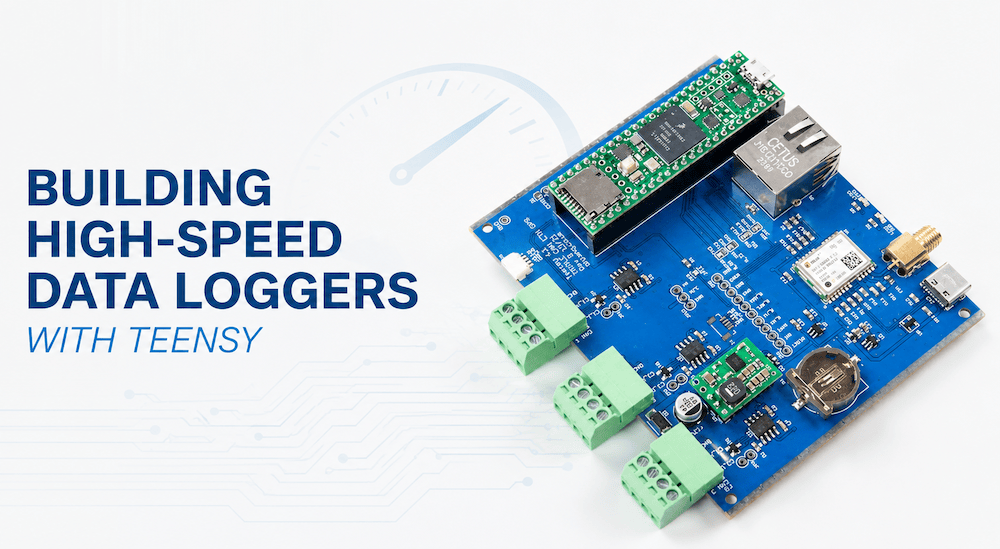 Data logging has evolved far beyond simply recording CAN messages to a memory card. Today's engineers expect real-time visualization, multi-channel data acquisition, remote connectivity, cloud integration, and support for modern protocols such as CAN FD—all while maintaining deterministic performance and low latency.
If you are designing a professional-grade data logger, the choice of hardware platform can determine whether your project becomes a quick success or an endless exercise in optimizing processor resources.
This is precisely where the Teensy platform excels.
Rather than merely offering a collection of development boards, the Copperhill Technologies Teensy product family provides a complete ecosystem for building high-performance CAN-based data acquisition systems, network gateways, protocol analyzers, and Industrial IoT devices. The product line includes numerous hardware configurations supporting Classical CAN, CAN FD, multiple CAN channels, integrated Ethernet, LCD displays, GNSS receivers, and application-specific interfaces.
Why Teensy Makes an Excellent Data Logger Platform
Many embedded developers begin with a standard Arduino board for CAN applications. While Arduino is an outstanding learning platform, data logging often pushes the hardware beyond its practical limits.
Professional data logging requires considerably more processing power.
A modern data logger may need to:
-
Receive traffic from multiple CAN buses simultaneously
-
Handle CAN FD data rates
-
Time-stamp thousands of messages per second
-
Store data on removable media
-
Drive graphical displays
-
Serve web pages through Ethernet
-
Forward information to cloud services
-
Execute filtering and protocol conversion in real time
These tasks demand substantially more CPU performance than traditional microcontrollers can comfortably provide.
The Teensy 4.x family addresses these challenges with a 600 MHz ARM Cortex-M7 processor while remaining fully compatible with the Arduino IDE and most Arduino libraries. Developers retain the familiar programming environment while gaining workstation-class processing performance in a remarkably compact embedded platform.
More Than Just Logging CAN Messages
Traditional CAN loggers simply capture traffic.
Modern embedded applications increasingly require intelligent edge processing.
Instead of recording every frame, the logger can:
-
Decode J1939 Parameter Groups
-
Monitor CANopen objects
-
Detect fault conditions
-
Calculate statistics
-
Generate alarms
-
Trigger digital outputs
-
Compress recorded data
-
Forward only relevant information
Moving data processing directly into the embedded device dramatically reduces bandwidth requirements while enabling autonomous operation without a continuously connected PC.
Classical CAN and CAN FD on One Platform
Many industrial and automotive systems are currently transitioning from Classical CAN to CAN FD.
Supporting both technologies within the same hardware platform provides significant long-term flexibility.
The Copperhill Technologies Teensy family includes boards featuring:
-
Single Classical CAN interfaces
-
Dual CAN networks
-
Triple CAN configurations
-
Mixed Classical CAN and CAN FD ports
-
CAN FD-to-USB interfaces
-
Specialized training and evaluation boards
This allows developers to build products that support today's installed systems while remaining compatible with future high-bandwidth CAN FD networks.
Multiple CAN Networks Open New Possibilities
One CAN interface is sufficient for a simple logger.
Two or three CAN interfaces transform the device into a much more capable system.
Applications include:
-
Vehicle gateway development
-
Network bridging
-
Simultaneous monitoring of independent buses
-
Data synchronization between ECUs
-
Diagnostic interfaces
-
Protocol translation
-
Bus load analysis
-
Hardware-in-the-loop testing
Instead of building separate products for logging, monitoring, and gateway functions, a single embedded platform can perform all three simultaneously.
Ethernet Changes Everything
One of the most significant additions to modern embedded systems is Ethernet connectivity.
Once your data logger gains an Ethernet interface, it becomes part of the Internet of Things rather than remaining an isolated measurement device.
Typical applications include:
-
Remote diagnostics
-
Browser-based dashboards
-
Firmware updates over the network
-
MQTT publishing
-
REST APIs
-
Cloud database uploads
-
Fleet monitoring
-
Remote configuration
-
Predictive maintenance
Several Teensy-based platforms from Copperhill Technologies combine multiple CAN interfaces with integrated Ethernet, allowing developers to bridge deterministic CAN networks with standard IP-based infrastructures.
Local Visualization Without an External PC
Many embedded data loggers eventually require a user interface.
Rather than connecting a laptop, several Teensy solutions integrate IPS LCD displays directly onto the hardware.
These displays can provide:
-
Live CAN statistics
-
Bus load indicators
-
Error counters
-
Network status
-
Graphical gauges
-
Sensor values
-
Configuration menus
-
Diagnostic information
This creates a self-contained embedded instrument suitable for laboratory use, field service, or permanent installation.
GPS and Time Synchronization
Certain applications require accurate location and time information.
Fleet management, agricultural equipment, construction machinery, and off-highway vehicles often need every CAN message correlated with geographic position.
Some Teensy platforms therefore include integrated GNSS receivers, enabling synchronized data collection without requiring external hardware.
From Prototype to Finished Product
One of the greatest advantages of the Teensy ecosystem is that it reduces the gap between prototyping and deployment.
Developers can:
-
Prototype in the Arduino IDE
-
Reuse existing libraries
-
Integrate third-party code
-
Add professional CAN interfaces
-
Expand storage capabilities
-
Introduce Ethernet networking
-
Create custom graphical interfaces
-
Deploy standalone embedded systems
Instead of redesigning the hardware after the proof-of-concept stage, many projects can evolve directly from prototype into production-quality embedded solutions.
Typical Applications
The flexibility of the platform makes it suitable for a broad range of industries:
-
Automotive diagnostics
-
SAE J1939 development
-
CAN FD evaluation
-
Industrial automation
-
Machine monitoring
-
Agricultural equipment
-
Marine electronics (NMEA 2000)
-
Predictive maintenance
-
Fleet telematics
-
Industrial IoT gateways
-
Protocol analyzers
-
High-speed CAN data logging
Looking Ahead
As embedded systems continue to generate increasing amounts of real-time data, simply recording CAN messages is no longer sufficient. Engineers need platforms capable of processing, filtering, visualizing, and securely transmitting information without sacrificing real-time performance.
By combining the computational power of the Teensy 4.x family with hardware options that include multiple Classical CAN interfaces, CAN FD, Ethernet, displays, storage, and GNSS, developers can build scalable solutions that extend well beyond traditional data loggers. Whether the goal is a portable diagnostic recorder, an industrial gateway, or a connected IoT edge device, the same hardware platform can serve as the foundation.
The result is a development environment that shortens time-to-market while providing the flexibility to grow alongside increasingly sophisticated embedded applications.
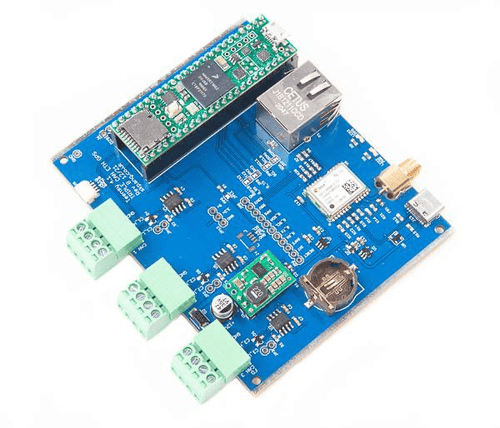 Teensy 4.1 Triple CAN Bus Board with ETH and u-blox NEO-M8M GNSS
The Teensy 4.1 Triple CAN Bus Board with Ethernet and u-blox NEO-M8M GNSS is a powerful embedded development platform designed for engineers building advanced automotive, industrial, and IoT applications. Based on the 600 MHz ARM Cortex-M7 Teensy 4.1 microcontroller, the board combines two Classical CAN channels, one CAN FD channel, integrated Ethernet, and a high-performance u-blox NEO-M8M GNSS receiver into a single compact solution. This unique combination allows developers to monitor multiple CAN networks simultaneously, synchronize data with precise positioning information, and exchange information over Ethernet without the need for additional expansion hardware.
Whether you are developing fleet telematics, autonomous vehicles, industrial automation systems, or intelligent CAN Bus gateways, this board dramatically reduces development time by providing all essential communication interfaces on one platform. The integrated GNSS module enables accurate location tracking and time synchronization, while the Ethernet interface opens the door to remote diagnostics, cloud connectivity, and Industrial IoT applications. Fully compatible with the Arduino IDE and the extensive Teensy software ecosystem, it provides a flexible and scalable foundation for rapid prototyping as well as deployment in demanding real-world embedded systems. More information...
Why the Teensy 4.1 Triple CAN-Bus Board with Ethernet Makes an Excellent CAN Data Logger
Modern vehicles, industrial machines, marine systems, and agricultural equipment generate enormous amounts of CAN bus traffic. Capturing, storing, and analyzing this data is essential for diagnostics, performance monitoring, predictive maintenance, fleet management, and product development. While there are many commercial CAN data loggers available, they often suffer from one or more limitations: High cost Limited customization Proprietary software Restricted storage [...]
The Teensy Series of Processor Modules: A Versatile Platform for Embedded Systems
The Teensy series of processor modules is a family of compact, high-performance microcontroller boards developed by PJRC. These boards are widely recognized for their small form factor, powerful processing capabilities, and extensive I/O support, making them an ideal choice for a variety of embedded systems applications, including robotics, audio processing, and IoT (Internet of Things) [...]
Selection Criteria and Requirements for a Telematics Gateway
The March 2023 issue of the CAN Newsletter, a CiA (CAN-in-Automation) online publication, posted an article on the selection criteria and requirements for a Telematics gateway. With cars evolving towards network technologies, OEMs (Original Equipment Manufacturers) require telematics solutions that boost seamless communication within and outside the vehicle. The device should be cloud-enabled, connectable to servers for real-time [...]
Standard IoT Gateway with ARM i.MX8M Plus Quad-Core Cortex-A53 Supports Two CAN FD Ports
Aaeon, a manufacturer of reliable and high-quality computing platforms, introduced its SRG-IMX8P IoT gateway solution with two CAN FD interfaces, which brings extended connectivity and utility across vertical markets. It is powered by Arm NXP i.MX8M Plus quad-core Cortex-A53 and Cortex-M7 processors with 8 GiB of onboard DDR4 reduce object detection time to 13 msec via a Neural [...]
DIN Rail Ethernet to CAN/CAN FD Interface Supports SAE J1939, NMEA 2000, CANopen
Kvaser introduced their DIN Rail SE410S-X10 Ethernet-to-CAN(FD) multi-channel interface with additional I/O support through add-on modules.Kvaser supplies advanced CAN Bus solutions to engineers designing and deploying systems in areas as wide-ranging as trucks and buses, petrol-driven and electric cars, industrial automation, avionics, construction equipment, building automation, domestic appliances, marine, medical, military, railway, telecoms, textiles and more.The [...]
SAE J1939 Protocol Converter Supports Modbus And Ethernet Connectivity
Axiomatic Technologies announced the release of their AX141810, a Modbus router with CAN Bus and Ethernet connectivity. It is available in two variants. The protocol converter is user-configurable via a web browser, featuring data exchange between a CAN Bus network, specifically SAE J1939, EIA-485, and Ethernet.The unit integrates one isolated extended frame format CAN Bus interface, [...]
Programmable CAN / CAN FD Router And Data Logger Comes With Optional Ethernet Port
The PCAN-Router Pro FD by PEAK-System is a six-channel CAN FD router and data logger, which is now offered with an RJ-45 Ethernet interface as an option. The programmable router comes with custom firmware, which is loaded using the CAN Bus network. In addition, the provided development package includes multiple C/C++ programming samples for employing the capabilities [...]
CAN Bus to Internet-of-Things (IoT) Projects with the ESP32
The integration of Wi-Fi, Bluetooth, and Bluetooth LE allows a wide range of applications with our modules. Using Wi-Fi secures connectivity within a large radius while using Bluetooth enables the user to efficiently detect (with low-energy beacons) a module and connect it to a smartphone. With in-built antenna switches, RF balun, power amplifier, low-noise receive [...]
System-On-Module (SOM) Dedicated To Commercial Vehicles Supports Two CAN FD Interfaces
Microsys Electronics announced its Miriac MPX‑LX2160A, a System-On-Module (SOM) dedicated to commercial vehicles and mobile systems. The module supports two CAN FD interfaces.The module is based on the NXP LX2160A processor and offers 16 Arm Cortex-A72 cores, which are twice as many as its predecessors. The configuration meets the requirements of (artificial intelligence) edge server applications, autonomous [...]