 Loading... Please wait...

Blog
Recent Posts
OBDII Breakout Box Review: The Ultimate Tool for ECU Programming, Protocol Detection, and Automotive Diagnostics
Posted by on
 As modern vehicles become increasingly dependent on electronic control units (ECUs), diagnosing and programming automotive systems requires specialized tools. The GODIAG GT100+ OBDII Breakout Box Protocol Detector is designed to simplify this process by providing a flexible testing and diagnostic platform for automotive technicians, locksmiths, ECU programmers, and advanced enthusiasts.
Instead of connecting diagnostic tools blindly and hoping that communication works, the GODIAG breakout box acts as a transparent interface between the vehicle and your diagnostic equipment, allowing you to inspect signals, monitor power, and troubleshoot communication problems before they damage expensive scan tools or ECUs.
What Is an OBDII Breakout Box?
An OBDII breakout box is essentially a signal access and monitoring platform for the vehicle’s diagnostic port. The GODIAG GT100+ connects between the vehicle’s OBDII port and a diagnostic device, exposing all 16 OBD pins for testing, signal detection, and measurement.
This design allows technicians to verify voltage levels, protocol activity, and wiring integrity before performing programming or diagnostics.
For anyone working with vehicle electronics, this capability can dramatically reduce troubleshooting time and prevent costly mistakes.
Key Features
1. OBD Protocol Detection and Communication Testing
The primary purpose of the GODIAG GT100+ is detecting OBDII communication protocols and verifying that communication between the vehicle and the diagnostic tool is working correctly.
The device supports several automotive communication standards including:
-
CAN Bus
-
K-Line
-
PWM
-
VPW
-
KWP2000
These protocols cover the majority of modern and legacy OBD communication systems used in vehicles.
LED indicators on the breakout box allow technicians to quickly confirm whether communication signals are present and whether the diagnostic link is functioning properly.
2. Real-Time Voltage and Current Monitoring
One of the most useful features of the upgraded GT100+ version is the integrated voltage and current display.
The built-in digital display allows you to monitor:
-
OBD power supply voltage
-
Current consumption of connected ECUs
-
Electrical anomalies during programming or testing
This is particularly useful during ECU programming or bench testing because abnormal current readings can indicate wiring errors or damaged modules before serious problems occur.
3. ECU Bench Testing and Programming
The breakout box can also be used to connect directly to ECU modules outside the vehicle, enabling bench testing and programming.
Using the DB25 connector or banana plug leads, technicians can:
-
Connect individual ECU modules
-
Test multiple modules simultaneously
-
Perform programming or coding with diagnostic tools
This makes the device extremely valuable for workshops performing ECU repairs, immobilizer programming, or advanced diagnostics.
4. Protecting Expensive Diagnostic Equipment
Professional scan tools and programming devices can be costly. Connecting them to a vehicle with faulty wiring or unstable voltage can damage them.
The breakout box helps prevent this by allowing technicians to verify power and communication lines first. If voltage or ground connections are incorrect, the issue can be detected before connecting the scan tool.
5. Auxiliary Power Supply During Battery Replacement
Another clever feature is the ability to maintain vehicle power while replacing the battery.
During battery replacement, some vehicles can lose ECU data, immobilizer settings, or remote key synchronization. The GT100+ can supply auxiliary power through the OBD port, ensuring the vehicle electronics remain powered during the swap.
6. OBD1 to OBD2 Conversion
Older vehicles often use non-standard diagnostic connectors. The GODIAG breakout box supports OBD1-to-OBD2 conversion, allowing older diagnostic ports to be connected to modern OBDII diagnostic tools.
This makes the tool useful not only for modern vehicles but also for legacy automotive systems.
Who Should Use This Tool?
The GODIAG GT100+ is designed for a wide range of automotive professionals:
-
Automotive diagnostic technicians
-
ECU programmers and repair specialists
-
Automotive locksmiths working with immobilizer systems
-
Automotive electronics engineers
-
Advanced DIY enthusiasts working with vehicle networks
If your work involves ECU diagnostics, programming, or CAN bus communication, a breakout box like this can quickly become an essential piece of equipment.
Why Tools Like This Matter
Modern vehicles are essentially distributed computer systems with dozens of ECUs connected through multiple communication networks. Diagnosing these systems requires visibility into signals, power, and protocols, something that a standard scan tool alone cannot provide.
The GODIAG GT100+ fills this gap by acting as a diagnostic bridge between the vehicle and your tools, enabling safer, faster, and more reliable troubleshooting.
Final Thoughts
For anyone working seriously with automotive electronics, the GODIAG GT100+ OBDII Breakout Box Protocol Detector is a practical and versatile diagnostic platform.
By providing direct access to OBD signals, protocol detection, real-time electrical measurements, and ECU bench testing capabilities, it turns the vehicle’s diagnostic connector into a powerful troubleshooting interface.
In an industry where electronic complexity continues to grow, tools like this are no longer optional—they are essential. More information...
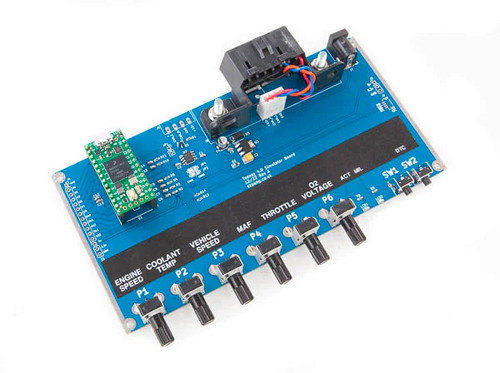 Teensy 4.0 OBDII CAN-Bus ECU Simulator Includes Teensy 4.0
The Teensy 4.0 OBDII CAN‑Bus ECU Simulator from Copperhill Technologies is a compact development platform designed for engineers, educators, and embedded developers working with automotive diagnostics. Built around a pre-installed and pre-programmed Teensy 4.0 microcontroller, the board simulates a vehicle’s Electronic Control Unit (ECU) and generates realistic OBD-II diagnostic data over the CAN bus. This allows developers to design and test OBD-II software, diagnostic tools, telemetry systems, or CAN-bus applications without needing access to an actual vehicle.
The simulator supports the ISO 15765 CAN-based OBD-II protocol used by most modern vehicles and provides a controlled environment for experimenting with diagnostic commands, parameter IDs (PIDs), and vehicle data communication. Because the system behaves like a real ECU on the CAN network, developers can validate code readers, logging tools, and vehicle-health monitoring systems safely on the workbench. This makes the platform ideal for rapid prototyping, training, and automotive software development where reliability and repeatability are essential. More information...