 Loading... Please wait...

Recent Posts
ESP32-S3 MicroPython Programming for CAN Bus and NMEA 2000
Posted by on
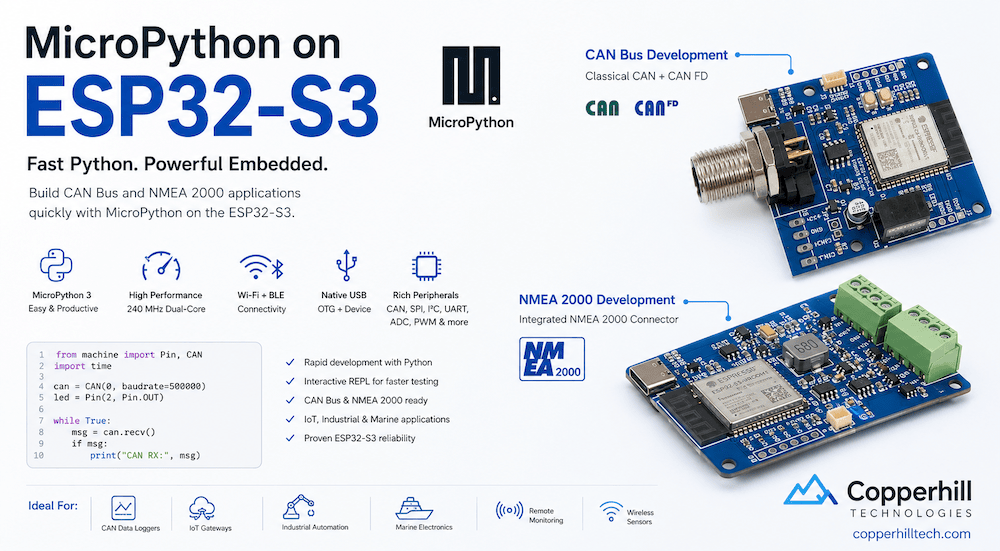 The embedded systems world has traditionally been dominated by C and C++, but over the past several years another language has been gaining remarkable momentum: Python. More specifically, MicroPython has become one of the most attractive development environments for engineers who want to prototype and deploy embedded applications quickly without sacrificing access to the underlying hardware.
When combined with the powerful ESP32-S3 processor family, MicroPython offers an impressive platform for industrial automation, IoT devices, CAN bus applications, and even marine electronics using the NMEA 2000 protocol.
In this article we’ll explain what MicroPython is, why the ESP32-S3 is such an excellent target platform, and how our ESP32-S3 CAN bus development boards make it easy to build professional communication systems.
What Is MicroPython?
MicroPython is a lightweight implementation of the Python 3 programming language specifically designed for microcontrollers and resource-constrained embedded systems. Instead of compiling source code into machine code like traditional C programs, MicroPython executes compact Python bytecode directly on the microcontroller. It provides an interactive REPL (Read-Evaluate-Print Loop), allowing developers to test commands immediately without repeatedly compiling and downloading firmware. The project also includes hardware-specific modules that provide direct access to GPIOs, timers, SPI, I²C, UARTs, PWM outputs, ADCs, and networking features. Official firmware is available for the ESP32-S3 family, making it one of the best-supported MicroPython platforms.
The result is dramatically shorter development cycles.
Instead of:
- Edit
- Compile
- Link
- Flash
- Reset
- Test
you simply:
- Edit
- Save
- Run
This difference alone can reduce development time by hours during the early stages of a project.
Why the ESP32-S3?
The ESP32-S3 has become one of the most capable microcontrollers available for embedded developers.
Among its major features are:
- Dual-core 240 MHz processor
- Wi-Fi
- Bluetooth Low Energy
- Native USB
- Large memory options
- Hardware encryption
- Excellent peripheral support
- Low power consumption
These features make it suitable for:
- Industrial automation
- Remote monitoring
- Data logging
- Vehicle communication
- Marine electronics
- IoT gateways
- Wireless sensor networks
Unlike many small microcontrollers, the ESP32-S3 has enough processing power and memory to comfortably run the MicroPython interpreter while still leaving resources available for demanding communication tasks. Official MicroPython firmware images are provided for generic ESP32-S3 hardware, simplifying deployment.
Why Developers Love MicroPython
One of the biggest advantages is readability.
Compare a simple LED blink example.
Traditional C code often requires dozens of lines involving initialization structures, compiler directives, and hardware configuration.
The same operation in MicroPython typically takes only a few lines:
from machine import Pin
import time

led = Pin(2, Pin.OUT)

while True:
    led.toggle()
    time.sleep(1)
Even engineers with little programming experience can understand this immediately.
That makes MicroPython an outstanding teaching language for embedded systems.
Interactive Development
Perhaps the most underrated feature is the REPL.
After connecting the ESP32-S3 over USB, you can immediately type commands such as:
>>> from machine import Pin
>>> led = Pin(2, Pin.OUT)
>>> led.on()
>>> led.off()
No compiling.
No flashing.
No waiting.
This is particularly useful when experimenting with hardware interfaces or debugging communication systems.
Perfect for Rapid Prototyping
Many commercial embedded products begin life as prototypes.
During this phase the priorities are usually:
- Getting hardware operational
- Testing communication protocols
- Verifying sensor interfaces
- Experimenting with algorithms
MicroPython excels here.
Once the concept has been validated, performance-critical portions can later be rewritten in C if necessary.
In many applications, however, MicroPython itself provides more than enough performance for the finished product.
CAN Bus Development Using the ESP32-S3
CAN bus remains one of the world’s most widely used industrial communication systems.
Applications include:
- Industrial machinery
- Agricultural equipment
- Heavy-duty vehicles
- Robotics
- Factory automation
- Laboratory equipment
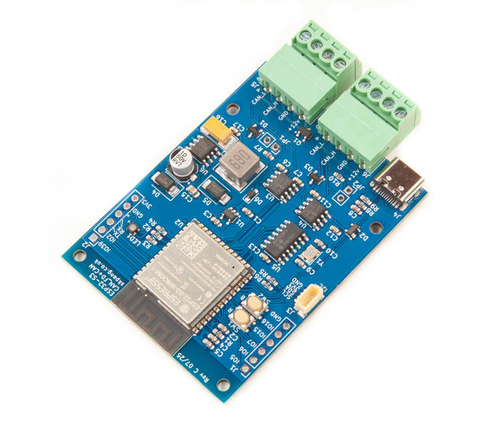 Our ESP32-S3 CAN Bus Development Board combines the ESP32-S3 processor with both Classical CAN and CAN FD interfaces, creating an ideal platform for experimenting with modern CAN-based networks.
Typical MicroPython applications include:
- CAN data logger
- Wireless CAN gateway
- Diagnostic interface
- CAN-to-Wi-Fi bridge
- CAN-to-MQTT gateway
- Remote monitoring device
- Industrial IoT edge controller
Because MicroPython simplifies application development, engineers can focus on solving communication problems rather than spending time managing low-level firmware infrastructure.
NMEA 2000 Development Made Easy
Marine electronics increasingly rely on the NMEA 2000 protocol.
Although NMEA 2000 is built upon the CAN physical layer, it introduces higher-level message structures specifically designed for marine applications.
Typical devices include:
- GPS receivers
- Chart plotters
- Engine monitors
- Fuel sensors
- Battery monitors
- Wind sensors
- Depth sounders
- Autopilots
 Our ESP32-S3 board with an integrated NMEA 2000 connector provides an excellent hardware platform for experimenting with these marine networks.
Using MicroPython, developers can rapidly prototype:
- Custom marine displays
- Wireless NMEA 2000 gateways
- Data loggers
- Cloud-connected monitoring systems
- Mobile phone interfaces
- Boat automation systems
The ESP32-S3’s integrated Wi-Fi and Bluetooth make these projects particularly attractive because no additional communication hardware is required.
Learning Embedded Systems Faster
Many newcomers are intimidated by embedded programming.
C is powerful—but it also requires understanding:
- Memory management
- Header files
- Compiler settings
- Linkers
- Build systems
- Pointer arithmetic
MicroPython removes much of this complexity.
Developers can immediately begin learning:
- GPIO control
- Timers
- Interrupts
- Serial communications
- Sensors
- Network programming
without first becoming experts in compiler technology.
Excellent Ecosystem
Another major advantage is the enormous Python ecosystem.
Even though MicroPython implements only a subset of standard Python, many programming concepts transfer directly.
Thousands of tutorials are available online covering:
- Web servers
- MQTT
- REST APIs
- JSON
- Data logging
- Networking
- Sensors
- OLED displays
- Touchscreens
Learning resources are abundant, making it one of the easiest embedded platforms to get started with.
Is MicroPython Always the Best Choice?
Not necessarily.
Applications requiring:
- extremely high-speed control loops,
- hard real-time response,
- digital signal processing,
- or maximum execution efficiency,
may still benefit from C or C++.
However, for communication-oriented systems—including CAN bus gateways, data acquisition devices, NMEA 2000 interfaces, wireless sensors, and IoT edge devices—MicroPython often delivers more than enough performance while significantly reducing development time.
Conclusion
MicroPython has fundamentally changed the way many engineers approach embedded development.
Combined with the ESP32-S3, it provides an exceptionally productive platform that balances ease of programming with powerful hardware capabilities. Whether you’re building a CAN bus data logger, an industrial IoT gateway, or a wireless NMEA 2000 interface, the combination of MicroPython and the ESP32-S3 allows you to move from idea to working prototype in a fraction of the time required by traditional development methods.
If you’re looking for a professional hardware platform, our ESP32-S3 development boards provide an excellent starting point:
- ESP32-S3 CAN Bus Development Board with Classical CAN and CAN FD support
- ESP32-S3 NMEA 2000 Development Board with integrated marine connector
Both platforms are designed to help engineers, students, and hobbyists accelerate embedded development while taking full advantage of the flexibility and productivity that MicroPython brings to modern embedded systems.
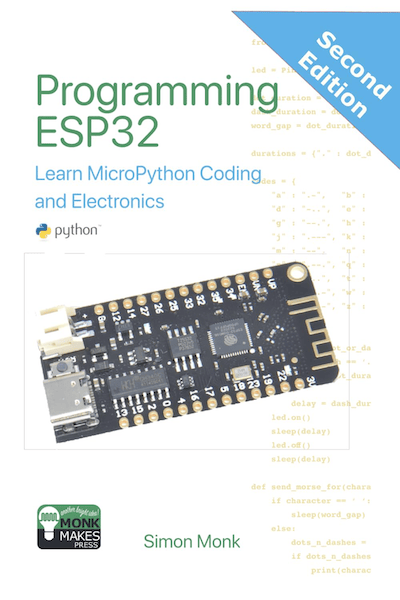 Programming ESP32: Learn MicroPython Coding and Electronics
Learn Python programming and basic electronics without requiring any prior experience in either subject. This book starts with the fundamentals of Python programming, gradually building your skills through practical examples, including a complete Morse code project.
The book is compatible with most ESP32 development boards, with a particular focus on the popular ESP32 Lite and ESP32 DevKit V1. For all electronics projects, detailed breadboard layouts are provided for both boards. This second edition also includes a new chapter dedicated to Bluetooth Low Energy (BLE).
In this book, you will learn how to:
- Install MicroPython firmware on an ESP32 board
- Set up and use the Thonny Python IDE to develop and upload programs
- Write Python programs to control the ESP32’s hardware
- Organize your code using functions and modules
- Work effectively with Python lists and dictionaries
- Interface LEDs, sensors, displays, and servo motors with the ESP32
- Use the ESP32’s built-in Wi-Fi and Bluetooth capabilities
- Create a web server running on the ESP32
- Access web services and Internet-based APIs from your ESP32 applications
This version reads more like the back cover of a modern technical book and uses terminology that is familiar to Python and ESP32 developers. I also changed “Flash Python firmware” to “Install MicroPython firmware,” since that is technically more accurate. More information...