 Loading... Please wait...

Blog
Recent Posts
Analog to NMEA 2000 Converter: Upgrade Legacy Boat Sensors to Digital NMEA 2000 Monitoring
Posted by on
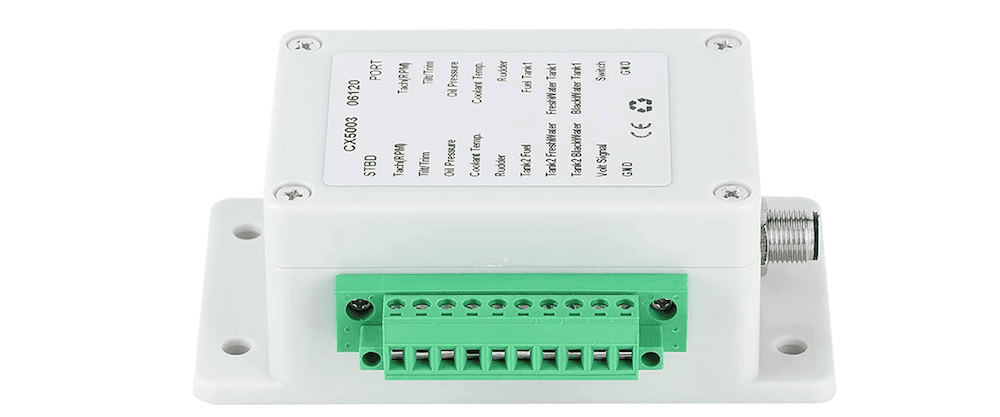 Many boats still rely on traditional analog gauges and sensors for monitoring engine performance and tank levels. While these systems are reliable, they cannot share information with modern multifunction displays (MFDs), digital dashboards, chartplotters, or onboard monitoring systems. An Analog to NMEA 2000 Converter bridges that gap by translating analog sensor signals into standardized NMEA 2000 messages, allowing existing equipment to become part of a modern marine electronics network.
Whether you are upgrading an older vessel or integrating custom monitoring systems into a new build, this converter provides a straightforward and cost-effective solution.
Convert Existing Analog Sensors to NMEA 2000
The converter accurately measures analog sensor inputs and translates them into standard NMEA 2000 Parameter Group Numbers (PGNs). Once connected, compatible chartplotters, digital gauges, and monitoring systems can display real-time engine and vessel information without replacing existing sensors.
This approach significantly reduces upgrade costs while preserving the original sensor installation.
Monitor Up to 18 Sensors Simultaneously
Unlike simple single-channel converters, this unit supports up to 18 analog sensor inputs, making it suitable for complex marine installations.
Typical applications include:
- Engine RPM (Tachometer)
- Engine Tilt and Trim
- Oil Pressure
- Coolant Temperature
- Rudder Position
- Fuel Tank Level
- Fresh Water Tank Level
- Black Water Tank Level
This broad sensor support allows nearly every critical analog measurement aboard the vessel to be available anywhere on the NMEA 2000 network.
High-Precision Signal Conversion
Accurate sensor conversion is essential for reliable navigation and engine monitoring. The converter continuously samples analog inputs and generates stable, repeatable NMEA 2000 data with excellent precision.
Its intelligent signal processing minimizes fluctuations and ensures dependable operation even in electrically noisy marine environments.
Adjustable Speed Ratio for Flexible Applications
Different installations often require different update rates. The converter offers an adjustable 1 to 128 speed ratio, allowing installers to optimize performance for various sensor types and operating conditions.
This flexibility helps balance network traffic while maintaining responsive updates for critical engine parameters.
Built for Harsh Marine Environments
Marine electronics must withstand water, vibration, temperature changes, and corrosive salt air.
The converter features an IP67-rated enclosure, providing excellent protection against:
- Water ingress
- Salt spray
- Dust
- Moisture
- Engine-room environments
- Mechanical vibration
The rugged construction ensures long-term reliability even in demanding offshore applications.
Compatible with Virtually Any NMEA 2000 Installation
The converter is designed for seamless integration into standard NMEA 2000 networks and works alongside equipment from most major marine electronics manufacturers. Once installed, converted sensor data becomes available to compatible displays, multifunction navigation systems, engine monitoring instruments, and vessel management systems.
This makes it an excellent solution for:
- Powerboats
- Sailboats
- Fishing boats
- Commercial vessels
- Workboats
- Yachts
- Custom marine projects
An Economical Upgrade Path
Replacing every analog sender with digital sensors can quickly become expensive. An Analog to NMEA 2000 Converter allows boat owners to modernize their instrumentation while continuing to use existing, proven analog sensors.
The result is a cleaner helm, centralized vessel monitoring, improved situational awareness, and better integration with today’s marine electronics—all without extensive rewiring or costly sensor replacement.
Typical Applications
The converter is ideal for:
- Modernizing older boats with NMEA 2000 capability
- Integrating legacy engine instrumentation into digital dashboards
- Monitoring multiple tanks from a single network
- Custom vessel monitoring systems
- Marine automation projects
- Retrofit installations where replacing sensors is impractical
Conclusion
An Analog to NMEA 2000 Converter offers one of the easiest ways to modernize a vessel without replacing existing analog sensors. With support for up to 18 sensor inputs, accurate analog-to-digital conversion, adjustable performance, rugged IP67 construction, and compatibility with standard NMEA 2000 networks, it provides an efficient bridge between traditional marine instrumentation and today’s connected marine electronics.
Whether you’re upgrading a recreational boat, commercial vessel, or custom marine project, this converter transforms valuable analog data into digital information that can be shared throughout your entire NMEA 2000 network. More information...
 Teensy 4.0 NMEA 2000 Simulator
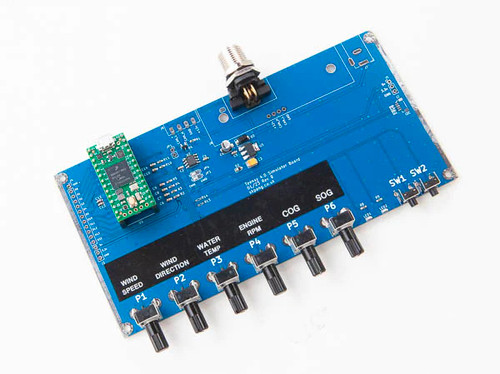
The Teensy 4.0 NMEA 2000 Simulator is a powerful development and diagnostic platform designed for engineers, marine electronics developers, and service technicians who need to test NMEA 2000-compatible devices without access to a complete onboard network. Powered by the high-performance Teensy 4.0 microcontroller, the simulator comes pre-programmed and ready to generate realistic NMEA 2000 traffic over a standard Micro-C connector. Six onboard potentiometers and two push-buttons provide interactive control of multiple Parameter Group Numbers (PGNs), allowing users to simulate changing sensor values such as wind speed, water temperature, engine RPM, course over ground, and speed over ground in real time.
With its open-source firmware and Arduino-compatible development environment, the simulator is easily customized to support additional PGNs or proprietary marine applications. It is an ideal solution for firmware development, laboratory testing, product demonstrations, technical training, and troubleshooting of chartplotters, autopilots, engine displays, and other NMEA 2000 devices. By providing a repeatable and controlled source of marine network data, the Teensy 4.0 NMEA 2000 Simulator significantly reduces development time while eliminating the need for expensive field testing aboard a vessel. More information...
ESP32-S3 MicroPython Programming for CAN Bus and NMEA 2000
The embedded systems world has traditionally been dominated by C and C++, but over the past several years another language has been gaining remarkable momentum: Python. More specifically, MicroPython has become one of the most attractive development environments for engineers who want to prototype and deploy embedded applications quickly without sacrificing access to the underlying [...]
NMEA 2000 Data Gateway Applications: What You Can Build with USB and Bluetooth Access
Modern boats generate an enormous amount of information. Engine controllers report RPM, temperatures, fuel consumption, and operating hours. GPS receivers provide position, speed, and heading. Sensors monitor tank levels, battery status, wind conditions, water depth, and much more. All of this information travels across the vessel’s NMEA 2000 network. For years, accessing that data meant purchasing expensive [...]
CAN, SAE J1939, and NMEA 2000 Development with Raspberry Pi and PiCAN HATs
The Raspberry Pi has evolved far beyond its origins as an educational computer. Today, it serves as a powerful platform for industrial automation, vehicle networking, marine electronics, telematics, data logging, and rapid embedded systems prototyping. When combined with the PiCAN family of Raspberry Pi HATs available from Copperhill Technologies, the Raspberry Pi becomes a versatile CAN [...]
Building NMEA 2000 Devices Has Never Been Easier: Meet the Teensy 4.0 with IPS LCD and NMEA 2000 Connector
Developing NMEA 2000 devices often involves a frustrating combination of custom hardware, display integration, network connectivity, and endless testing. Many engineers and hobbyists spend more time wiring components together than actually developing their applications. The Teensy 4.0 with NMEA 2000 Connector and 240×240 IPS LCD changes that equation completely. By combining a powerful microcontroller, integrated NMEA [...]
NMEA 2000 Explained: A Practical Guide to CAN Bus Marine Networking
Modern marine electronics rely on NMEA 2000, a standardized CAN-based network that allows engines, sensors, displays, navigation systems, and monitoring devices to communicate over a single, shared backbone. Instead of point-to-point wiring, NMEA 2000 uses a robust two-wire CAN bus to distribute data efficiently and reliably across the vessel. While powerful and flexible, this technology [...]
Unlock the Future of Marine Apps with the ESP32-S3 CAN Bus Board with NMEA 2000 Connector
As the marine industry continues to embrace smart technologies, there's a growing demand for powerful, connected, and reliable embedded solutions that can handle everything from engine diagnostics to GPS data aggregation. Whether you're building a marine monitoring system, an onboard data logger, or an intelligent control unit, you need a development board that offers high [...]
Next-Level Boat Monitoring: Sensar Marine and the Power of NMEA 2000
In today’s digitally connected world, smart technology is no longer confined to homes or personal gadgets. It's now transforming the way we experience boating. Sensar Marine, a company at the forefront of marine innovation, has developed a modern solution for boat owners who want to monitor, protect, and manage their vessels with the same confidence [...]
NMEA 2000: A Comprehensive Overview and Integration with Copperhill PiCAN-M Series
NMEA 2000 (National Marine Electronics Association 2000) is a standardized communication protocol used in the marine industry to facilitate seamless data exchange between electronic devices onboard vessels. Based on the Controller Area Network (CAN) protocol (ISO 11898), NMEA 2000 enables efficient, real-time data sharing between sensors, navigation instruments, and control systems. This standard has been [...]
Testing NMEA 0183 For The PICAN-M - NMEA 0183 & NMEA 2000 HAT For Raspberry Pi
PICAN-M - NMEA 0183 & NMEA 2000 HAT For Raspberry Pi Our PICAN-M (M = Marine) is a Raspberry Pi HAT with NMEA 0183 and NMEA 2000 connection. The NMEA 0183 (RS422) port is accessible via a 5-way screw terminal. The NMEA 2000 port is accessible via a Micro-C connector. The board comes with a 3A SMPS [...]