Loading... Please wait...



)

Product Description
Free Shipping Within the United States!
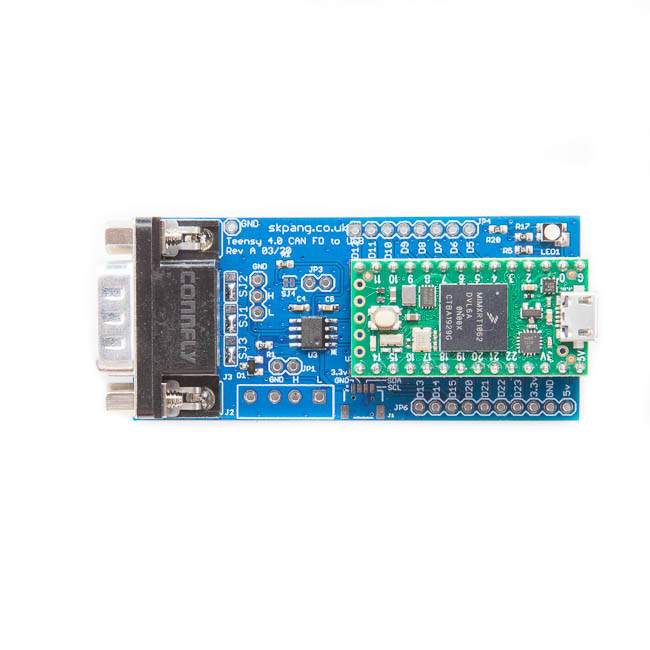
The Teensy 4.0 CAN FD to USB Converter combines the exceptional processing power of the Teensy 4.0 with a high-speed CAN FD interface, creating a compact yet powerful tool for automotive, industrial, and embedded networking applications. Powered by the 600 MHz NXP i.MX RT1062 ARM Cortex-M7 processor, the converter delivers the performance required to capture, process, and transfer CAN and CAN FD traffic with minimal latency. Whether you are developing next-generation ECUs, analyzing network traffic, or building custom communication tools, this converter provides a professional-grade platform in a remarkably compact package.
Designed for engineers who value flexibility, the converter supports both Classical CAN and CAN FD, making it equally suitable for legacy systems and modern high-bandwidth vehicle networks. The integrated MCP2558FD transceiver supports data rates of up to 8 Mbps and includes a silent monitoring mode, allowing passive observation of live CAN networks without affecting bus operation. The high-speed USB interface communicates through the well-established Lawicel ASCII protocol, making integration with custom software, test applications, and existing development environments straightforward and efficient.
Unlike many dedicated USB-to-CAN interfaces, this converter is fully Arduino-compatible, enabling developers to customize firmware or create entirely new applications using the familiar Arduino IDE and the extensive Teensy software ecosystem. Beyond serving as a reliable CAN FD interface, it can evolve into a protocol gateway, data logger, network analyzer, or application-specific communication device. Whether your project involves automotive diagnostics, industrial automation, SAE J1939, CANopen, or proprietary CAN-based protocols, the Teensy 4.0 CAN FD to USB Converter provides the performance, flexibility, and expandability needed to accelerate development and reduce time to market.
At the heart of the converter is the Teensy 4.0, powered by the NXP i.MX RT1062 ARM Cortex-M7 processor running at 600 MHz. This microcontroller boasts:
- 1 MB of RAM (with 512 KB tightly coupled for high-speed access)
- 2 MB of Flash memory
- Dual 480 Mbps USB ports
- Multiple I/O interfaces, including SPI, I2C, UART, PWM, and ADC
- Cryptographic acceleration and a random number generator
- Real-time clock (RTC) support
Programming is facilitated through the Arduino IDE with the Teensyduino add-on, ensuring compatibility with a wide range of Arduino libraries and examples.
MCP2558FD CAN FD Transceiver
The MCP2558FD transceiver from Microchip Technology enables high-speed CAN FD communication up to 8 Mbps. Key features include:
- Compliance with ISO 11898-2:2016 standards
- Support for both Classical CAN and CAN FD protocols
- Silent mode operation for passive monitoring
- Enhanced ESD protection
Silent mode can be activated via software or a hardware link, allowing the device to monitor CAN traffic without influencing the network.
Interface Details
CAN FD Interface
The converter connects to CAN networks through a DB9 connector, configurable for OBD-II or CAN analyzer pinouts. This flexibility ensures compatibility with various automotive and industrial CAN applications.
USB Interface
The high-speed USB interface (480 Mbps) facilitates rapid data transfer between the CAN network and a host computer. The converter utilizes the Lawicel protocol, employing simple ASCII commands for communication, making it accessible for developers and engineers.
Additional Features
- RGB LED indicator for status monitoring
- Compact design for easy integration into existing systems
- Free shipping within the United States
Teensy 4.0 Technical Specifications
- ARM Cortex-M7 at 600 MHz
- 1024K RAM (512K is tightly coupled)
- 2048K Flash (64K reserved for recovery & EEPROM emulation)
- 2 USB ports, both 480 MBit/sec
- 3 CAN Bus (1 with CAN FD)
- 2 I2S Digital Audio
- 1 S/PDIF Digital Audio
- 1 SDIO (4 bit) native SD
- 3 SPI, all with 16 word FIFO
- 3 I2C, all with 4 byte FIFO
- 7 Serial, all with 4 byte FIFO
- 32 general purpose DMA channels
- 31 PWM pins
- 40 digital pins, all interrupt capable
- 14 analog pins, 2 ADCs on chip
- Cryptographic Acceleration
- Random Number Generator
- RTC for date/time
- Programmable FlexIO
- Pixel Processing Pipeline
- Peripheral cross triggering
- Power On/Off management
Download the PDF: Teensy Software Installation & Downloading Programs (Sketches)...
TEENSY Resources
- TEENSY USB Development Board...
- TEENSY Loader to download code...
- Teensyduino, add-on for Arduino IDE...
Development Resources
Demo Sketch
The demo sketch (see download link above) uses the FlexCAN library, and it represents a serial protocol for communication between the gateway and an external system, for instance, a PC. The protocol is based on the ASCII commands developed by LAWICEL but extended to accommodate CAN FD.
The protocol uses ASCII commands to set the CAN baud rate, transmit CAN Bus data frames, and more. They are documented in the above download referenced download page (github).
 Arduino Cookbook
Want to build devices that interact with the physical world? This cookbook is an excellent choice for anyone who wants to experiment with the popular Arduino microcontroller and programming environment.
You’ll find more than 200 tips and techniques for building a variety of objects and prototypes such as toys, detectors, robots, and interactive clothing that can sense and respond to touch, sound, position, heat, and light.
You don’t need to have mastered Arduino or programming to get started. Updated for the Arduino 1.0 release, the recipes in this second edition include practical examples and guidance to help you begin, expand, and enhance your projects right away—whether you’re an artist, designer, hobbyist, student, or engineer.
- Get up to speed on the Arduino board and essential software concepts quickly
- Learn basic techniques for reading digital and analog signals
- Use Arduino with a variety of popular input devices and sensors
- Drive visual displays, generate sound, and control several types of motors
- Interact with devices that use remote controls, including TVs and appliances
- Learn techniques for handling time delays and time measurement
- Apply advanced coding and memory handling techniques