 Loading... Please wait...

Blog
Recent Posts
LIN Bus Development Made Easy: Integrating Automotive LIN Networks with Any UART-Based Embedded System
Posted by on
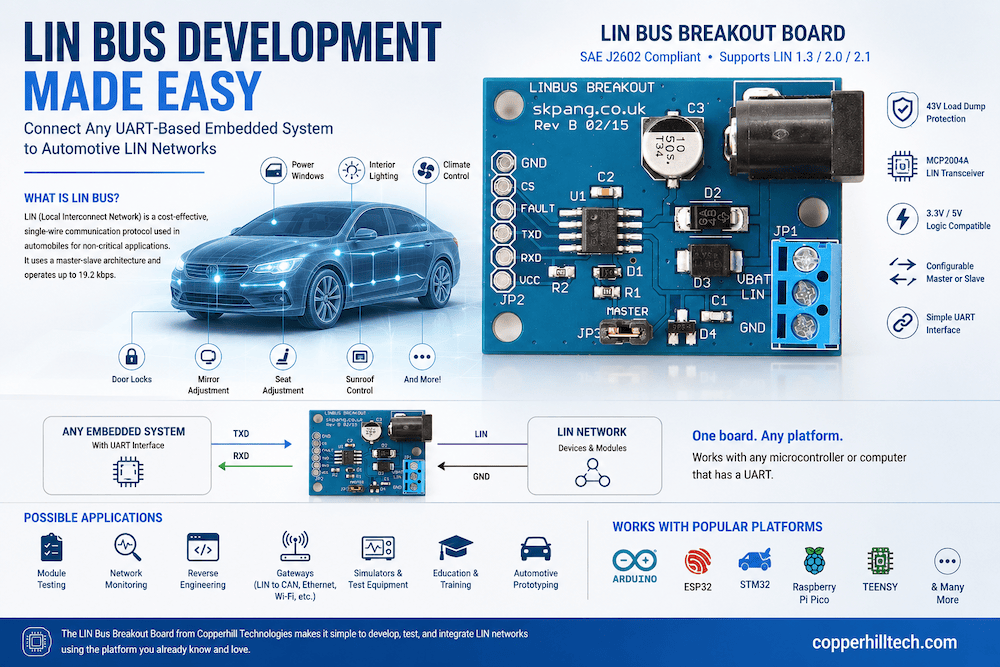 Modern automobiles contain dozens of electronic control units (ECUs) that communicate with each other to manage everything from engine performance to seat adjustments. While high-speed networks such as CAN Bus handle critical vehicle functions, many automotive subsystems rely on a simpler and less expensive communication technology: the Local Interconnect Network, better known as LIN Bus.
For engineers, developers, students, and automotive enthusiasts interested in working with LIN-based systems, the LIN Bus Breakout Board from Copperhill Technologies provides a straightforward and hardware-independent solution. Unlike platform-specific designs, this board can be connected to virtually any embedded system equipped with a standard UART (serial) interface.
What Is LIN Bus?
LIN (Local Interconnect Network) was developed as a low-cost complement to the CAN Bus. As automotive electronics became increasingly sophisticated during the 1990s, manufacturers needed an economical way to connect sensors, switches, actuators, and other non-critical devices without the expense of a full CAN Bus implementation. The LIN Consortium, founded by major European automakers, created a standardized solution that is still widely used today.
LIN Bus is a single-wire serial communication network that typically operates at speeds up to 19.2 kbps. Unlike CAN Bus, which uses a decentralized architecture, LIN uses a master-slave model where a single master node controls communication with multiple slave devices. This approach reduces hardware complexity and system cost.
Where Is LIN Bus Used?
Although many people associate vehicle networking exclusively with CAN Bus, LIN Bus is responsible for numerous convenience and comfort functions found in modern automobiles.
Typical LIN applications include:
- Power window controls
- Seat adjustment systems
- Mirror positioning and folding
- Interior lighting systems
- Rain and light sensors
- Climate control actuators
- Sunroof controls
- Steering wheel switches
- Door lock modules
- Seat occupancy sensors
In many vehicles, multiple LIN networks are connected to a central CAN Bus gateway. This architecture allows manufacturers to reserve CAN Bus bandwidth for safety-critical functions while using LIN for lower-speed subsystems.
The Challenge of LIN Bus Development
While LIN Bus itself is relatively simple, developers still need an interface between their microcontroller and the physical LIN network.
A standard UART port cannot be connected directly to a LIN Bus because the electrical characteristics differ significantly from standard serial communication. LIN requires a dedicated transceiver that handles:
- Voltage level conversion
- Bus wake-up functions
- Bus protection
- LIN-compliant signal generation
- Fault tolerance
This is where the Copperhill Technologies LIN Bus Breakout Board becomes particularly useful.
Introducing the LIN Bus Breakout Board
 The LIN Bus Breakout Board is based on the proven Microchip MCP2004A LIN transceiver and provides a complete physical interface between a UART-equipped controller and a LIN network.
Key Features
- SAE J2602 compliant
- Supports LIN specifications 1.3, 2.0, and 2.1
- 43-volt load dump protection
- Compatible with both 3.3V and 5V logic
- Configurable as LIN Master or LIN Slave
- Flexible power input options
- Simple UART connection interface
Perhaps the most attractive feature is its simplicity.
The board connects to an embedded controller through a standard UART interface:
- Controller TX → Board RX
- Controller RX → Board TX
That's all that is required on the digital side. The breakout board handles the physical-layer details necessary for LIN communication.
Compatible Embedded Platforms
One of the biggest advantages of this breakout board is that it is not tied to a specific processor family.
Any platform with a UART can be used, including:
- Arduino Uno, Mega, Due
- ESP32
- STM32
- Raspberry Pi Pico
- Teensy
- NXP LPC series
- Microchip PIC microcontrollers
- AVR devices
- ARM Cortex-M systems
- Linux-based embedded systems
- Custom embedded hardware
If your processor can transmit and receive serial data, it can communicate through the LIN Bus Breakout Board.
This flexibility makes the board an excellent choice for both rapid prototyping and production development.
Development Applications
Automotive Module Testing
Many automotive modules can be tested on a workbench without requiring a complete vehicle.
Examples include:
- Window controllers
- Lighting modules
- Mirror control units
- HVAC actuators
- Door modules
By using the breakout board in master mode, a developer can generate LIN commands and observe the response from a target module.
Reverse Engineering LIN Networks
Engineers frequently need to analyze existing LIN communication.
Potential tasks include:
- Identifying message schedules
- Decoding frame identifiers
- Capturing sensor data
- Understanding proprietary protocols
The breakout board provides a simple hardware interface for custom monitoring software running on a PC-connected microcontroller.
Automotive Retrofit Projects
Many modern automotive components require LIN communication.
Examples include:
- Intelligent ambient lighting
- Smart mirror assemblies
- Electronic HVAC controls
- Power seats
The breakout board allows hobbyists and professional developers to integrate these components into custom projects.
Educational and Training Platforms
LIN Bus is often overlooked in embedded systems education despite its widespread automotive use.
The breakout board offers an affordable way to teach:
- Automotive networking concepts
- Master-slave communication
- UART-based protocol implementation
- Vehicle electronics fundamentals
Students can quickly build working LIN networks without designing custom transceiver hardware.
Gateway Development
Developers can build protocol gateways between LIN and other communication systems, including:
- LIN-to-CAN
- LIN-to-CAN FD
- LIN-to-J1939
- LIN-to-NMEA 2000
- LIN-to-Ethernet
- LIN-to-Wi-Fi
- LIN-to-Bluetooth
An ESP32 combined with the LIN Bus Breakout Board, for example, can create a wireless monitoring gateway for automotive LIN networks.
Test Equipment and Simulators
Because the board can operate as either a LIN master or slave, it is ideal for creating:
- LIN simulators
- Diagnostic tools
- Automated test systems
- Manufacturing test fixtures
- Hardware-in-the-loop (HIL) systems
The ability to switch roles through a simple jumper greatly increases flexibility during development.
Why Use a Generic UART-Based Solution?
Many LIN development platforms are tied to a specific processor or software ecosystem.
The Copperhill Technologies LIN Bus Breakout Board takes a different approach.
Instead of forcing developers into a particular hardware platform, the board exposes a simple UART interface that works with virtually any embedded system. This provides several advantages:
- Freedom to choose your preferred processor
- Easy migration between platforms
- Reduced development costs
- Reusable hardware across multiple projects
- Simplified prototyping
Whether you're developing on an Arduino today and an STM32 tomorrow, the same breakout board can remain part of your toolset.
Conclusion
LIN Bus remains one of the most important communication technologies in modern vehicles. While it may not receive as much attention as CAN Bus or CAN FD, millions of LIN nodes are deployed in automobiles worldwide, handling everything from interior lighting to power seat controls.
The Copperhill Technologies LIN Bus Breakout Board provides a simple and versatile way to access these networks. By combining a standards-compliant LIN transceiver with a straightforward UART interface, it enables LIN development on virtually any embedded platform.
Whether you're building a diagnostic tool, reverse-engineering an automotive subsystem, creating a LIN gateway, or simply learning about vehicle networking, this compact breakout board offers a flexible starting point without locking you into any specific hardware architecture.