 Loading... Please wait...

Blog
Recent Posts
ESP32S3 CAN & LIN-Bus Board – Accelerating CAN-to-LIN Gateway Development
Posted by on
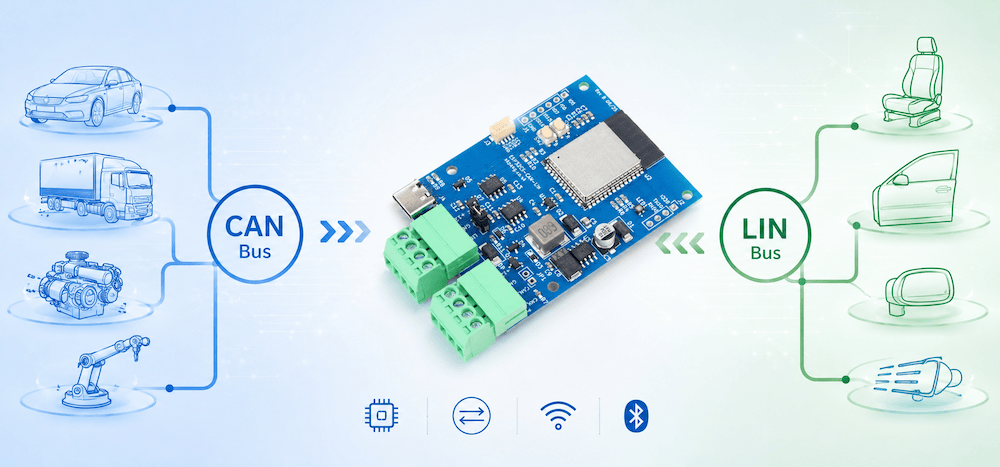 Modern vehicles and industrial machines increasingly rely on multiple communication networks. While CAN Bus serves as the backbone for critical control systems, LIN (Local Interconnect Network) provides a low-cost solution for intelligent sensors, switches, actuators, and body electronics. In many applications, engineers need a reliable method to exchange data between these two networks.
The ESP32S3 CAN & LIN-Bus Board from Copperhill Technologies was designed precisely for this purpose. By combining a powerful ESP32-S3 microcontroller with dedicated CAN and LIN interfaces on a single board, it provides a ready-to-use platform for developing CAN-to-LIN gateways, protocol converters, diagnostic tools, and custom control applications.
Instead of spending valuable engineering time designing hardware from scratch, developers can immediately focus on their application software and communication logic.
Why Connect CAN Bus and LIN Bus?
At first glance, CAN and LIN appear to serve similar purposes—they both allow electronic devices to communicate. However, they were designed for very different requirements.
CAN Bus offers:
- High reliability
- Multi-master communication
- Sophisticated error detection
- Fast data transmission
- Support for real-time control systems
LIN Bus was developed as a cost-effective alternative for less demanding applications:
- Simple single-master architecture
- Reduced wiring complexity
- Lower component cost
- Ideal for sensors and actuators
- Simplified implementation
As a result, many systems use both networks simultaneously.
A typical automotive example might include:
- CAN Bus connecting the engine controller, transmission controller, ABS, and dashboard.
- LIN Bus connecting seat modules, mirror controls, window motors, rain sensors, and lighting controls.
The challenge arises when information must move between these networks. This is where a CAN-to-LIN gateway becomes essential.
Typical CAN-to-LIN Gateway Applications
Automotive Body Electronics
Many body control modules act as translators between CAN and LIN networks.
Examples include:
- Mirror position commands received over CAN and forwarded to LIN mirror modules
- Door-lock status reported from LIN nodes to CAN controllers
- Lighting commands translated between networks
- Seat-position information exchanged with central vehicle controllers
The ESP32S3 CAN & LIN-Bus Board provides an ideal platform for prototyping and testing such gateway concepts.
Electric Vehicle Subsystems
EV developers frequently integrate third-party modules that communicate using different protocols.
A gateway can:
- Collect LIN sensor data
- Convert information into CAN messages
- Forward status information to vehicle controllers
- Provide diagnostic access to both networks
Industrial Equipment
Many industrial systems combine CAN-based machine controllers with low-cost intelligent devices.
Examples include:
- HVAC controllers
- Smart switches
- Operator panels
- Lighting controllers
- Position sensors
The board can bridge these devices while maintaining complete control over message translation and timing.
Agricultural Equipment
Agricultural machinery often uses CAN-based control systems while incorporating numerous intelligent peripheral devices.
Potential applications include:
- Sensor integration
- Lighting control
- Cab electronics
- Auxiliary control panels
- Actuator monitoring
Developers can create custom gateways that translate LIN-based subsystem data into CAN messages suitable for machine-wide monitoring and control.
Test and Simulation Systems
The board is also an excellent platform for laboratory environments.
Engineers can:
- Simulate LIN nodes
- Simulate CAN controllers
- Generate test traffic
- Monitor network activity
- Validate gateway functionality
- Evaluate new system architectures
Why the ESP32-S3?
At the heart of the board is the ESP32-S3, one of the most popular embedded processors available today.
Key advantages include:
- Dual-core processing architecture
- High clock speed
- Large memory resources
- USB connectivity
- Integrated Wi-Fi
- Integrated Bluetooth
- Extensive development ecosystem
- Excellent Arduino IDE support
These capabilities enable applications far beyond simple protocol conversion.
For example, a gateway can simultaneously:
- Receive CAN messages
- Process LIN traffic
- Log data to memory
- Serve a web-based dashboard
- Transmit information via Wi-Fi
- Stream diagnostic data over Bluetooth
All on a single board.
Wireless CAN and LIN Monitoring
One particularly attractive application is wireless monitoring.
Using the ESP32-S3's built-in Wi-Fi and Bluetooth capabilities, developers can create:
- Wireless diagnostic tools
- Mobile monitoring applications
- Remote data acquisition systems
- Cloud-connected gateways
- Predictive maintenance solutions
Instead of connecting a laptop directly to a machine, users can monitor network activity remotely through a smartphone, tablet, or web browser.
Accelerating Development with Software Examples
Hardware is only part of the development challenge.
To help engineers get started quickly, Copperhill Technologies provides software examples demonstrating CAN and LIN communication concepts. These examples allow developers to:
- Verify hardware operation immediately
- Learn CAN communication techniques
- Learn LIN communication techniques
- Understand gateway architectures
- Build proof-of-concept applications rapidly
- Reduce development risk
Rather than beginning with a blank project, engineers can use the provided examples as a foundation for their own applications.
This approach can save days or even weeks of development effort.
A Platform for Innovation
Whether your project involves automotive electronics, industrial automation, agricultural machinery, diagnostics, or wireless monitoring, the ESP32S3 CAN & LIN-Bus Board provides a flexible and powerful development platform.
By combining CAN, LIN, Wi-Fi, Bluetooth, and the processing power of the ESP32-S3 on a single board, it enables rapid development of sophisticated gateway and monitoring applications without the complexity of custom hardware design.
For engineers seeking a practical CAN-to-LIN gateway platform, the ESP32S3 CAN & LIN-Bus Board offers an efficient path from concept to working prototype. More information...
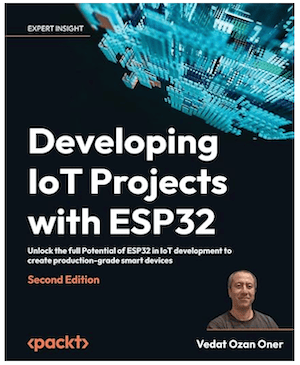 ESP32, the low-cost, energy-efficient system-on-a-chip (SoC) microcontroller, has become a cornerstone of modern Wi-Fi-enabled devices, driving innovation across the Internet of Things (IoT) landscape. This comprehensive guide offers a practical, end-to-end approach to building secure, scalable IoT systems using the powerful ESP32 platform.
From foundational concepts to advanced implementation, the book walks you through the complete lifecycle of developing an IoT device with ESP32. Beginning with essential IoT principles and real-world use cases, each chapter progressively builds your skills—covering sensor communication, integration of key libraries like LittleFS and LVGL, Wi-Fi connectivity, data security, and cloud integration. You'll also learn how to visualize real-time data using tools like Grafana, making your solutions truly production-ready.
A special section is dedicated to artificial intelligence and machine learning (AI/ML) for embedded systems. You'll explore how to build and deploy tinyML models on the ESP32-S3, enabling intelligent edge computing capabilities for your next-generation embedded products.
Adopting a hands-on, project-driven approach, the book ensures that you can apply your knowledge from day one. As a capstone, you'll develop a full-scale Smart Home system, consolidating all the concepts and technologies explored throughout the book.
Whether you're a maker, engineer, or embedded systems developer, this book equips you to build secure, real-world IoT solutions with ESP32—ready for deployment in today’s connected world. More information...
LIN Bus Development Made Easy: Integrating Automotive LIN Networks with Any UART-Based Embedded System
Modern automobiles contain dozens of electronic control units (ECUs) that communicate with each other to manage everything from engine performance to seat adjustments. While high-speed networks such as CAN Bus handle critical vehicle functions, many automotive subsystems rely on a simpler and less expensive communication technology: the Local Interconnect Network, better known as LIN Bus. For [...]