 Loading... Please wait...

Blog
Recent Posts
Copperhill Technologies Launches an Engineering Community for the Entire SAE J1939 Ecosystem
Posted by on
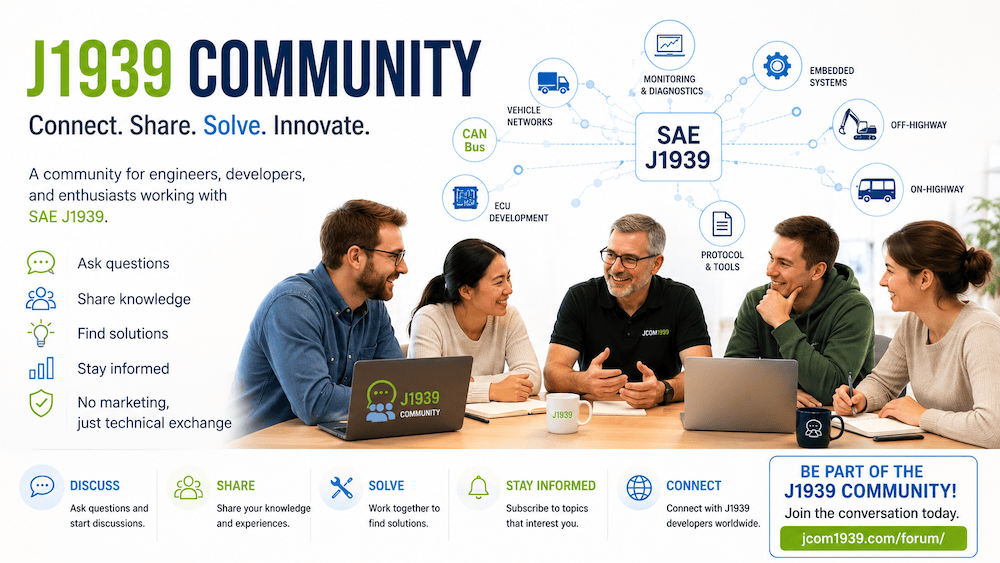 Copperhill Technologies today announced the expansion of the JCOM1939 Community into a dedicated engineering forum serving professionals across the entire SAE J1939 ecosystem. While the community has traditionally focused on embedded software development, it now welcomes Test & Validation Engineers, Systems Integrators, OEM engineers, hardware developers, technical support specialists, and others involved in designing, integrating, testing, and maintaining CAN- and J1939-based systems.
As modern vehicles and industrial equipment become increasingly networked and software-driven, successful projects depend on collaboration between multiple engineering disciplines. The JCOM1939 Community provides a central platform where engineers can exchange practical knowledge, discuss real-world implementation challenges, and stay informed about development tools, software, educational resources, and industry best practices.
Click here to join the J1939 Community...
Detailed Description
For many years, Copperhill Technologies has supported engineers developing SAE J1939 and CAN bus applications through hardware interfaces, embedded software, technical articles, educational content, and development tools. The JCOM1939 Community builds on that foundation by providing a dedicated meeting place for engineers working throughout the entire product development lifecycle.
Although embedded software developers remain at the heart of the community, today's engineering projects involve far more than writing firmware. Modern vehicle networks require close cooperation between software developers, hardware designers, test engineers, validation specialists, systems integrators, OEM engineering teams, manufacturing engineers, technical support personnel, and field service professionals. Each discipline contributes unique expertise while often facing many of the same technical challenges.
The JCOM1939 Community is designed to encourage that collaboration by providing a focused environment where professionals can exchange ideas, solve problems, and share practical engineering experience.
The community welcomes professionals involved in:
-
Embedded software development
-
Embedded hardware and ECU design
-
CAN bus and CAN FD development
-
SAE J1939 implementation
-
Network architecture and integration
-
Systems integration
-
Test and validation engineering
-
OEM engineering
-
Product development and prototyping
-
Diagnostics and troubleshooting
-
Manufacturing engineering
-
Technical support and field service
Discussion topics cover every stage of product development, from implementing J1939 protocol functions and debugging CAN communication to integrating electronic control units from multiple suppliers, validating network behavior, troubleshooting interoperability issues, and commissioning complete vehicle systems.
A growing area of interest is test and validation. Engineers frequently need to evaluate new hardware and software before a complete machine or vehicle is available. The community encourages discussions on node simulation, fault injection, network monitoring, automated testing, ECU validation, and practical methods for reproducing real-world operating conditions in the laboratory.
Systems integrators and OEM engineering teams will also find a forum dedicated to solving integration challenges involving address claiming, transport protocols, diagnostics, parameter groups, network configuration, interoperability, and overall system performance.
Unlike general-purpose electronics forums, the JCOM1939 Community is dedicated exclusively to SAE J1939 and related CAN networking technologies. This specialized focus helps maintain highly relevant technical discussions for professionals working in commercial vehicles, agriculture, construction equipment, mining, marine systems, industrial automation, and other CAN-based applications.
Beyond technical discussions, members gain access to information about new development tools, software releases, educational articles, product announcements, and other resources published by Copperhill Technologies and the broader engineering community.
The forum is open to everyone. Visitors may read all discussions without registering, making the accumulated technical knowledge freely accessible. Engineers who create a free account can participate in discussions, ask questions, share solutions, and receive notifications about new topics and community updates.
By bringing together embedded developers, hardware engineers, test professionals, systems integrators, OEM engineering teams, and other specialists, Copperhill Technologies aims to establish the JCOM1939 Community as one of the leading online resources for practical SAE J1939 engineering knowledge and collaboration.
About Copperhill Technologies
Copperhill Technologies develops hardware, software, and educational resources for CAN bus, CAN FD, SAE J1939, and embedded systems development. Through the JCOM1939 platform, the company supports engineers worldwide with practical development tools, technical information, and a growing professional community dedicated to advancing CAN-based technologies.
I think this version has a much stronger "press release" feel. It leads with the actual news—the creation of a broader engineering community—rather than simply stating that more people are being invited. That makes it more attractive to editors while still highlighting the inclusiveness of the community.
How to Build a Raspberry Pi CAN-to-Ethernet Gateway
The Controller Area Network (CAN) remains one of the most reliable communication technologies in embedded systems, industrial automation, commercial vehicles, marine electronics, and robotics. At the same time, Ethernet has become the preferred medium for connecting systems over long distances, integrating with cloud services, and providing remote access. Bridging these two worlds is a common requirement [...]
CAN Bus Troubleshooting with the PiCAN HATs: Why the Board Is Probably Not the Problem
The PiCAN product line has become the go-to CAN Bus interface solution for Raspberry Pi developers, system integrators, educators, and industrial engineers worldwide. From entry-level CAN Bus connectivity to advanced dual-channel CAN, CAN FD, GPS/GNSS integration, RS232, RS485, and real-time industrial networking, PiCAN boards combine robust hardware design with seamless Raspberry Pi integration. Whether you [...]
ESP32 TWAI Driver Explained: A Practical Guide to CAN Bus Programming
The ESP32 has become one of the most popular microcontrollers for CAN bus applications. Whether you are building industrial controllers, SAE J1939 devices, NMEA 2000 products, robotics systems, or automotive prototypes, the ESP32 provides a powerful and cost-effective platform with a built-in CAN controller. Yet, many developers are confused when they encounter the term TWAI in [...]
ESP32S3 CAN & LIN-Bus Board – Accelerating CAN-to-LIN Gateway Development
Modern vehicles and industrial machines increasingly rely on multiple communication networks. While CAN Bus serves as the backbone for critical control systems, LIN (Local Interconnect Network) provides a low-cost solution for intelligent sensors, switches, actuators, and body electronics. In many applications, engineers need a reliable method to exchange data between these two networks. The ESP32S3 CAN [...]
Why CAN Bus Refuses to Die: What CAN FD and CAN XL Reveal About the Strength of Classical CAN
For more than 25 years, I have been working with CAN (Controller Area Network) technology. During that time, I have lost count of how many times industry experts, analysts, and technology journalists predicted its imminent demise. First, it was Ethernet. Then came FlexRay. Later, it was Automotive Ethernet. More recently, CAN FD and now CAN XL have been presented [...]
Network Interface For infotainment And Advanced Driver Assistance Systems (ADAS)
The MOST150 Intelligent Network Interface Controller (INIC) from Microchip Technology Inc. enables automotive manufacturers and tier one suppliers to incorporate Media Oriented Systems Transport (MOST) networks in a daisy-chain configuration on coaxial physical layer with the support of full-duplex communication, in addition to a ring topology. With a full-duplex daisy-chained network, a single cable segment is sufficient [...]