 Loading... Please wait...

Blog
Recent Posts
ESP32 CAN Data Logger over Wi-Fi and Bluetooth: Build a Remote CAN & CAN FD Monitoring System
Posted by on
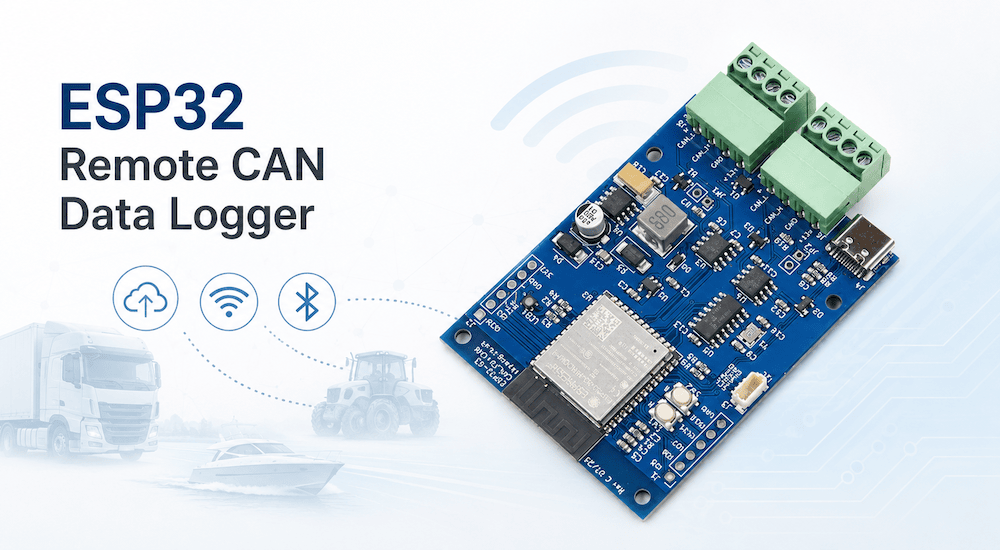 Industrial machines, commercial vehicles, agricultural equipment, marine electronics, and factory automation systems all generate valuable information over the CAN bus. The challenge is rarely collecting the data—it's accessing that data without being physically connected to the network.
Imagine monitoring an engine from your office, recording CAN FD traffic from inside an industrial cabinet without opening the enclosure, or deploying a wireless CAN data logger in a test vehicle that automatically uploads recorded information to your computer. These applications are no longer reserved for expensive commercial hardware. With today's ESP32 technology, they can be implemented using an inexpensive, programmable platform that combines CAN communications with built-in wireless networking.
This post explains how an ESP32-S3 equipped with both Classical CAN and CAN FD interfaces can become a flexible remote CAN data logger for development, diagnostics, predictive maintenance, and Internet of Things (IoT) applications.
Copperhill ESP32 and ESP32-S3 product line
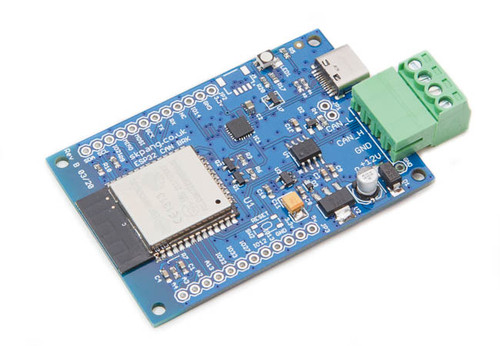 The Copperhill ESP32 and ESP32-S3 product line combines powerful wireless microcontrollers with robust CAN Bus connectivity, providing developers with a flexible platform for industrial, automotive, marine, and IoT applications. Whether your project involves Classical CAN, CAN FD, SAE J1939, NMEA 2000, or custom embedded protocols, these development boards deliver the processing performance, real-time communication, and integrated Wi-Fi and Bluetooth capabilities needed to build intelligent connected systems. From compact CAN interfaces to advanced CAN FD platforms, every board is designed to accelerate development while remaining fully programmable using the familiar Arduino IDE or Espressif's ESP-IDF environment.
The product family includes solutions for wireless CAN gateways, remote data loggers, embedded controllers, protocol converters, IoT edge devices, and rapid application prototyping. Many boards feature integrated USB-C programming, high-performance ESP32-S3 processors, support for both Classical CAN and CAN FD, and expansion options for sensors, displays, Ethernet, GPS, and other peripherals. Whether you are monitoring industrial equipment, developing vehicle electronics, designing marine systems, or creating the next generation of connected CAN Bus devices, the Copperhill ESP32 product line provides a reliable hardware foundation that bridges real-time CAN communications with modern wireless networking technologies. More information...
The Problem with Traditional CAN Data Logging
Most CAN data loggers require a direct USB connection to a PC.
While this works perfectly in the laboratory, it quickly becomes inconvenient in real-world installations:
-
The vehicle may be moving.
-
The equipment may be outdoors.
-
The controller may be installed inside a sealed enclosure.
-
Multiple CAN networks may need to be monitored simultaneously.
-
Long USB cables are unreliable and impractical.
-
Engineers often need access from tablets or smartphones instead of laptops.
Wireless communication solves these problems immediately.
Instead of bringing the computer to the machine, the machine simply transmits the data.
Why ESP32?
The ESP32 family has become one of the most popular embedded development platforms for a simple reason—it combines considerable processing power with integrated wireless communication.
Depending on the model, an ESP32 provides:
-
Dual-core processing
-
Wi-Fi
-
Bluetooth Classic
-
Bluetooth Low Energy (BLE)
-
Multiple UARTs
-
SPI interfaces
-
USB support
-
Extensive GPIO resources
-
Low power consumption
For CAN applications, this combination is especially attractive because one processor can simultaneously:
-
Read CAN traffic
-
Timestamp messages
-
Store data locally
-
Filter selected messages
-
Host a web server
-
Stream live traffic over Wi-Fi
-
Communicate with smartphones via BLE
-
Upload data to cloud services
The result is a complete wireless gateway instead of merely another CAN interface. The ESP32's integrated resources make it particularly well suited for CAN, higher-layer protocols such as SAE J1939 and NMEA 2000, and IoT gateway applications.
Classical CAN and CAN FD on One Platform
One of the biggest advantages of the latest ESP32-S3 CAN development boards is support for both CAN technologies.
Classical CAN
Classical CAN remains the dominant network technology for:
-
Industrial automation
-
Agricultural equipment
-
Commercial vehicles
-
Construction machinery
-
Marine electronics
-
Building automation
Many existing products will continue using Classical CAN for many years.
CAN FD
CAN FD extends the original CAN protocol by providing:
-
Payloads up to 64 bytes
-
Higher data throughput
-
Faster firmware updates
-
Reduced bus utilization
-
Better support for modern diagnostics
New automotive and industrial designs increasingly adopt CAN FD because of its improved bandwidth while remaining compatible with existing CAN concepts. Since the ESP32's built-in CAN controller supports Classical CAN only, CAN FD capability is typically added through an external controller such as the MCP2518FD.
Having both interfaces available allows developers to work on legacy systems while preparing for future CAN FD applications.
Remote Data Logging Architecture
A typical system is surprisingly simple.
CAN Network
      │
      │
ESP32-S3 CAN Logger
 ├── Classical CAN
 ├── CAN FD
 ├── SD Card (optional)
 ├── Wi-Fi
 ├── Bluetooth/BLE
 └── USB
      │
      ├── Laptop
      ├── Smartphone
      ├── Tablet
      └── Cloud Server
The ESP32 becomes the intelligent bridge between the CAN network and the outside world.
Wi-Fi Applications
Wi-Fi provides the highest bandwidth and longest practical communication distance.
Typical applications include:
Live CAN Monitor
Instead of connecting via USB, engineers simply open a desktop application connected through TCP/IP.
CAN frames appear in real time.
Embedded Web Server
The ESP32 can host its own web page displaying:
-
Bus load
-
Error counters
-
Bus state
-
Received frames
-
Node statistics
-
System status
No dedicated PC software is required.
Open a browser.
View the CAN network.
Wireless Firmware Updates
The same Wi-Fi connection can be used for:
-
OTA firmware updates
-
Configuration changes
-
Remote diagnostics
-
Maintenance
No physical access to the device is necessary.
Cloud Connectivity
Collected CAN data can be uploaded to:
-
MQTT brokers
-
REST APIs
-
SQL databases
-
Industrial cloud platforms
This enables predictive maintenance and fleet monitoring applications.
Bluetooth Classic
Bluetooth Classic is ideal for continuous communication with nearby devices.
Typical applications include:
-
Windows diagnostic software
-
Android applications
-
Portable maintenance terminals
-
Wireless serial replacement
Developers who already communicate through a UART can often replace the cable with Bluetooth while keeping most of the application software unchanged.
Bluetooth Low Energy (BLE)
BLE is optimized for:
-
Low power consumption
-
Smartphones
-
Tablets
-
Sensor gateways
Typical applications include:
-
Service technicians
-
Mobile configuration apps
-
Equipment commissioning
-
Portable diagnostics
A technician can walk up to a machine, connect using a phone, retrieve diagnostic information, adjust settings, and disconnect without ever opening the control cabinet.
Local Data Logging
Wireless communication is not always available.
For this reason, many remote loggers also record data locally.
Possible storage options include:
-
SPI Flash
-
SD Cards
-
External Flash memory
-
PSRAM buffering
The logger records continuously.
Once Wi-Fi becomes available, the recorded data can be transferred automatically.
This is especially useful in:
-
Agricultural machinery
-
Mining equipment
-
Remote pumping stations
-
Marine installations
Intelligent Filtering
Recording every CAN frame is rarely necessary.
Instead, firmware can filter traffic based on:
-
CAN ID
-
Extended IDs
-
PGNs (SAE J1939)
-
Source address
-
Destination address
-
Message frequency
-
Time
-
Error conditions
Filtering dramatically reduces storage requirements while focusing on the information that actually matters.
Additional Diagnostic Features
Because the ESP32 is programmable, it can perform much more than simple recording.
Examples include:
-
Bus load calculation
-
Error frame monitoring
-
Transmit and receive error counters
-
Bus-Off detection
-
Automatic recovery
-
Timestamp generation
-
Message statistics
-
Event triggers
-
Alarm generation
Instead of downloading gigabytes of raw CAN traffic, the logger can immediately notify users when predefined conditions occur.
Ideal Applications
A wireless ESP32 CAN logger is suitable for numerous applications:
Commercial Vehicles
-
Engine diagnostics
-
Fleet monitoring
-
Remote troubleshooting
Industrial Automation
-
PLC monitoring
-
Machine diagnostics
-
Production statistics
Agriculture
-
ISOBUS systems
-
Tractor diagnostics
-
Equipment monitoring
Marine Electronics
-
NMEA 2000 monitoring
-
Vessel diagnostics
-
Sensor logging
Research & Development
-
Prototype testing
-
Long-term recording
-
Field validation
A Flexible Development Platform
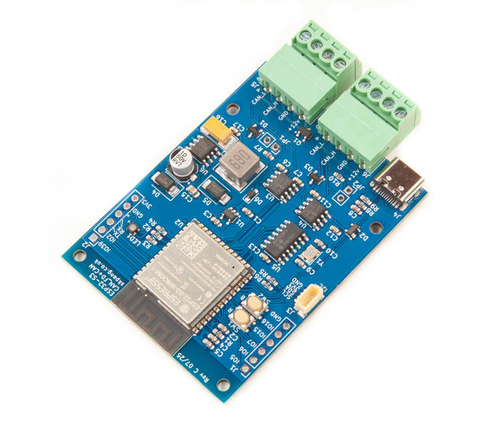 Rather than purchasing a dedicated CAN logger for every new project, developers increasingly prefer programmable hardware that can evolve with their requirements.
The ESP32-S3 CAN development board available from Copperhill Technologies combines:
-
ESP32-S3 processor
-
Classical CAN interface
-
CAN FD interface
-
Wi-Fi
-
Bluetooth Classic
-
Bluetooth Low Energy (BLE)
-
USB-C programming
-
Expansion capabilities for custom applications
This makes it suitable not only as a CAN data logger but also as a CAN gateway, protocol converter, IoT edge device, wireless diagnostic tool, or embedded controller.
Conclusion
Remote CAN monitoring is rapidly becoming the preferred approach for diagnostics, testing, and IoT deployments. By combining Classical CAN, CAN FD, Wi-Fi, and Bluetooth into a single programmable platform, the ESP32-S3 enables engineers to build solutions that are significantly more flexible than traditional USB-connected CAN interfaces.
Whether the goal is streaming live CAN traffic over Wi-Fi, logging CAN FD data to local storage, communicating with a smartphone over BLE, or forwarding diagnostic information to a cloud server, a single embedded platform can perform all of these tasks simultaneously.
For developers working with modern embedded systems, this combination of real-time CAN communications and wireless connectivity opens the door to an entirely new generation of intelligent, remote CAN applications.
 Getting Started with Bluetooth Low Energy: Tools and Techniques for Low-Power Networking
With Bluetooth Low Energy (BLE), smart devices are becoming more connected, efficient, and intelligent than ever before. This practical guide shows software developers how to build mobile applications that seamlessly communicate with BLE-enabled hardware, while helping hardware engineers integrate reliable wireless connectivity into their embedded designs. Whether you're developing IoT devices, wearable technology, industrial equipment, or consumer products, this book provides the knowledge needed to bridge the gap between embedded systems and today's mobile platforms.
The book offers a comprehensive yet accessible overview of Bluetooth Low Energy, explaining not only how BLE devices communicate, but also why the technology has become the wireless standard for battery-powered applications. Through practical examples and hands-on projects, you'll learn how to use affordable development and testing tools while creating BLE applications for iOS, Android, and popular embedded platforms.
Inside the Book
-
Gain a thorough understanding of the Bluetooth Low Energy architecture and communication model.
-
Learn how BLE organizes, advertises, and transfers data between connected devices.
-
Explore BLE concepts, capabilities, limitations, and network topology.
-
Understand the complete BLE protocol stack and how its individual layers work together.
-
Discover how BLE devices find each other, pair securely, and establish reliable connections.
-
Set up a complete development environment using inexpensive hardware and software tools.
-
Build BLE applications that communicate with iPhones, iPads, Android devices, sensors, and embedded controllers.
-
Develop firmware for a complete example project that transmits heart-rate data from an embedded device to a mobile application.
Ideal for embedded developers, hardware engineers, mobile application programmers, and IoT designers, this book provides the practical knowledge required to develop reliable Bluetooth Low Energy applications—from the fundamentals to real-world implementations. More information...