 Loading... Please wait...

Recent Posts
Teensy 4.1 Triple CAN Bus Board with Ethernet and LCD – High-Performance Multi-CAN IoT Gateway Controller
Posted by on
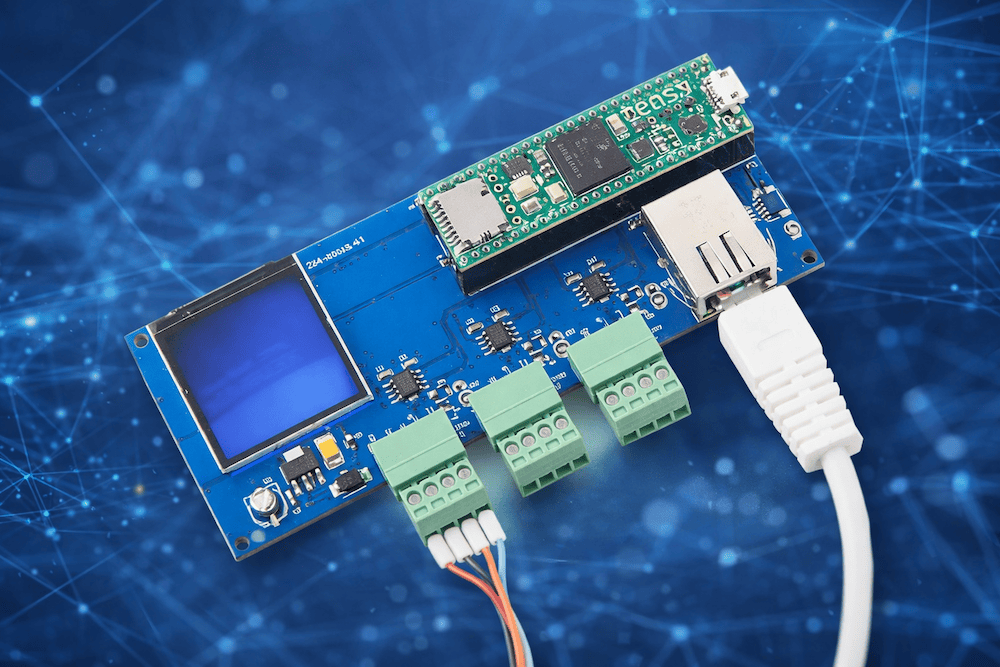 Modern embedded systems increasingly demand more than a single network interface. Industrial automation, vehicle integration, marine electronics, energy systems, and IoT gateways often require simultaneous access to multiple CAN networks while also maintaining Ethernet connectivity for cloud access, remote diagnostics, or data logging. The Teensy 4.1 Triple CAN Bus Board with integrated 240x240 LCD and Ethernet was designed precisely for these advanced, multi-network applications.
This board combines the extraordinary performance of the Teensy microcontroller platform with three independent CAN channels, Ethernet capability, and a built-in high-resolution LCD display — delivering a compact yet powerful solution for professional developers and system integrators.
Understanding the Teensy Microcontroller Series
The Teensy series is known for delivering desktop-class performance in a compact microcontroller format. Developed for engineers who demand both speed and flexibility, Teensy boards provide:
- Extremely high clock speeds
- Advanced 32-bit ARM Cortex-M processors
- Large memory resources
- Real-time performance capabilities
- Extensive peripheral interfaces
The Teensy 4.1, at the heart of this Triple CAN board, is based on a 600 MHz ARM Cortex-M7 processor. This level of performance allows it to handle complex communication stacks, real-time control algorithms, data filtering, encryption, and network protocol processing simultaneously — without compromising determinism.
Unlike many typical microcontroller platforms, Teensy boards are capable of bridging the gap between embedded control and higher-level data processing. This makes them ideal for gateway applications, protocol conversion, and edge intelligence tasks.
Why Triple CAN Matters
Controller Area Network (CAN) remains the backbone of reliable, real-time communication in:
- Automotive systems
- Heavy equipment
- Agricultural machinery
- Marine electronics
- Industrial automation
- Energy storage and battery systems
However, modern systems rarely operate on a single CAN network. Increasingly, engineers must work with multiple independent CAN domains, such as:
- Powertrain CAN
- Body control CAN
- Diagnostic CAN
- Battery management CAN
- Safety or redundant CAN
Triple CAN capability allows a single embedded controller to:
- Monitor multiple networks simultaneously
- Bridge messages between networks
- Perform filtering and security validation
- Translate between different CAN baud rates
- Implement isolation strategies
- Log traffic independently per bus
This is particularly useful in fleet retrofits, advanced diagnostics, telematics modules, or research and development environments where engineers must observe and interact with multiple CAN segments concurrently.
The Role of Ethernet in Modern Embedded Systems
Ethernet transforms a CAN-based controller into a connected system node.
By integrating Ethernet alongside triple CAN, this board enables:
- IoT gateway functionality
- Cloud connectivity
- Remote firmware updates
- Web-based diagnostics interfaces
- Data streaming to backend servers
- Remote configuration and monitoring
- Integration into enterprise networks
In industrial IoT (IIoT) environments, CAN networks often operate at the machine level, while Ethernet connects systems to plant infrastructure or the cloud. This board acts as a high-speed bridge between deterministic fieldbus communication and TCP/IP-based networking.
For example:
A battery energy storage system may use multiple CAN networks internally (battery modules, inverter control, thermal management), while Ethernet is required for SCADA integration or remote monitoring.
An agricultural machine may operate separate CAN buses for engine and implement control, while Ethernet provides telemetry to fleet management platforms.
A laboratory test bench may require simultaneous CAN logging from multiple devices, with Ethernet transferring captured data to a remote workstation.
Integrated 240x240 LCD for Standalone Operation
The built-in 240x240 LCD adds another dimension: immediate local interaction.
With an integrated display, developers can implement:
- Live CAN traffic visualization
- System status dashboards
- Diagnostic message displays
- Configuration menus
- Error logging views
- Field service interfaces
This eliminates the need for an external HMI in many applications. The system can function as a self-contained controller, diagnostic tool, or network monitor without requiring a connected PC.
For field engineers, service technicians, and R&D environments, this dramatically improves usability.
Ideal Applications
The combination of triple CAN, Ethernet, and high-performance processing makes this board particularly suited for:
IoT Gateways
Bridging industrial CAN networks to cloud-based analytics platforms.
Protocol Converters
Translating CAN traffic into Modbus TCP, MQTT, HTTP, or custom Ethernet protocols.
Automotive and EV Development
Monitoring multiple vehicle CAN networks while streaming data to a development workstation.
Fleet Telematics
Capturing data from multiple onboard CAN networks and transmitting summaries over Ethernet or external gateways.
Industrial Automation Controllers
Acting as supervisory controllers across segmented CAN subsystems with centralized Ethernet reporting.
Energy Storage and Power Systems
Integrating battery management systems, inverter CAN networks, and Ethernet-based energy management systems.
Marine and Off-Highway Equipment
Managing redundant CAN networks while maintaining external connectivity.
Research and Development Platforms
High-speed data acquisition and real-time analysis across multiple CAN domains.
Engineering Advantages
High-speed 600 MHz processing for complex filtering and bridging
- Multiple independent CAN interfaces
- Ethernet for TCP/IP networking
- Integrated display for standalone operation
- Compact footprint
- Professional-grade hardware design
- Suitable for both prototyping and production
A True Edge Intelligence Platform
The convergence of CAN networking and Ethernet connectivity defines modern embedded systems. Data must move reliably within machines while also being accessible externally for monitoring, analytics, and predictive maintenance.
The Teensy 4.1 Triple CAN Bus Board with 240x240 LCD and Ethernet is not merely an interface board — it is a complete edge processing platform. It allows engineers to design systems that:
- Observe
- Decide
- Filter
- Secure
- Bridge
- Report
All in real time.
For engineers building next-generation connected systems, this board delivers the performance, connectivity, and flexibility required to move beyond simple embedded control and into intelligent networked solutions. More information...
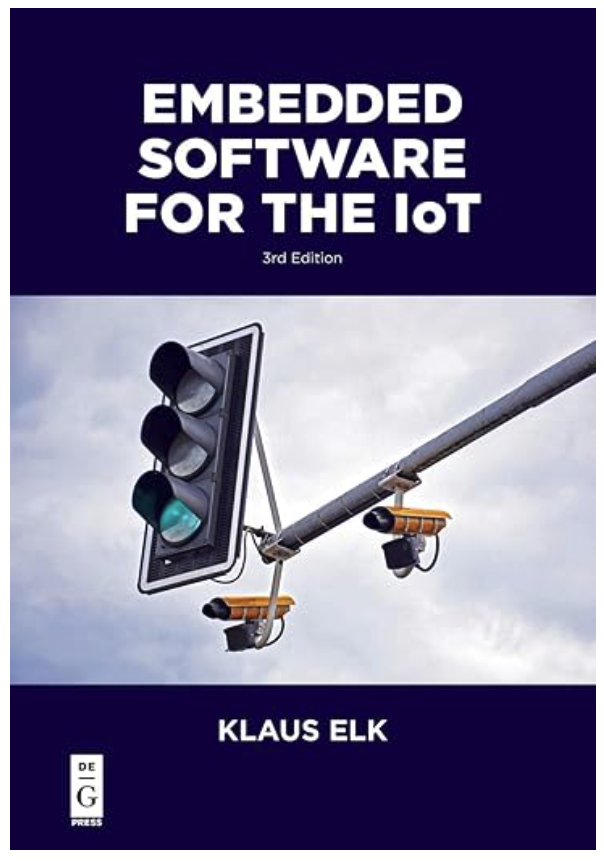 Embedded Software for the Internet of Things
Even the most conservative projections confirm that the Internet of Things (IoT) represents one of the largest and fastest-growing technology markets of our time. Innovation is not optional in this space — it is essential. As billions of devices become connected, the demand for skilled programmers who understand both software and hardware integration continues to rise dramatically.
The challenge is that IoT development spans multiple knowledge domains. Success requires more than writing application code. Developers must understand embedded hardware, real-time constraints, networking protocols, security architectures, data processing, and system reliability. This book equips programmers with the foundational knowledge required to thrive in this multidisciplinary environment.
Embedded Software for the IoT provides a practical and structured introduction to embedded programming within connected systems. It explains the underlying technologies that power IoT devices and clarifies how hardware and software interact in real-world applications. Readers gain a clear understanding of IoT architectures, system design parameters, and best practices in coding, version control, and defect tracking — all essential for building robust, maintainable, and scalable connected systems.
The book begins with a concise overview of the evolution of the Internet and the World Wide Web, providing historical context for today’s connected ecosystem. It then introduces modern CPU architectures and operating systems commonly used in embedded environments, establishing the technical foundation necessary for advanced topics.
From there, the discussion moves into key IoT domains, including:
- Wired and wireless networking
- Digital signal processing and filtering
- Security in embedded and networked systems
- Statistical process control and Industry 4.0 concepts
By combining theoretical grounding with practical insight, this book bridges the gap between traditional software development and embedded engineering.
Embedded Software for the IoT is ideal for software developers transitioning into embedded systems as well as experienced embedded engineers seeking a broader understanding of modern connected architectures. It enables readers to build reliable, secure, and scalable IoT solutions — and to reach their full potential in one of the most dynamic technology fields today. More information...