 Loading... Please wait...

Blog
Recent Posts
Raspberry Pi and PiCAN-M in Marine NMEA 2000 Systems: Power Supply Considerations
Posted by on
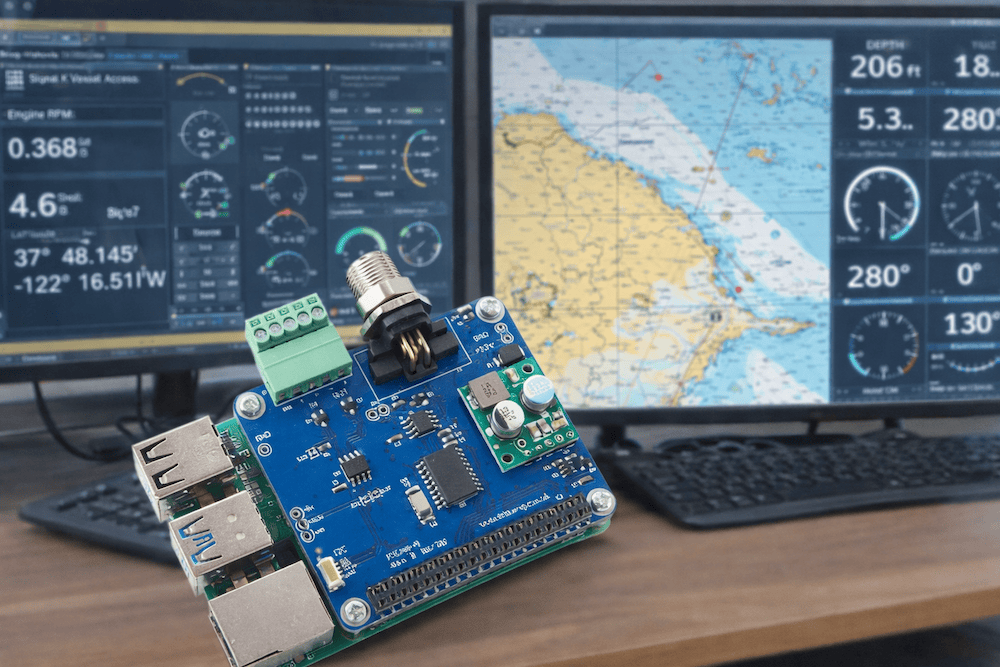 Single-board computers based on the Raspberry Pi have become common building blocks in modern marine electronics. When combined with PiCAN-M, they are frequently used as onboard data gateways for applications such as Signal K and OpenPlotter, translating NMEA 2000 traffic into IP-based data streams, dashboards, and logs.
In practice, most field issues reported in these systems are not related to CAN communication itself, but to power budgeting and power stability, especially when the Raspberry Pi is powered directly from the NMEA 2000 backbone.
This article explains how Raspberry Pi power requirements differ across versions 3, 4, and 5, how those requirements interact with the NMEA 2000 power model, and how the PiCAN-M variants with and without onboard SMPS should be used in each case.
NMEA 2000 Power Model in Brief
NMEA 2000 is designed around a shared network power concept. Devices are powered from the backbone and are budgeted using Load Equivalency Numbers (LEN), where 1 LEN corresponds to 50 mA at nominal network voltage.
In real installations, the following assumptions are common:
-
Backbone power is nominally 12 VDC (with an allowed operating range).
-
Total backbone current is typically limited to about 3 A by cabling, fusing, and installation practice.
-
Devices drawing more than approximately 1 A equivalent are normally expected to be powered separately, even if they remain connected to the network for data.
This model works very well for sensors, displays, gateways, and control units that draw modest and predictable current. It is not well suited to powering general-purpose computers.
Raspberry Pi Power Requirements by Generation
The Raspberry Pi family spans multiple performance classes. While they share a 5 V input requirement, their current demand and transient behavior differ significantly.
Raspberry Pi 3
Raspberry Pi 3 models are specified for a 5 V supply rated at approximately 2.5 A.
In marine gateway applications (Signal K, OpenPlotter, logging, light dashboards), the Pi 3 typically operates comfortably within this envelope. Peak current events exist, but they are relatively modest.
From a power perspective, the Raspberry Pi 3 is generally compatible with small, well-designed DC/DC converters.
Raspberry Pi 4
Raspberry Pi 4 models increase CPU performance, memory bandwidth, and I/O capability. The recommended supply rating increases to 5 V at 3 A.
In steady operation, a Pi 4 used as a marine gateway often runs below this limit, but transient peaks become more significant, particularly during:
-
boot
-
CPU bursts
-
Wi-Fi activity
-
SD card writes
This places the Pi 4 at the upper edge of what a 5 V / 3 A rail can reliably support.
Raspberry Pi 5
Raspberry Pi 5 represents a major architectural jump. It is specified for a 5 V supply rated up to 5 A.
Even when no USB SSDs or high-power peripherals are attached, the Pi 5 can draw substantially more current than previous generations due to higher CPU performance, I/O bandwidth, and power management behavior.
A 5 V / 3 A supply is sufficient only in a restricted mode and leaves little margin for transient load events.
From a marine power-distribution perspective, Raspberry Pi 5 must be treated as a computer-class load, not as a typical embedded device.
Translating 5 V Raspberry Pi Loads to NMEA 2000 Backbone Current
When a Raspberry Pi is powered from the NMEA 2000 backbone, the 12 V network power must be converted to 5 V using a switch-mode power supply (SMPS).
This conversion matters.
Approximate power relationships:
-
Raspberry Pi 3:
5 V × 2.5 A ≈ 12.5 W → roughly 1.1–1.3 A from the 12 V side -
Raspberry Pi 4:
5 V × 3 A ≈ 15 W → roughly 1.4–1.6 A from the 12 V side -
Raspberry Pi 5:
5 V × 5 A ≈ 25 W → roughly 2.3–2.7 A from the 12 V side
These values assume reasonable SMPS efficiency and do not include additional margin for transient load spikes.
In a network commonly constrained to about 3 A total, a Raspberry Pi 5 alone can consume most of the entire backbone power budget.
PiCAN-M Variants and Power Behavior
The PiCAN-M by Copperhill Technologies is a compact and robust CAN bus interface designed specifically for Raspberry Pi systems used in marine and industrial applications. It provides a direct hardware connection to NMEA 2000 and other CAN-based networks, enabling reliable reception and transmission of CAN frames for software platforms such as Signal K and OpenPlotter. PiCAN-M integrates seamlessly with the Raspberry Pi ecosystem, offering stable CAN communication, galvanic isolation options depending on variant, and versions with or without an onboard 12 V to 5 V switch-mode power supply, allowing flexible integration into a wide range of power architectures. Designed with real-world installations in mind, PiCAN-M is widely used as a dependable gateway between modern IP-based systems and CAN-based marine networks.
The PiCAN-M is available in variants with and without an onboard SMPS.
PiCAN-M with onboard SMPS (NMEA-powered)
This variant includes a 12 V → 5 V switch-mode power supply rated for 5 V at 3 A. The SMPS draws its input power directly from the NMEA 2000 network.
Behavior by Raspberry Pi version:
-
Raspberry Pi 3
Generally suitable. The SMPS provides adequate current, and the resulting backbone load is usually acceptable in lightly to moderately loaded networks. -
Raspberry Pi 4
Typically functional but operating at the limit. System stability depends heavily on backbone wiring quality, total network load, and transient behavior. Marginal installations may exhibit occasional undervoltage symptoms. -
Raspberry Pi 5
Not suitable. The 5 V / 3 A limit is below the Pi 5’s specified requirement, and the corresponding 12 V backbone current approaches or exceeds what many networks can reliably supply. Undervoltage warnings, reboots, or intermittent behavior should be expected.
PiCAN-M without onboard SMPS (externally powered Raspberry Pi)
In this configuration, the Raspberry Pi is powered independently, and PiCAN-M interfaces only to the CAN bus.
Behavior by Raspberry Pi version:
-
Raspberry Pi 3
Fully supported with a dedicated 5 V / 2.5 A supply or equivalent DC/DC converter. -
Raspberry Pi 4
Fully supported with a dedicated 5 V / 3 A supply. -
Raspberry Pi 5
Strongly recommended approach. A dedicated 5 V / 5 A-class supply provides the required headroom and isolates the NMEA 2000 network from computer-class power demand.
This configuration aligns best with NMEA 2000 power-budget assumptions and results in the highest system reliability.
Typical Failure Patterns Caused by Marginal Power
When Raspberry Pi power is undersized or drawn from an overstressed backbone, the symptoms are often indirect:
-
spontaneous reboots under load
-
SD card filesystem corruption over time
-
intermittent disappearance of NMEA 2000 devices
-
unstable Wi-Fi or delayed startup
-
undervoltage warnings logged by the operating system
These issues are frequently misattributed to software or CAN communication problems, when the root cause is power integrity.
Practical Guidance for Marine Installations
-
Raspberry Pi 3 and Raspberry Pi 4 can be used with PiCAN-M SMPS variants in suitable networks, provided total backbone load is well understood.
-
Raspberry Pi 5 should be powered from a dedicated supply and not from NMEA 2000 backbone power.
-
Treat NMEA 2000 power as a network-device resource, not as a general 5 V power rail.
-
Separating computing loads from network power improves stability, simplifies troubleshooting, and aligns with established marine installation practice.
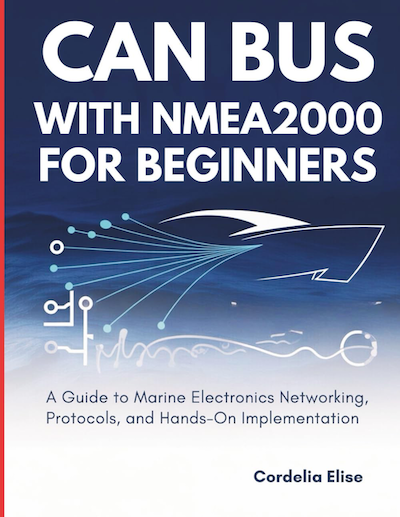 CAN Bus with NMEA 2000 for Beginners: A Guide to Marine Electronics Networking, Protocols, and Hands-On Implementation
Modern marine electronics rely on NMEA 2000, a standardized CAN-based network that allows engines, sensors, displays, navigation systems, and monitoring devices to communicate over a single, shared backbone. Instead of point-to-point wiring, NMEA 2000 uses a robust two-wire CAN bus to distribute data efficiently and reliably across the vessel. While powerful and flexible, this technology often appears intimidating due to unfamiliar terminology, strict wiring rules, and a lack of clear beginner-level explanations.
Many boat owners, technicians, and engineers struggle to understand how CAN Bus and NMEA 2000 systems actually work in practice. Confusing diagrams, fragmented documentation, and overly theoretical explanations make it difficult to build or troubleshoot a network with confidence. That is exactly why First Steps in CAN Bus with NMEA 2000 was written. This book provides a beginner-friendly yet technically accurate path to understanding, designing, and maintaining NMEA 2000 networks without requiring prior CAN experience.
Whether you are new to marine electronics or looking to strengthen your foundation before moving on to advanced configurations, this guide walks you through every critical concept step by step. It explains how CAN communication works, how NMEA 2000 builds on it, and how real devices share data on the network. Rather than acting as a dry reference manual, the book emphasizes practical understanding through real-world examples, clear diagrams, and straightforward explanations.
Inside the book, you will learn how to design a stable network using correct cabling and termination practices, manage power and grounding to avoid common failures, understand PGNs and data flow, and safely integrate displays, sensors, GPS units, and engine gateways. Dedicated chapters focus on troubleshooting and testing, showing how to diagnose voltage issues, communication errors, and network load problems using practical methods that reflect real installations.
Written with field-tested experience and a clear, professional voice, First Steps in CAN Bus with NMEA 2000 turns a complex marine communication standard into something practical and approachable. It gives you the knowledge and confidence to design, install, and maintain reliable NMEA 2000 networks, helping your systems perform as intended and saving time, frustration, and costly mistakes along the way. More information...
Why the PiCAN-M with SMPS Cannot Power Raspberry Pi 5 — and the Simple Workaround
The PiCAN-M HAT from Copperhill Technologies is a specialized interface developed exclusively for marine applications and specifically targets NMEA 2000 networks. NMEA 2000 is the standard backbone for modern marine electronics, used to interconnect engines, chart plotters, sensors, and onboard monitoring systems. In its standard version without SMPS, the PiCAN-M HAT is powered directly from [...]
How to Wire NMEA 2000 with the PICAN-M Raspberry Pi HAT and Power It Using the Onboard SMPS
The PICAN-M is a marine-grade Raspberry Pi HAT that brings both NMEA 0183 and NMEA 2000 connectivity to your Pi, with the added convenience of an onboard 3 A SMPS (Switch-Mode Power Supply) for powering the Pi itself. This makes it ideal for embedded marine systems using platforms like OpenPlotter or Signal K. In this [...]
Exploring Copperhill Technologies' NMEA 2000 PICAN-M HATs for Raspberry Pi
Copperhill Technologies has established itself as a prominent supplier of embedded systems and hardware solutions for applications in industrial, automotive, and maritime domains. Among its innovative offerings is the NMEA 2000 PICAN-M HAT, a Hardware Attached on Top (HAT) module designed specifically for the Raspberry Pi platform. This HAT is tailored to support NMEA 2000 [...]
Testing NMEA 0183 For The PICAN-M - NMEA 0183 & NMEA 2000 HAT For Raspberry Pi
PICAN-M - NMEA 0183 & NMEA 2000 HAT For Raspberry Pi Our PICAN-M (M = Marine) is a Raspberry Pi HAT with NMEA 0183 and NMEA 2000 connection. The NMEA 0183 (RS422) port is accessible via a 5-way screw terminal. The NMEA 2000 port is accessible via a Micro-C connector. The board comes with a 3A SMPS [...]
Programmable Maritime Application System Based on Raspberry Pi Supports NMEA 2000 Functionality
NMEA 2000 is a marine networking standard created and administered by the National Marine Electronics Association (NMEA). The NMEA is an association of marine electronics manufacturers, dealers, and technicians. The NMEA 2000 standard describes a low-cost, moderate capacity, bi-directional, multi-transmitter, multi-receiver instrument network. Typical data on a network using this standard include: Position latitude and longitude. GPS status. Steering [...]
NMEA 2000 Powered Computer System With Raspberry Pi 4, NMEA 2000 HAT, Pre-Installed OpenPlotter And Signal K
Copperhill Technologies offers various NMEA 2000 compatible embedded systems, including HATs for the Raspberry Pi and the Arduino-compatible line of Teensy modules. The NMEA 2000 standard defines a low-cost, modest capacity, bi-directional, multi-transmitter, multi-receiver instrument network. The hardware layer utilizes the CAN (Controller Area Network) technology. Typical data on an NMEA 2000 network include: Position latitude and longitude GPS [...]