 Loading... Please wait...

Blog
Recent Posts
How to Build a Raspberry Pi CAN-to-Ethernet Gateway
Posted by on
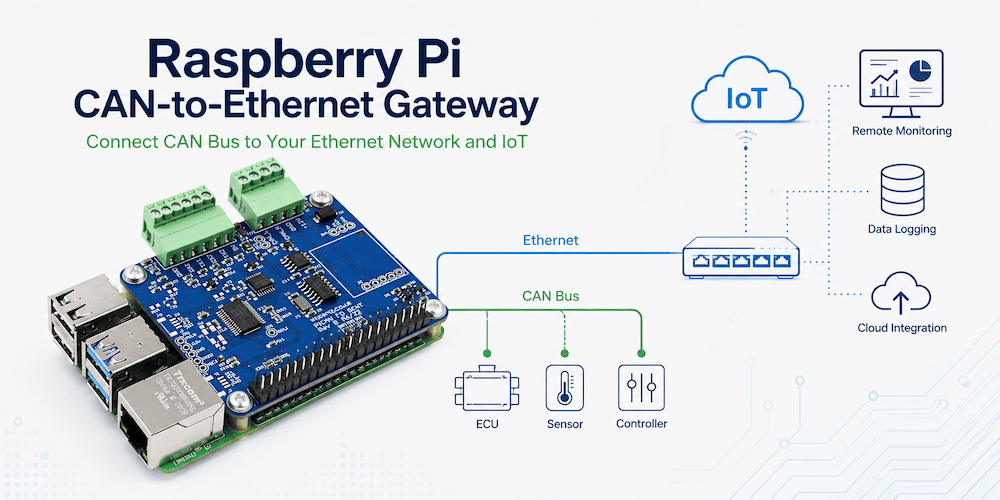 The Controller Area Network (CAN) remains one of the most reliable communication technologies in embedded systems, industrial automation, commercial vehicles, marine electronics, and robotics. At the same time, Ethernet has become the preferred medium for connecting systems over long distances, integrating with cloud services, and providing remote access.
Bridging these two worlds is a common requirement in modern applications. Whether you need to monitor CAN traffic from a remote workstation, connect multiple CAN networks across a building, or collect data for Industrial IoT applications, a Raspberry Pi equipped with a PiCAN interface provides an inexpensive yet remarkably powerful CAN-to-Ethernet gateway.
In this article, we'll examine the concept, implementation, and practical applications of a Raspberry Pi CAN-to-Ethernet gateway and explain why the PiCAN product family from Copperhill Technologies is an excellent foundation for such projects.
Why Bridge CAN and Ethernet?
CAN Bus was designed for deterministic, real-time communication between electronic control units (ECUs). Ethernet, on the other hand, excels at transporting data over large networks and integrating with existing IT infrastructure.
A gateway allows both networks to perform what they do best.
Typical reasons include:
-
Remote CAN Bus monitoring
-
Data logging over a LAN
-
Industrial IoT connectivity
-
Cloud integration
-
Remote diagnostics
-
Multi-building machine monitoring
-
Vehicle fleet data collection
-
Marine electronics networking
-
CAN network simulation and testing
Instead of connecting a PC directly to the CAN Bus with a USB adapter, the Raspberry Pi becomes an intelligent network appliance that can be installed anywhere Ethernet is available.
Basic Gateway Architecture
A typical installation looks like this:
           Ethernet Network
                  |
          +----------------+
          | Raspberry Pi   |
          |                |
          | SocketCAN      |
          | Gateway App    |
          +----------------+
                  |
             PiCAN HAT
                  |
             CAN Bus Network
                  |
      ECUs • Sensors • Controllers
The Raspberry Pi continuously exchanges CAN messages with the field network while communicating with remote computers over Ethernet using TCP/IP, UDP, MQTT, HTTP, WebSockets, or custom protocols.
Unlike a simple USB-CAN adapter, the Raspberry Pi can preprocess, filter, timestamp, log, or even modify traffic before forwarding it.
Why Raspberry Pi?
The Raspberry Pi has become one of the most popular embedded Linux platforms available.
Advantages include:
-
Quad-core processor
-
Built-in Ethernet
-
Linux operating system
-
Gigabytes of RAM
-
Massive software ecosystem
-
Low power consumption
-
Excellent reliability
-
Very affordable
Because Raspberry Pi runs Linux, developers gain access to powerful networking tools that are difficult to implement on traditional microcontrollers.
Enter the PiCAN Product Family
 Copperhill Technologies offers the PiCAN series of Raspberry Pi CAN interface boards specifically designed for professional CAN development and deployment. The PiCAN family supports SocketCAN, the standard Linux CAN networking framework, allowing CAN interfaces to appear just like network interfaces under Linux.
The product line includes numerous options to match different applications:
-
Classical CAN
-
CAN FD
-
Single-channel interfaces
-
Dual-channel interfaces
-
GPS-equipped versions
-
Real-Time Clock (RTC)
-
Isolated models
-
NMEA 2000 interfaces
-
LIN Bus support on selected models
This flexibility allows developers to build anything from a simple CAN monitor to sophisticated industrial gateways.
SocketCAN Makes Everything Easy
One of Linux's greatest strengths is SocketCAN.
Instead of using proprietary APIs, CAN interfaces become standard Linux network devices.
Typical commands include:
ip link set can0 up type can bitrate 500000
Monitoring traffic:
candump can0
Sending a frame:
cansend can0 123#1122334455667788
Because SocketCAN integrates directly into the Linux networking stack, developers can use numerous existing libraries and applications without writing low-level drivers. Tools such as can-utils, Wireshark, and python-can work seamlessly with PiCAN hardware. (Copperhill Technologies)
Gateway Software Possibilities
Once CAN frames are available through SocketCAN, almost any networking protocol can be used.
Examples include:
TCP Server
The Raspberry Pi accepts TCP client connections and streams CAN frames.
Ideal for:
-
Windows applications
-
Laboratory equipment
-
Custom engineering software
UDP Broadcast
Useful for:
-
Fast monitoring
-
Multiple simultaneous clients
-
Low-overhead communication
MQTT
Excellent for Industry 4.0 applications.
The gateway publishes CAN messages to an MQTT broker where cloud applications, dashboards, or data historians subscribe.
HTTP REST API
Applications can request:
-
Current sensor values
-
Device status
-
Historical information
-
Diagnostics
This is ideal for web dashboards.
WebSockets
Perfect for browser-based CAN monitoring software requiring real-time updates.
Intelligent Data Processing
One advantage of using Linux instead of a small microcontroller is the ability to perform sophisticated processing before transmitting data.
Examples include:
Message Filtering
Only forward selected CAN identifiers.
Example:
-
Engine speed
-
Vehicle speed
-
Oil pressure
instead of the entire network.
Protocol Decoding
Instead of forwarding raw CAN frames:
18F00400
FF 00 5A 01 ...
the gateway can decode them into engineering values:
Engine Speed: 1850 RPM
Oil Pressure: 64 PSI
Coolant Temperature: 91°C
This dramatically reduces processing requirements on client software.
Data Aggregation
Rather than sending thousands of CAN frames every second, the gateway can periodically publish summarized information.
For example:
{
 EngineSpeed: 1852
 FuelRate: 18.6
 VehicleSpeed: 42.8
}
This reduces Ethernet bandwidth while simplifying application development.
Dual CAN Gateway Applications
The PiCAN Duo models open even more possibilities by providing two independent CAN channels.
Applications include:
-
Bridging two CAN networks
-
Protocol translation
-
CAN filtering
-
Baud rate conversion
-
Vehicle network isolation
-
Test bench simulation
A Raspberry Pi can receive messages on one CAN network, process them, and transmit selected information onto another network.
Industrial IoT Applications
Many industrial systems still rely heavily on CAN.
Adding Ethernet connectivity enables:
-
Factory monitoring
-
Predictive maintenance
-
Energy monitoring
-
Equipment diagnostics
-
Cloud dashboards
-
Historical data collection
Because Linux supports databases such as SQLite, PostgreSQL, or InfluxDB, the Raspberry Pi can store extensive historical CAN data before forwarding it elsewhere.
Remote Diagnostics
One particularly useful application is remote troubleshooting.
Instead of sending a technician to the machine:
-
Install Raspberry Pi
-
Connect to CAN Bus
-
Connect Ethernet
-
Access remotely
Authorized users can monitor live CAN traffic, retrieve logs, update software, or diagnose communication issues from virtually anywhere on the network.
Marine Applications
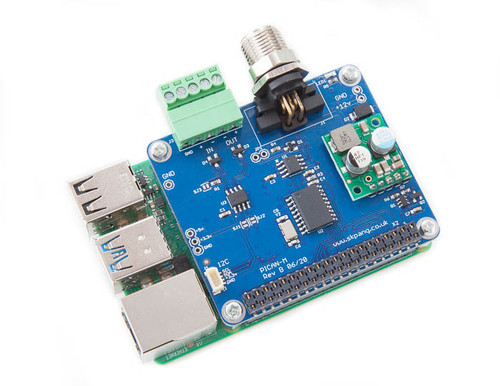 The PiCAN-M models support NMEA 2000, making them suitable for marine applications where vessel data needs to be integrated with onboard Ethernet networks.
Typical applications include:
-
Navigation systems
-
Engine monitoring
-
Fuel management
-
Environmental sensors
-
Remote vessel monitoring
Software Development
Because Raspberry Pi supports multiple programming languages, developers can choose the environment they know best.
Popular choices include:
-
Python
-
C/C++
-
Node.js
-
Go
-
Rust
Combined with SocketCAN, developing a complete CAN gateway often requires surprisingly little code.
Future Expansion
One of the Raspberry Pi's biggest strengths is its flexibility.
A gateway can later be expanded with:
-
GPS positioning
-
Wi-Fi
-
Cellular connectivity
-
Bluetooth
-
Local web server
-
Database logging
-
Secure VPN access
-
Docker containers
-
AI-based analytics
The hardware platform remains the same while software capabilities continue to grow.
Conclusion
A Raspberry Pi equipped with a PiCAN interface offers far more than a simple CAN adapter. It becomes a powerful embedded gateway capable of connecting real-time CAN networks to modern Ethernet infrastructures while leveraging the extensive Linux software ecosystem.
Whether you're building an industrial data logger, a remote diagnostics platform, an automotive development tool, or an IIoT edge device, the combination of Raspberry Pi, SocketCAN, and the PiCAN product family from Copperhill Technologies provides a flexible, scalable, and cost-effective solution. With support for Classical CAN, CAN FD, dual-channel interfaces, GPS, NMEA 2000, and other specialized configurations, the PiCAN lineup allows developers to tailor the hardware to the needs of virtually any CAN-to-Ethernet application.
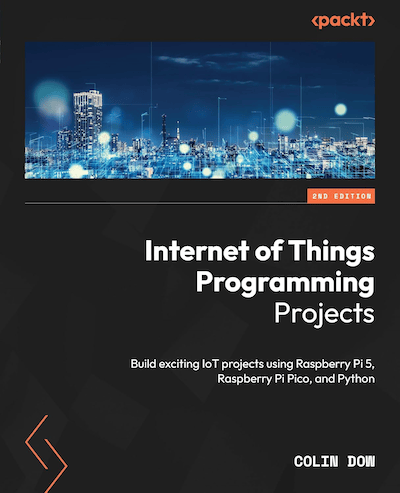 Internet of Things Programming Projects: Build exciting IoT projects using Raspberry Pi 5, Raspberry Pi Pico, and Python
Build practical Internet of Things (IoT) applications ranging from weather stations and information displays to home security systems and an AI-powered vision recognition robot car.
Key Features
-
Learn how to develop real-world IoT applications with Raspberry Pi and Raspberry Pi Pico
-
Explore modern IoT technologies including MQTT, LoRa, LoRaWAN, and the Robot Operating System (ROS)
-
Build increasingly sophisticated projects, culminating in a vision recognition robot car with autonomous capabilities
-
Includes a free PDF eBook with the purchase of the print or Kindle edition
Book Description
The Raspberry Pi has become one of the world's most popular platforms for developing Internet of Things (IoT) applications thanks to its low cost, flexibility, and extensive ecosystem. Whether you're a hobbyist, student, or professional developer, this updated edition of Internet of Things Programming Projects provides a practical, project-based approach to mastering IoT development.
Written by an experienced software engineer, the book begins with the fundamentals before guiding you through progressively more advanced projects. You'll learn how to interface sensors, displays, motors, and wireless communication modules while integrating cloud services and real-time data. Along the way, you'll build projects such as weather indicators, information displays, environmental monitoring systems, home security applications, and an autonomous robot car.
The book introduces powerful technologies including MQTT for messaging, LoRa and LoRaWAN for long-range wireless communication, and the Robot Operating System (ROS) for advanced robotics. Through hands-on examples, you'll discover how to combine hardware and software into reliable, intelligent IoT systems capable of solving real-world problems.
By the end of the book, you'll have the knowledge and confidence to design, build, and expand your own IoT projects using Raspberry Pi, integrating external hardware, cloud connectivity, and modern communication technologies.
What You Will Learn
-
Build connected IoT applications using Raspberry Pi and Raspberry Pi Pico
-
Interface sensors, motors, displays, and other peripherals
-
Integrate web services for real-time data collection, visualization, and analysis
-
Develop a weather indicator using LEDs, servo motors, and environmental sensors
-
Build an autonomous robot car with vision recognition and ROS-based control
-
Create a home security system with real-time alerts and SMS notifications
-
Implement MQTT for reliable IoT messaging
-
Explore LoRa and LoRaWAN for long-range, low-power environmental monitoring
This version improves the SEO by emphasizing high-value search terms such as Raspberry Pi, IoT, MQTT, LoRa, LoRaWAN, ROS, robotics, and vision recognition while making the copy read more naturally and professionally. More information...
Raspberry Pi CAN FD and 10BASE-T1L: Building Industrial IoT and Embedded Networking Solutions
The Raspberry Pi has become one of the world’s most popular embedded computing platforms. It is inexpensive, powerful, runs a full Linux operating system, and supports countless programming languages and development tools. Yet many engineers quickly discover a limitation when they move from software development into real-world industrial applications. The Raspberry Pi provides Ethernet, USB, Wi-Fi, Bluetooth, [...]
Miniature Embedded Cortex-M7 Module for IIot Applications Supports up to Three CAN FD Ports
TQ announced their TQMa117xL system-on-chip (SOC) module to develop space-saving and energy-efficient control systems. The board supports up to three CAN FD interfaces.The module uses the power of the NXP i.MX RT1170 MCU. It comes a compact size of 31 mm x 31 mm (1.2 " x 1.2") and supplies all CPU signals via a total [...]
CAN Bus Bolt Connects Industrial Machinery And Devices to Wireless Networks, WiFi And Bluetooth
HMS Networks introduced its Anybus Wireless Bolt CAN gateway, providing CAN Bus communication via WiFi or Bluetooth. The device builds on the success of Anybus Wireless Bolt, which is applied to wireless Ethernet access. Like its predecessor, the gateway for bolt-on-machine mounting is suitable for heavy-duty machinery and demanding industrial applications. Applications include warehouse installations and AGVs (Automated [...]
CAN Bus Enabled PC For Industrial IoT (IIoT) And Transportation Applications
Portwell launched its Lynx-612B PC, an industrial PC of their Lynx-6000 Industrial IoT (Internet of Things) gateway series based on the Intel Celeron N3350 CPU (formerly Apollo Lake platform). The device is equipped with a two-core CPU, and it is certified by Microsoft Azure IoT, which provides a scalable infrastructure for data, virtual machines, servers, and front-end [...]
RFID Reader Device Supports CANopen, SAE J1939 Data Monitoring And Recording For IoT, IIoT Applications
The Bluebox CX series by iDTRONIC (Germany) represent CAN-Bus-connectible RFID reader devices supporting the CANopen and SAE J1939 higher-layer protocols.The CAN Bus data monitoring and recording is made possible using the CAN Bus connection (CANopen or SAE J1939), RS232/485, or Wiegand interfaces. The CAN Bus also manages the real-time transmission of ongoing processes in automotive, medical technology, or agricultural [...]
Design Concept: Ethernet Controller For Embedded IoT Systems And Automotive Networking
We at Copperhill Technologies have plans to create gateways for automotive networking, which includes serial protocols such as Automotive Ethernet, CAN (Controller Area Network), and LIN (Local Interconnect Network). The following focusses on the Ethernet part of the concept, where Ethernet also applies to Internet-of-Things (IoT) and Industrial-Internet-of-Things (IIoT) applications. The basic idea is to build [...]
COM Express Type 6 Basic Module For Industrial IoT Applications
Axiomtek announced the release of its CEM520, a COM Express Type 6 basic module featuring triple independent displays, industrial operating temperature range, and plenty of possibilities for expansions. The CEM520 utilizes the Intel Xeon E-2176M and 8th generation Intel Core i7/i5/i3 processors (codename: Coffee Lake) with the Intel CM246/QM370/HM370 chipset. The 125 x 95 mm system-on-module [...]
Ecosystem For Securely Connecting Industrial IoT (IIoT) And Automotive Systems To Cellular Networks
STMicroelectronics has designed a complete ecosystem for securely connecting Industrial IoT (IIoT) and automotive systems to cellular networks.Through offering access to networks and services worldwide, ST’s solution serves to simplify connectivity for IIoT applications such as remote condition monitoring and predictive maintenance, as well as connected-driving services such as infotainment, vehicle diagnostics, and emergency assistance.ST [...]
IIoT Gateway Connects Modbus Devices To Cloud-Based Data Logging Solutions
The STRIDE MQTT gateway by AutomationDirect connects industrial Modbus devices to an MQTT (Message Queuing Telemetry Transport) cloud-based data logging system. MQTT is a machine-to-machine IIoT (Industrial Internet of Things) connectivity protocol that renders low power usage, data packets, and distribution of information to single or multiple receivers.The STRIDE MQTT gateway implements a hardware setup to add Modbus RTU/TCP [...]