 Loading... Please wait...

Blog
Recent Posts
CAN, SAE J1939, and NMEA 2000 Development with Raspberry Pi and PiCAN HATs
Posted by on
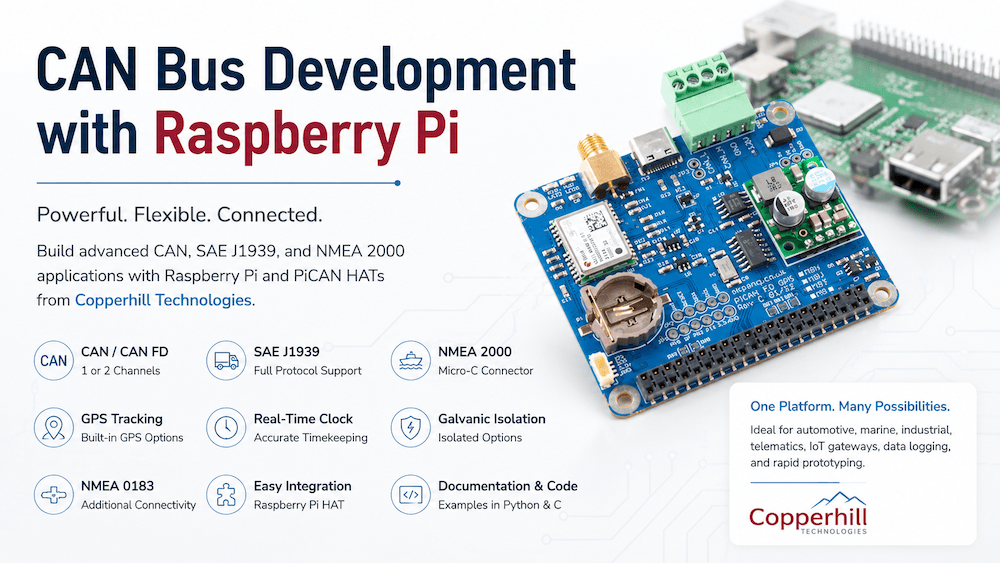 The Raspberry Pi has evolved far beyond its origins as an educational computer. Today, it serves as a powerful platform for industrial automation, vehicle networking, marine electronics, telematics, data logging, and rapid embedded systems prototyping.
When combined with the PiCAN family of Raspberry Pi HATs available from Copperhill Technologies, the Raspberry Pi becomes a versatile CAN bus development platform capable of supporting projects based on:
- Classical CAN
- SAE J1939
- NMEA 2000
- Industrial CAN applications
- GPS tracking systems
- Remote monitoring and data logging
- IoT gateways
- Vehicle telematics
- Marine navigation systems
Why Raspberry Pi for CAN Development?
The Raspberry Pi offers a unique combination of advantages:
- Low cost
- Linux operating system
- Built-in Ethernet, Wi-Fi, and Bluetooth
- Large developer community
- Extensive software ecosystem
- Support for Python, C/C++, Node.js, and many other languages
Using Linux SocketCAN drivers, CAN interfaces appear as native network devices, making development remarkably straightforward.
For many applications, developers can move from concept to proof-of-concept within hours rather than weeks.
The PiCAN Product Family
Copperhill Technologies offers a range of PiCAN HATs designed to support different CAN-based applications and industries.
Depending on the selected model, features may include:
- Single or dual CAN channels
- CAN FD support
- SAE J1939 compatibility
- NMEA 2000 connectivity
- NMEA 0183 support
- GPS receivers
- Real-Time Clock (RTC)
- Switch-mode power supplies
- Galvanic isolation options
- Screw terminal connections
- DB9 connectors
- Micro-C connectors for NMEA 2000 networks
- I2C expansion ports for additional sensors
This flexibility allows a single Raspberry Pi platform to support a wide variety of development projects.
SAE J1939 Development
SAE J1939 remains the dominant communication protocol in heavy-duty vehicles, construction equipment, agricultural machinery, power generation systems, and many military applications.
A Raspberry Pi equipped with a PiCAN HAT can be used for:
- J1939 data monitoring
- ECU development
- Gateway applications
- Fleet telematics
- Data logging
- Protocol analysis
- Vehicle diagnostics
- Prototype controller development
Using Linux SocketCAN and readily available software libraries, engineers can transmit and receive J1939 messages with minimal setup.
Python-based applications can monitor PGNs, decode parameters, and store vehicle data in local or cloud databases.
NMEA 2000 Development
Since NMEA 2000 is built on CAN technology, the Raspberry Pi provides an excellent foundation for marine electronics projects.
Specialized PiCAN-M HATs provide direct connectivity to NMEA 2000 networks through industry-standard Micro-C connectors while also supporting NMEA 0183 communications. These boards are compatible with popular marine software such as OpenCPN, OpenPlotter, Signal K, and CANBoat.
Typical applications include:
- Marine data logging
- Navigation displays
- Vessel monitoring
- Sensor integration
- Custom dashboards
- Signal K servers
- Remote vessel monitoring
The Raspberry Pi can collect data from chartplotters, engine systems, weather instruments, fuel systems, and navigation sensors while simultaneously providing web-based dashboards and cloud connectivity.
GPS Tracking and Location-Based Applications
Several PiCAN models support GPS integration, enabling developers to combine vehicle or vessel network data with location information.
Applications include:
- Fleet tracking
- Vehicle monitoring
- Route logging
- Asset tracking
- Agricultural equipment monitoring
- Marine navigation systems
Combining CAN data with GPS coordinates creates powerful telematics and analytics solutions without requiring expensive proprietary hardware.
Real-Time Clock (RTC) Support
For data logging and monitoring systems, accurate timestamps are essential.
Many PiCAN models include a Real-Time Clock (RTC), allowing systems to maintain accurate time even when disconnected from the Internet.
Benefits include:
- Reliable event logging
- Accurate fault reporting
- Time synchronization
- Improved data analysis
This feature is especially useful for remote installations, mobile systems, and marine environments.
Galvanic Isolation for Industrial Reliability
In industrial, vehicle, and marine environments, electrical noise and ground loops can create communication problems and potentially damage equipment.
For these applications, galvanically isolated CAN interfaces are often preferred because they separate the CAN network electrically from the Raspberry Pi system while still allowing data communication. Galvanic isolation is widely recognized as an important technique for preventing ground-loop-related issues and improving system robustness.
Typical applications include:
- Industrial automation
- Generator control systems
- Marine electronics
- Heavy-duty vehicle networks
- Long cable installations
Selecting an isolated PiCAN model can significantly improve reliability in harsh environments.
Documentation and Sample Software
One of the major advantages of the PiCAN ecosystem is the availability of documentation and software examples.
Developers have access to:
- Hardware documentation
- Installation guides
- SocketCAN configuration examples
- Python sample programs
- C/C++ examples
- Linux utilities
- Open-source software integration
Programming can be performed using Python or C/C++, and SocketCAN support allows applications to interact with CAN networks using standard Linux tools and libraries. Extensive documentation and sample code help accelerate development and reduce project startup time.
One Platform, Many Projects
Perhaps the greatest advantage of the Raspberry Pi and PiCAN combination is flexibility.
The same hardware platform can serve as:
- A J1939 data logger today
- A CAN gateway tomorrow
- A GPS-based tracking system next month
- An NMEA 2000 monitoring system next season
Instead of investing in multiple dedicated devices, developers can build a wide range of CAN-based applications using a common hardware and software foundation.
Final Thoughts
Whether your focus is automotive, heavy-duty vehicles, industrial automation, marine electronics, or IoT connectivity, the Raspberry Pi combined with Copperhill Technologies' PiCAN HAT family provides a powerful and cost-effective development platform.
With support for CAN, SAE J1939, and NMEA 2000 networks, optional GPS and RTC functionality, galvanic isolation options, extensive documentation, and ready-to-run sample code, developers can quickly move from concept to working prototype while leveraging the flexibility of Linux and the Raspberry Pi ecosystem. More information...
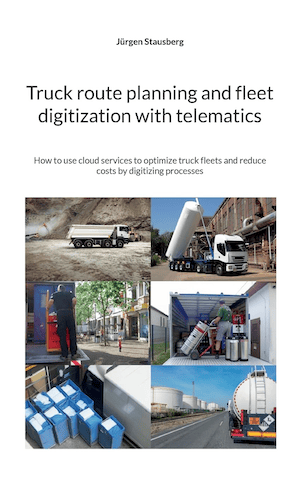 Truck route planning and fleet digitization with telematics
This book demonstrates how digitizing your vehicle fleet can drive significant efficiency gains across a wide range of industries, including bakery distribution, construction logistics, brewing, vehicle transport, fresh food delivery, beverage and food wholesale, oil distribution, milling, recycling, plumbing supplies, and textile services.
The primary focus is on practical methods for route optimization and the accurate calculation of transportation costs, both per transport unit and for each individual customer stop. Drawing on many years of hands-on experience, Dr. Jürgen Stausberg explains how organizations can successfully implement digital transformation initiatives and effectively communicate the resulting changes to dispatchers, controllers, planners, and drivers. His insights help bridge the gap between technology and day-to-day operations, ensuring that digitization delivers measurable business value. More information...