Loading... Please wait...



)

Product Description
Free Shipping Within the United States!
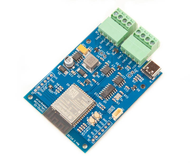
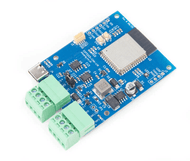
This product consists of two stacked boards. The base board is built around an ESP32-S3-WROOM-1-N8R8 module featuring Bluetooth, Wi-Fi, and an integrated CAN transceiver. It includes an onboard RGB LED, boot and reset buttons, and is programmed via a USB-C interface.
The top board is designed for NMEA 2000 device simulation and features two potentiometers, two push buttons, and four indicator LEDs. By default, the device simulates temperature data on PGN 130316, adjustable via potentiometer P1, and humidity data on PGN 130313, adjustable via potentiometer P2. All simulation functions, including PGN assignments and control behavior, can be reprogrammed through firmware to support custom applications.
- ESP32-S3 series of SoCs embedded, Xtensa® dual-core 32-bit LX7 microprocessor (with single precision FPU), up to 240 MHz
- 8MB Quad SPI flash
- 8MB PSRAM
- Bluetooth LE, Bluetooth 5 and Bluetooth mesh
- Wifi 802.11b/g/n
- On-board PCB antenna
- Programming via USB-C connector
- Boot and Reset push button
- CAN transceiver
- I2C connector for sensors
- Supply voltage : 7VDC to 24VDC SMPS module with reverse polarity protection
- RGB LED
- Top board:
- 2x potentiometer
- 2x push button
- 4x LED
Simulation
PGN 130316 is used to simulate temperature data on the NMEA 2000 network. In the default firmware configuration, temperature values are generated by the device and adjusted in real time using potentiometer P1 on the top board. This allows controlled variation of the transmitted temperature parameter for testing and demonstration purposes. The associated behavior, scaling, and update rate can be modified through firmware reprogramming to support alternative temperature-related simulations or custom PGN payloads.
PGN 130313 is used to simulate humidity data on the NMEA 2000 network. In the default configuration, humidity values are adjusted using potentiometer P2, enabling precise manual control of the transmitted data. As with the temperature simulation, the firmware is fully reprogrammable, allowing PGN 130313 to be repurposed, reassigned, or replaced with other environmental or sensor-related PGNs as required by the application.
DocumentsAdditional Resources
 Advanced Marine Electrics and Electronics Troubleshooting
Whether you are a marine electronics professional or a boat owner, Advanced Marine Electrics and Electronics Troubleshooting helps you understand the new, more powerful methods of troubleshooting marine electrical and electronic systems.
A modern boat’s sophisticated installations and networked electronics can stretch the traditional diagnostic methods based on trouble lights and multimeters past their useful limits.
This book will show you how to:
- Use microprocessor-based diagnostic tools and techniques from the automotive and communications sectors, adapted for boats for the first time
- Diagnose the most difficult AC and DC problems
- Protect communications and navigation electronics from interference and lightning
- Seek out and eliminate stray-current sources and galvanic corrosion