 Loading... Please wait...
Recent Posts
Why the Teensy 4.1 Triple CAN-Bus Board with Ethernet Makes an Excellent CAN Data Logger
Posted by on
 Modern vehicles, industrial machines, marine systems, and agricultural equipment generate enormous amounts of CAN bus traffic. Capturing, storing, and analyzing this data is essential for diagnostics, performance monitoring, predictive maintenance, fleet management, and product development.
 While there are many commercial CAN data loggers available, they often suffer from one or more limitations:
- High cost
- Limited customization
- Proprietary software
- Restricted storage capacity
- Limited support for CAN FD
- No integration with custom applications
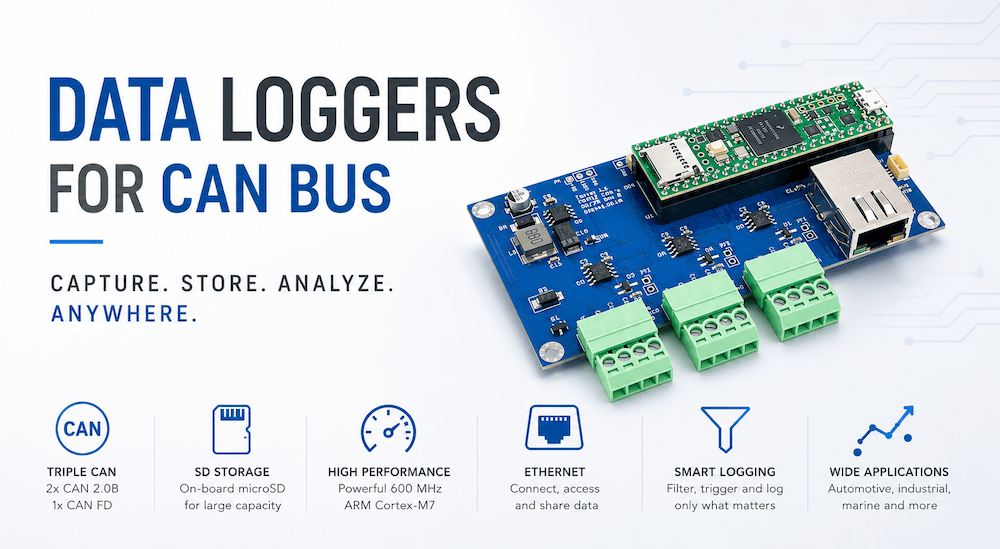
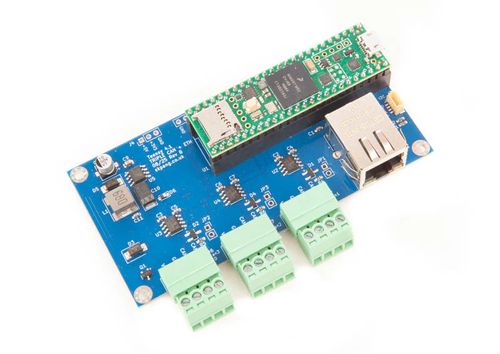
The Teensy 4.1 Triple CAN-Bus Board with Ethernet offers an attractive alternative. Combining a powerful 600 MHz ARM Cortex-M7 processor, multiple CAN interfaces, Ethernet connectivity, and native microSD card support, it provides all the essential building blocks for a professional-grade CAN and CAN FD data logger.
Why Data Logging Matters
CAN data logging is used in a wide range of applications:
Vehicle Development
Engineers record CAN traffic to:
- Analyze ECU behavior
- Verify communication timing
- Monitor sensor values
- Validate software updates
Fleet Monitoring
Fleet operators can collect:
- Engine operating hours
- Fuel consumption
- Driver behavior
- Fault codes
- Vehicle utilization statistics
Predictive Maintenance
Continuous logging allows maintenance teams to identify:
- Rising temperatures
- Pressure abnormalities
- Sensor degradation
- Component wear
before failures occur.
Industrial Automation
Manufacturing equipment often uses CAN-based communication networks. Logging helps identify:
- Production bottlenecks
- Controller faults
- Communication errors
- Performance trends
Marine Electronics
NMEA 2000 networks are based on CAN technology. Data logging can capture:
- GPS data
- Engine information
- Fuel consumption
- Navigation parameters
- Environmental measurements
Hardware Features That Make Logging Easy
600 MHz Processing Power
At the heart of the board is the Teensy 4.1 microcontroller based on the NXP i.MX RT1062 ARM Cortex-M7 processor running at 600 MHz. This level of performance is far beyond what is required for simple CAN reception and provides plenty of headroom for advanced processing tasks.
The processor can easily:
- Receive multiple CAN streams simultaneously
- Filter messages
- Decode protocols
- Compress data
- Write to storage
- Serve web interfaces
- Perform cloud communications
all at the same time.
Triple CAN Capability
The board provides:
- Two Classical CAN 2.0B interfaces
- One CAN FD interface
This configuration opens interesting possibilities.
For example:
Simultaneous Logging
Capture data from:
- Vehicle CAN
- Body CAN
- Diagnostic CAN
at the same time.
Gateway Logging
Monitor traffic entering and leaving a gateway.
CAN FD Development
Log modern CAN FD networks while simultaneously monitoring legacy CAN systems.
Multi-Network Vehicles
Many modern machines contain multiple CAN networks operating at different bit rates.
The board allows all of them to be monitored simultaneously.
Native MicroSD Storage
One of the most important requirements of a data logger is storage.
The Teensy 4.1 includes a built-in microSD card interface, allowing virtually unlimited logging capacity depending on the selected card size.
Typical storage options:
| Card Size | Approximate Logging Capacity* |
|---|---|
| 8 GB | Several weeks |
| 32 GB | Several months |
| 128 GB | Years of selected data |
*Actual capacity depends on bus load and logging format.
Advantages include:
- No external storage hardware
- Simple file management
- Easy data transfer to PC
- Low cost storage expansion
CAN FD Support
Many modern systems are migrating from Classical CAN to CAN FD.
CAN FD offers:
- Data payloads up to 64 bytes
- Faster data transfer rates
- Improved efficiency
The dedicated CAN FD interface makes the board suitable for both current and future vehicle platforms.
A logger developed today can continue supporting new vehicle architectures without hardware changes.
Ethernet Connectivity
One feature that distinguishes this board from many competing solutions is the integrated Ethernet interface.
Ethernet enables capabilities beyond traditional data logging.
Remote Access
Access recorded files from another computer on the network.
Live Monitoring
View CAN traffic in real time through a browser-based dashboard.
Cloud Connectivity
Upload selected data to:
- AWS
- Azure
- Google Cloud
- Private servers
Fleet Data Collection
Vehicles can automatically upload logs whenever connected to a local network.
Remote Diagnostics
Technicians can analyze system behavior without physically retrieving SD cards.
Real-Time Protocol Decoding
Rather than recording raw CAN frames, the Teensy has enough processing power to decode higher-level protocols while logging.
Examples include:
SAE J1939
Record:
- Engine speed
- Vehicle speed
- Fuel rate
- Temperatures
- Diagnostic messages
instead of raw CAN frames.
NMEA 2000
Decode:
- GPS position
- Heading
- Wind data
- Tank levels
- Engine parameters
CANopen
Store engineering values rather than raw message traffic.
This significantly reduces post-processing effort.
Smart Logging Strategies
The board's processing power allows implementation of advanced logging methods.
Trigger-Based Logging
Start recording when:
- A fault occurs
- Engine starts
- Speed exceeds a threshold
- Temperature rises above limits
Circular Buffer Logging
Maintain a rolling buffer and save only the data before and after an event.
Selective Logging
Record only specific PGNs, message IDs, or parameters.
Exception Logging
Store data only when values change significantly.
These methods reduce storage requirements while preserving important information.
Example Applications
J1939 Engine Data Logger
Record:
- Engine speed
- Fuel rate
- Coolant temperature
- Oil pressure
- Active fault codes
to an SD card.
NMEA 2000 Voyage Recorder
Store:
- Position
- Speed
- Heading
- Wind
- Engine data
for later analysis.
Fleet Tracking Device
Combine:
- CAN data
- GPS position
- Ethernet uploads
for complete fleet monitoring.
Industrial Machine Recorder
Capture machine operating statistics and fault conditions for maintenance analysis.
Software Development Benefits
The board is fully supported through the Arduino IDE and Teensyduino environment.
Benefits include:
- Fast development
- Extensive libraries
- Familiar programming environment
- Large user community
- Easy integration with existing CAN software
For developers already familiar with Arduino, the learning curve is minimal.
Conclusion
The Teensy 4.1 Triple CAN-Bus Board with Ethernet combines all the key ingredients required for a powerful CAN data logger:
- 600 MHz processing performance
- Two Classical CAN channels
- One CAN FD channel
- Native microSD card storage
- Ethernet connectivity
- Arduino compatibility
- Compact form factor
Whether your application involves J1939, CANopen, NMEA 2000, industrial automation, fleet management, or CAN FD development, the board provides a highly capable and cost-effective platform for building custom data logging solutions.
Unlike many commercial loggers that are fixed-function devices, the Teensy platform allows developers complete control over data collection, filtering, storage, analysis, and network communication. The result is a data logger tailored exactly to the requirements of the application rather than forcing the application to adapt to the logger.
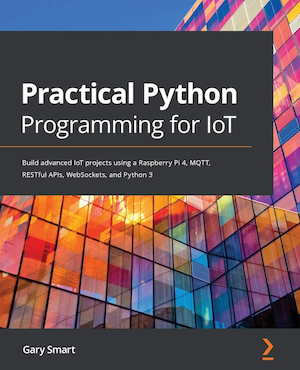 Practical Python Programming for IoT: Build advanced IoT projects using a Raspberry Pi 4, MQTT, RESTful APIs, WebSockets, and Python 3
Build practical Internet of Things (IoT) applications with Python and Raspberry Pi through a series of hands-on projects that combine software, networking, sensors, and electronics. Starting with the fundamentals of Raspberry Pi setup, GPIO interfacing, and electronic circuits, you’ll learn how connected devices communicate using technologies such as REST APIs, WebSockets, and MQTT. Along the way, you’ll create real-world applications ranging from remote LED control and motion detection to smart monitoring and automation systems.
As your skills progress, you’ll integrate sensors, actuators, motors, ultrasonic ranging, and environmental measurements into increasingly sophisticated projects. The book also covers modern Python development techniques, including asynchronous programming and publish/subscribe architectures, while demonstrating integration with IoT platforms and cloud services. By the end, you’ll have the knowledge and practical experience needed to design, build, and deploy your own intelligent IoT solutions using Python and Raspberry Pi. More information…