 Loading... Please wait...

Blog
Recent Posts
When CAN FD Meets Precision Positioning: Building Next-Generation Vehicle Telematics with Raspberry Pi
Posted by on
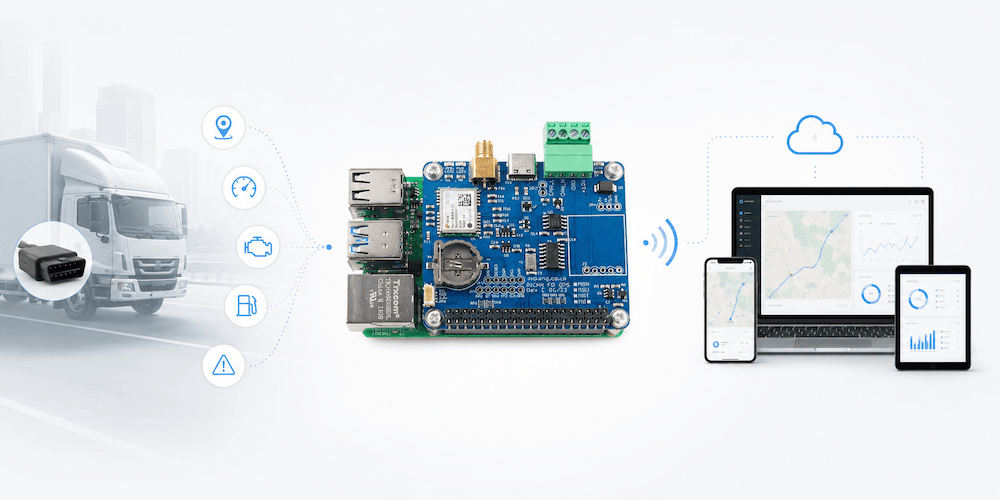 Modern vehicles generate enormous amounts of data. Engine parameters, fuel consumption, battery status, vehicle speed, GPS location, driver behavior, and diagnostic information all play a role in today’s connected transportation systems.
The challenge is not collecting the data—it is collecting the right data reliably, even when GPS signals disappear.
 That is where the PiCAN FD with GPS/GNSS u-blox NEO-M8U Untethered Dead Reckoning board for Raspberry Pi shines. By combining CAN FD connectivity with advanced GNSS positioning and dead-reckoning technology, it provides a powerful platform for telematics, fleet management, autonomous systems, data logging, and vehicle analytics applications.
More Than Just a CAN Interface
At first glance, the board appears to be a CAN FD interface for the Raspberry Pi. However, it is much more than that.
The board combines:
- CAN FD and Classical CAN communication
- High-performance Microchip MCP2518FD CAN controller
- Integrated u-blox NEO-M8U GNSS receiver
- Multi-constellation satellite support
- Built-in accelerometer and gyroscope sensors
- Untethered Dead Reckoning (UDR) technology
- SocketCAN compatibility under Linux
- C and Python programming support
- Raspberry Pi HAT compatibility
The result is a compact platform capable of simultaneously collecting vehicle network data and highly accurate positioning information.
Why Traditional GPS Is Not Enough
Anyone who has used a GPS receiver knows the limitations.
Position information is usually excellent in open areas, but performance deteriorates when vehicles enter:
- Parking garages
- Tunnels
- Urban canyons
- Dense city centers
- Industrial facilities
- Covered loading areas
Traditional GPS receivers often lose their position completely under such conditions.
The u-blox NEO-M8U addresses this problem using Untethered Dead Reckoning (UDR), a technology that combines GNSS data with onboard inertial sensors such as accelerometers and gyroscopes. When satellite reception becomes unavailable, the receiver continues estimating vehicle position using motion data.
For telematics applications, this means fewer gaps in tracking data and significantly improved route accuracy.
Application #1: Fleet Management Systems
Fleet operators depend on accurate vehicle location information.
A Raspberry Pi equipped with the PiCAN FD GPS board can simultaneously:
- Monitor vehicle position
- Collect fuel consumption data
- Record engine hours
- Capture driver behavior
- Monitor fault codes
- Track route efficiency
Because the board can access CAN and CAN FD networks directly, valuable operational data can be combined with location information in a single system.
Examples include:
- Truck fleets
- Municipal vehicles
- Delivery vans
- Construction equipment
- Utility service vehicles
- Agricultural machinery
The integrated dead-reckoning capability helps maintain location awareness even when vehicles enter tunnels, parking structures, or dense urban environments.
Application #2: Usage-Based Insurance (UBI)
Insurance companies increasingly rely on driving behavior analytics.
A vehicle monitoring system based on Raspberry Pi and PiCAN FD can collect:
- Vehicle speed
- Acceleration events
- Harsh braking events
- Cornering behavior
- Trip duration
- Distance traveled
The NEO-M8U’s integrated motion sensors provide additional information that can be used to identify aggressive driving patterns and accident-related events. Similar use cases have been highlighted as key applications for dead-reckoning technology.
Application #3: Commercial Vehicle Telematics
Heavy-duty vehicles already contain a wealth of information on their CAN networks.
For SAE J1939 applications, developers can access data such as:
- Engine speed
- Vehicle speed
- Fuel rate
- Engine temperatures
- Engine load
- Diagnostic trouble codes
- Aftertreatment data
Combining these parameters with accurate GNSS positioning creates a powerful telematics platform suitable for:
- Fleet optimization
- Fuel-efficiency studies
- Driver performance monitoring
- Predictive maintenance
- Regulatory reporting
The Raspberry Pi provides sufficient computing power to analyze and upload this information in real time.
Application #4: Vehicle Data Loggers
Engineers often need to record vehicle data during development and testing.
The PiCAN FD GPS board allows simultaneous recording of:
- CAN traffic
- CAN FD traffic
- GPS coordinates
- Vehicle movement
- Time synchronization information
Potential users include:
- Automotive engineers
- Off-highway vehicle developers
- Agricultural equipment manufacturers
- Research institutions
- University engineering programs
With SocketCAN support, developers can immediately leverage existing Linux tools and software libraries.
Application #5: Road Pricing and Mileage Tracking
Several transportation systems rely on precise distance measurements and vehicle tracking.
Applications include:
- Road-use charging
- Tolling systems
- Commercial mileage reporting
- Fleet billing
- Vehicle utilization monitoring
Dead-reckoning technology helps maintain route continuity where GPS coverage would normally be interrupted. In fact, road-pricing applications are specifically identified as a key benefit of UDR technology.
Application #6: Smart Agriculture
Modern agricultural equipment increasingly relies on CAN-based communication.
A Raspberry Pi equipped with this board can become the heart of:
- Tractor monitoring systems
- Sprayer controllers
- Harvesting data collection
- Equipment utilization tracking
- Remote fleet monitoring
The ability to combine vehicle-network data with precise location information opens opportunities for precision farming applications.
Application #7: Emergency and Service Vehicles
Location accuracy becomes critically important for:
- Ambulances
- Fire departments
- Police vehicles
- Utility repair fleets
- Roadside assistance vehicles
When operating in cities, parking garages, or other GPS-challenged environments, dead-reckoning technology helps maintain continuous positioning information. Similar deployments have already been identified for emergency-service applications.
Application #8: Autonomous and Robotics Platforms
Although the NEO-M8U is optimized for motor vehicles, the combination of:
- GNSS positioning
- Inertial sensors
- CAN FD communication
- Raspberry Pi processing power
creates an attractive development platform for robotics and autonomous vehicle research.
Developers can use CAN FD to communicate with motor controllers, sensors, and other intelligent devices while simultaneously maintaining accurate positioning information.
Easy Development with Linux and Raspberry Pi
One of the board’s strongest advantages is simplicity.
The CAN interface appears as a standard SocketCAN device under Linux, allowing developers to immediately use:
- Python
- C/C++
- Node-RED
- ROS
- MQTT
- Cloud platforms
- Existing Linux CAN utilities
This significantly shortens development time compared to building a custom hardware platform from scratch.
The Bottom Line
The PiCAN FD with GPS/GNSS u-blox NEO-M8U is much more than a CAN FD interface. It is a complete vehicle-data acquisition and positioning platform that combines CAN networking, GNSS navigation, inertial sensing, and Raspberry Pi computing power into a single compact solution.
Whether you are developing a fleet-management platform, telematics gateway, usage-based insurance device, vehicle data logger, agricultural monitoring system, or smart transportation application, this board provides the building blocks needed to transform raw vehicle data into actionable information.
In an industry where knowing both what the vehicle is doing and where it is doing it is becoming increasingly important, the combination of CAN FD and untethered dead reckoning creates opportunities that extend far beyond traditional GPS tracking.
 Truck route planning and fleet digitization with telematics: How to use cloud services to optimize truck fleets and reduce costs by digitizing processes
This book demonstrates how digitizing your fleet can drive measurable efficiency gains across a wide range of industries, including bakery distribution, construction logistics, brewing, vehicle transport, fresh food delivery, beverage and food wholesale, oil distribution, milling, recycling, plumbing supplies, and textile services.
The primary focus is on practical route optimization strategies and the accurate calculation of transportation costs—both per transport unit and for individual customer stops. These insights enable companies to improve resource utilization, reduce operating costs, and make more informed logistics decisions.
Drawing on many years of industry experience, Dr. Jürgen Stausberg also explains how organizations can successfully manage the human side of digital transformation. He provides practical guidance on communicating change to dispatchers, controllers, planners, and drivers, helping companies gain acceptance and maximize the benefits of fleet digitization. More information...
ESP32-S3 vs. Raspberry Pi + PiCAN: Which Platform Is Better for Cloud-Connected CAN Bus Applications?
The growing popularity of Industrial IoT, fleet management, predictive maintenance, and cloud-based monitoring has created a demand for embedded systems that can bridge CAN networks with modern software platforms. Two popular approaches dominate the market: An ESP32-S3 embedded system with integrated CAN connectivity A Raspberry Pi combined with a PiCAN interface board Both platforms can transmit CAN data to [...]
Understanding SAE J1939 and Telematics
SAE J1939 is a high-level communications protocol standard widely used in the commercial vehicle industry. Developed by the Society of Automotive Engineers (SAE), it is primarily utilized for communication and diagnostics among vehicle components and systems, including engines, transmissions, and braking systems. When integrated with telematics, SAE J1939 unlocks new possibilities for vehicle monitoring, diagnostics, [...]
Copperhill Technologies and Their J1939 Gateways
Copperhill Technologies is a company known for providing high-quality, reliable networking solutions for industrial and transportation applications. Among its range of offerings, their J1939 gateways stand out as key components for connecting devices that use the SAE J1939 protocol, a standard that is integral to modern heavy-duty vehicles and industrial machinery.Understanding SAE J1939 The SAE J1939 [...]
JCOM1939 Monitor Software - A Critical SAE J1939 Diagnostic and Analysis Tool
The JCOM1939 Monitor Software is a specialized tool designed to interface with and monitor data on the SAE J1939 communication network. SAE J1939 is a standardized protocol commonly used in heavy-duty vehicles, agriculture equipment, and industrial machinery for onboard diagnostics and data communication. This essay explores the features, applications, and significance of JCOM1939 Monitor Software in [...]
Know OBD2 Before You Start That Development Project
We at Copperhill Technologies offer a variety of CAN (Controller Area Network) devices for developing automotive and industrial embedded systems. In that capacity, we receive frequent inquiries regarding OBD2 (Onboard Diagnostics). OBD2, or Onboard Diagnostics Second Generation, is a vehicle diagnosis system found in modern cars and trucks. The OBD2 system collects data from sensors and [...]
Contactless CAN Bus, SAE J1939, OBD-II, SAE J1708 Reader
CAN (J1939) and J1708 networks transport multiple valuable information for telematics of vehicles and stationary objects, such as engine parameters, ABS, EPS, diagnostic codes (DTC), and much more. Crocodile contactless readers are used in telematics systems to gather data from digital buses without breaking the insulation of wires and electrical contacts and without sending active requests [...]
Data Acquisition from Heavy Duty Vehicles Using SAE J1939 CAN Bus
Modern vehicles have electronic control units (ECUs) to control various subsystems such as the engine, brakes, steering, air conditioning, and infotainment. These ECUs (or ‘controllers’) are networked to convey information and output measured and calculated data to each other.This in-vehicle network is a data goldmine for improved maintenance, measuring vehicle performance and its subsystems, fleet [...]
SAE J1708 To SAE J1939 Gateway for Vehicle Telematics and Fleet Management
The MasterCAN V-Gate module reads messages from an SAE J1587 and SAE J1939 network, filters and merges the data into single SAE J1939 messages, and transfers the processed data via the output CAN Bus interface. The converter is suitable for vehicles and machinery equipped with SAE J1708 (SAE J1587) networks. The device input signals may be:PGNs (Parameter Group Numbers) according [...]
Electronic Logging Devices (ELD) for Fleet Management – SAE J1939 And SAE J1708/J1587 Parameters
An electronic logging device (ELD) is electronic hardware that is attached to a commercial motor vehicle engine to record driving hours. The driving hours of commercial drivers (truck and bus drivers) are regulated by a set of rules known as the hours of service (HOS). The Commercial Vehicle Driver Hours of Service Regulations vary in Canada and [...]