 Loading... Please wait...

Blog
Recent Posts
Raspberry Pi CAN FD and 10BASE-T1L: Building Industrial IoT and Embedded Networking Solutions
Posted by on
 The Raspberry Pi has become one of the world’s most popular embedded computing platforms. It is inexpensive, powerful, runs a full Linux operating system, and supports countless programming languages and development tools.
Yet many engineers quickly discover a limitation when they move from software development into real-world industrial applications.
The Raspberry Pi provides Ethernet, USB, Wi-Fi, Bluetooth, GPIO, SPI, and I²C interfaces—but it has no native support for CAN FD or the emerging Single Pair Ethernet (SPE) standards used in modern industrial and automotive networks.
This creates an obvious question:
How can you transform a Raspberry Pi into a professional development platform capable of communicating with both CAN FD and 10BASE-T1L networks?
The answer is surprisingly simple.
The Challenge
Modern embedded systems rarely operate in isolation.
Today’s devices frequently need to exchange information with:
- Industrial controllers
- Remote sensors
- Vehicle ECUs
- Battery management systems
- Energy monitoring equipment
- Process automation networks
- Building automation systems
Many of these systems rely on CAN Bus or CAN FD because of their robustness, deterministic communication, and exceptional reliability.
At the same time, industrial networking is rapidly adopting Single Pair Ethernet (SPE), allowing both data and power to be transmitted over a single twisted pair while dramatically reducing wiring complexity.
Unfortunately, these technologies are not available on a standard Raspberry Pi.
Without additional hardware, developers often end up connecting multiple external adapters, USB interfaces, or custom electronics—adding unnecessary complexity and reducing reliability.
A Better Solution
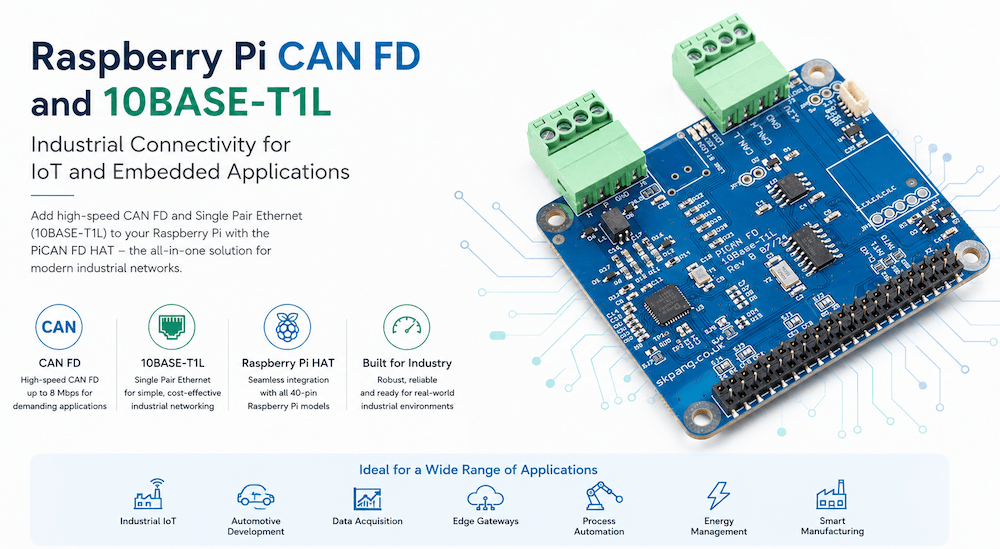
 The PiCAN FD HAT with 10BASE-T1L for Raspberry Pi was designed specifically to solve this problem.
Instead of assembling multiple interface boards, the HAT combines two powerful industrial communication technologies onto a single Raspberry Pi expansion board:
- High-speed CAN FD
- 10BASE-T1L Single Pair Ethernet
Together, they transform the Raspberry Pi into an industrial communications gateway suitable for development, testing, prototyping, and deployment.
Why Raspberry Pi Makes an Excellent Industrial Platform
Although originally introduced as an educational computer, today’s Raspberry Pi offers capabilities that make it highly attractive for professional embedded development.
Advantages include:
- Quad-core 64-bit processors
- Linux operating system
- Gigabytes of RAM
- Gigabit networking
- Extensive Python, C/C++, and Rust support
- Large open-source ecosystem
- Built-in remote management capabilities
- Excellent long-term software support
Perhaps even more important, Raspberry Pi development is incredibly fast.
Instead of writing low-level firmware for every feature, developers can leverage mature Linux libraries, networking stacks, databases, web servers, Docker containers, MQTT brokers, and cloud services.
The result is dramatically shorter development cycles.
Why CAN FD?
Classical CAN remains one of the most reliable field buses ever developed.
CAN FD extends those capabilities by offering:
- Payloads up to 64 bytes
- Data rates up to 8 Mbps
- Improved bandwidth
- Greater efficiency
- Backward compatibility with many existing CAN installations
These improvements make CAN FD ideal for:
- High-speed data acquisition
- Advanced diagnostics
- Robotics
- Electric vehicles
- Industrial automation
- Machine control
- Data logging
The board uses the proven Microchip MCP2518FD controller and integrates seamlessly with Linux SocketCAN, allowing applications to access the interface as a standard CAN network device.
Why 10BASE-T1L Matters
Single Pair Ethernet is becoming one of the most important technologies in industrial networking.
Unlike conventional Ethernet, which typically requires four twisted pairs, 10BASE-T1L operates over just a single balanced pair.
Its benefits include:
- Reduced cable cost
- Smaller cable bundles
- Simplified installation
- Long cable distances
- Native Ethernet connectivity
- Seamless integration with IP-based networks
For industrial plants, process automation, smart buildings, and energy systems, this represents a significant step toward converged Ethernet architectures.
The PiCAN HAT incorporates the Microchip LAN8651 MAC/PHY, providing direct support for IEEE 802.3cg Single Pair Ethernet.
Typical Applications
Because the Raspberry Pi runs Linux while simultaneously supporting CAN FD and 10BASE-T1L, numerous applications become possible.
Industrial IoT Gateway
Collect CAN FD data from field devices and forward it to cloud services using MQTT, HTTP, OPC UA, or REST APIs.
Predictive Maintenance
Monitor motors, pumps, compressors, and industrial equipment while simultaneously forwarding operational data over Ethernet for analysis.
Automotive Development
Connect to CAN FD networks for ECU testing, diagnostics, firmware validation, and data logging.
Smart Manufacturing
Bridge legacy CAN-based machinery with modern Ethernet infrastructure without replacing existing equipment.
Energy Management
Collect measurements from distributed controllers and transmit them over Single Pair Ethernet into supervisory control systems.
Process Automation
Develop intelligent edge controllers that combine deterministic CAN communication with modern Ethernet networking.
Research and Education
Create affordable laboratory platforms for learning CAN FD, SocketCAN, Linux networking, and Single Pair Ethernet technologies.
Rapid Software Development
One of the biggest advantages of the Raspberry Pi ecosystem is the available software.
Developers can immediately begin working with:
- Python
- C/C++
- SocketCAN
- Docker
- Node-RED
- MQTT
- SQLite
- InfluxDB
- Grafana
- REST APIs
- Web dashboards
Instead of spending weeks building infrastructure, engineers can focus on solving their application problem.
Future-Proof Your Designs
Industrial networking continues to evolve toward Ethernet-based architectures while CAN FD remains indispensable for embedded control systems.
Rather than choosing between the two technologies, the PiCAN FD HAT allows developers to use both simultaneously.
This makes the Raspberry Pi an excellent platform for developing gateways, edge controllers, industrial data acquisition systems, and intelligent automation solutions that must communicate across multiple network technologies.
Conclusion
As industrial systems become increasingly connected, engineers need development platforms that bridge proven field buses with next-generation Ethernet networks.
The Raspberry Pi already delivers exceptional computing performance, Linux flexibility, and an unmatched software ecosystem.
By adding the PiCAN FD HAT with 10BASE-T1L, the platform gains reliable CAN FD communication alongside modern Single Pair Ethernet connectivity, creating a compact and affordable solution for industrial automation, automotive development, robotics, energy management, and Industrial IoT applications.
Whether you’re building a prototype, validating a new network architecture, or developing a production-ready gateway, combining Raspberry Pi with CAN FD and 10BASE-T1L provides a practical foundation for the next generation of embedded systems.
 Ethernet: The Definitive Guide: Designing and Managing Local Area Networks
Get up to speed with the latest Ethernet technologies for designing, deploying, and maintaining networks ranging from home and office installations to enterprise data centers and server rooms. Fully revised and updated, this comprehensive guide draws on the authors’ decades of real-world experience to explain Ethernet from fundamental concepts to advanced network design, management, and troubleshooting.
When is it time to migrate to higher-speed Ethernet? How can switches be used to build larger, more resilient networks? What are the most effective methods for diagnosing and resolving network issues? This book answers these questions and many more. Whether you’re designing a new network or upgrading an existing infrastructure, it provides the practical knowledge needed to build scalable, high-performance Ethernet systems that meet today’s bandwidth demands and prepare for tomorrow’s applications.
Inside you’ll learn how to:
- Understand the fundamental principles of Ethernet and the IEEE standards that define its operation
- Explore the most widely deployed Ethernet media, including copper, fiber optic, 40 Gigabit Ethernet, and 100 Gigabit Ethernet
- Master Ethernet’s core technologies, including full-duplex operation, Power over Ethernet (PoE), and Energy Efficient Ethernet (EEE)
- Design structured cabling systems and select the components required for reliable network installations
- Use Ethernet switches to expand networks, improve performance, and enhance reliability
- Optimize Ethernet performance at both the individual link and enterprise network levels
- Apply proven troubleshooting techniques to identify and resolve common problems in twisted-pair and fiber-optic networks
Whether you’re a network engineer, system administrator, installer, or technology professional, this definitive guide delivers the practical insights and technical depth needed to successfully design, deploy, and maintain modern Ethernet networks. More information...
Raspberry Pi CAN Bus and LIN Bus Interface: CAN FD Development Made Easy
The Raspberry Pi has evolved far beyond its educational roots. With modern multi-core processors, generous memory, Linux support, and an enormous software ecosystem, it has become one of the most capable embedded computing platforms available today. When combined with a CAN and LIN interface, the Raspberry Pi transforms into an excellent development platform for automotive, industrial [...]
Why Would You Need Two CAN Ports on a Raspberry Pi?
When developers first start working with CAN bus networks, a single CAN interface is usually sufficient. It allows them to monitor traffic, transmit messages, and develop applications for automotive, industrial, marine, or agricultural systems. However, as projects become more sophisticated, the limitations of a single CAN port quickly become apparent. This is where dual-channel CAN interfaces [...]
How to Wire NMEA 2000 with the PICAN-M Raspberry Pi HAT and Power It Using the Onboard SMPS
The PICAN-M is a marine-grade Raspberry Pi HAT that brings both NMEA 0183 and NMEA 2000 connectivity to your Pi, with the added convenience of an onboard 3 A SMPS (Switch-Mode Power Supply) for powering the Pi itself. This makes it ideal for embedded marine systems using platforms like OpenPlotter or Signal K. In this [...]
Testing NMEA 0183 For The PICAN-M - NMEA 0183 & NMEA 2000 HAT For Raspberry Pi
PICAN-M - NMEA 0183 & NMEA 2000 HAT For Raspberry Pi Our PICAN-M (M = Marine) is a Raspberry Pi HAT with NMEA 0183 and NMEA 2000 connection. The NMEA 0183 (RS422) port is accessible via a 5-way screw terminal. The NMEA 2000 port is accessible via a Micro-C connector. The board comes with a 3A SMPS [...]