 Loading... Please wait...

Blog
Recent Posts
MicroPython Meets CAN Bus: The Fastest Way to Build Industrial IoT and Embedded CAN Applications
Posted by on
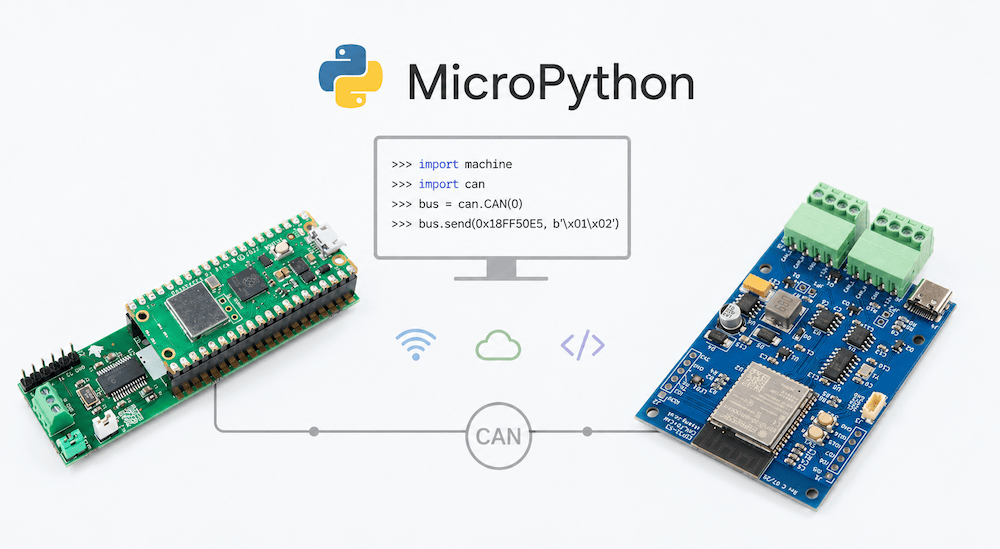 If you’ve ever programmed a CAN Bus application in C or C++, you already know the learning curve. Before sending the first CAN message, you typically need to configure a compiler, install SDKs, understand build systems, and write dozens of lines of initialization code.
But what if you could start communicating over a CAN network with just a few lines of Python?
That’s exactly what MicroPython makes possible.
Today, engineers, students, makers, and professional developers are increasingly choosing MicroPython to prototype embedded systems because it dramatically reduces development time while still providing access to powerful hardware. When combined with modern CAN-enabled development boards such as the Raspberry Pi Pico WH and the ESP32-S3, MicroPython becomes an outstanding platform for developing industrial control systems, IoT devices, automotive applications, robotics, and CAN-based data acquisition systems.
What Is MicroPython?
MicroPython is a lightweight implementation of Python 3 designed specifically for microcontrollers. Instead of writing firmware in C or C++, developers write familiar Python code that runs directly on the microcontroller.
Compared to traditional embedded development, MicroPython offers several advantages:
- Much faster development
- Interactive programming using the REPL
- Easy debugging
- Readable code
- Extensive standard libraries
- Large and active community
For many applications, you can move from idea to working prototype in a matter of hours rather than days.
Why Combine MicroPython with CAN Bus?
CAN Bus has become the communication backbone of countless embedded systems, including:
- Industrial automation
- Agricultural equipment
- Heavy-duty vehicles
- Marine electronics
- Robotics
- Building automation
- Battery management systems
- Renewable energy systems
Traditionally, CAN software has been developed almost exclusively in C because of the protocol’s real-time requirements.
Modern microcontrollers, however, are significantly more powerful than their predecessors. Combined with efficient CAN controllers, they allow many CAN applications to be implemented successfully using MicroPython.
Examples include:
- Reading CAN messages
- Sending CAN messages
- CAN monitoring
- Data logging
- CAN-to-Wi-Fi gateways
- CAN-to-MQTT gateways
- Cloud connectivity
- IoT edge devices
- Sensor interfaces
- Industrial dashboards
For these applications, development speed is often more important than squeezing every last microsecond out of the processor.
Isn’t Python Too Slow?
This is one of the first questions engineers ask.
The short answer is:
Not necessarily.
MicroPython is interpreted, meaning it executes Python bytecode instead of native machine code. This introduces additional execution overhead compared to C or C++.
The primary performance limitations are:
- Interpreter overhead
- Garbage collection pauses
- Dynamic memory allocation
- Slower execution of computationally intensive code
However, it’s important to understand where these limitations matter.
Most CAN controllers buffer incoming messages in hardware. As long as the software empties the receive buffer quickly enough, MicroPython performs remarkably well on lightly to moderately loaded CAN networks.
For applications such as:
- Monitoring traffic
- Logging messages
- Controlling devices
- Remote diagnostics
- Sensor gateways
MicroPython is often more than fast enough.
When Should You Still Use C or C++?
For highly demanding applications, native code remains the best choice.
Examples include:
- Heavy SAE J1939 traffic
- Multiple simultaneous Transport Protocol sessions
- CAN FD gateways operating at high throughput
- Safety-critical control systems
- Hard real-time control loops
These applications benefit from deterministic execution and maximum processing speed.
Fortunately, this doesn’t mean you must abandon MicroPython.
A common architecture is to implement the timing-critical CAN protocol engine in C while exposing a simple MicroPython interface for the application logic. This gives developers the simplicity of Python while retaining the performance of native code.
CANPico V2: A Perfect Introduction to MicroPython CAN Development
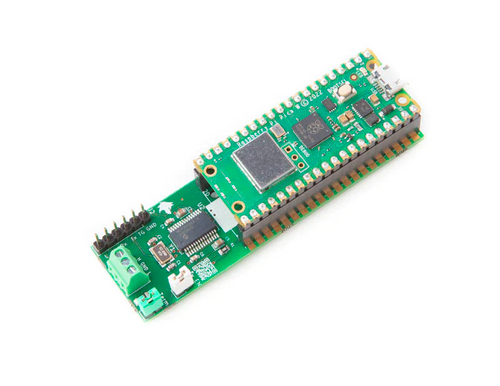 If you’re looking for the easiest way to start programming CAN Bus with MicroPython, the CANPico V2 is an excellent choice.
Built around the Raspberry Pi Pico WH, the board combines:
- RP2040 dual-core microcontroller
- Integrated Wi-Fi
- MCP2515 CAN controller
- CAN transceiver
- Screw terminal connections
- Onboard termination resistor
Even better, the Pico WH ships with MicroPython already installed, allowing you to start writing Python code almost immediately. Copperhill Technologies also provides MicroPython examples for CAN initialization, message transmission, reception, and error handling, making it easy for beginners to get started.
Typical applications include:
- Learning CAN Bus
- Educational projects
- J1939 experimentation
- NMEA 2000 development
- CAN data logging
- IoT gateways
ESP32-S3: Bringing Wireless IoT to CAN Networks
When your application requires more processing power, additional memory, Wi-Fi, Bluetooth, and CAN FD support, the ESP32-S3 platform becomes an excellent next step.
The ESP32-S3 combines:
- Dual-core 240 MHz processor
- Wi-Fi
- Bluetooth
- USB connectivity
- Excellent MicroPython support
- High processing performance
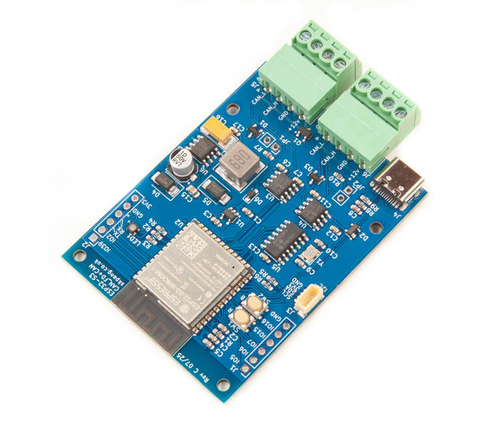 When paired with Copperhill Technologies’ ESP32-S3 development board featuring both Classical CAN and CAN FD interfaces, developers can build sophisticated connected systems capable of bridging industrial networks with cloud services.
Typical projects include:
- Industrial IoT gateways
- Remote monitoring systems
- MQTT clients
- REST APIs
- CAN-to-cloud bridges
- Predictive maintenance
- Wireless diagnostics
- Fleet monitoring
Because MicroPython is officially supported on the ESP32 family, developers can rapidly prototype sophisticated wireless CAN applications without dealing with the complexity of traditional embedded toolchains.
What About SAE J1939?
One of the most exciting opportunities is bringing SAE J1939 development into the MicroPython ecosystem.
Most existing J1939 protocol stacks are written entirely in C or C++, where performance is critical.
However, many educational examples and less demanding applications could benefit enormously from the simplicity of Python.
Imagine writing code such as:
ecu.claim_address()

ecu.send_engine_speed(1800)

ecu.request_pgn(65260)

ecu.on_pgn(65262, coolant_temperature_callback)
Rather than focusing on low-level protocol details, developers could concentrate on solving their actual application problems.
For more demanding applications, the underlying J1939 protocol engine could remain in native C while exposing a clean and intuitive MicroPython API.
This hybrid approach combines the best of both worlds: the performance of native code with the simplicity and productivity of Python.
MicroPython Is Changing Embedded Development
For decades, embedded development meant writing thousands of lines of C code before seeing the first successful CAN message.
Today, that workflow is changing.
MicroPython enables developers to:
- Prototype faster
- Experiment more easily
- Learn embedded networking more quickly
- Build IoT devices in a fraction of the traditional development time
While C and C++ will always remain essential for high-performance embedded software, MicroPython is opening CAN Bus development to a much broader audience.
Whether you’re building an industrial gateway, a wireless sensor node, a CAN data logger, or your first SAE J1939 application, MicroPython provides an accessible and highly productive development environment.
Ready to Get Started?
If you’re interested in developing CAN-enabled applications with MicroPython, Copperhill Technologies offers two excellent hardware platforms:
- CANPico V2 with Raspberry Pi Pico WH – ideal for learning CAN Bus, rapid prototyping, and educational projects.
- ESP32-S3 Board with Classical CAN and CAN FD – perfect for connected IoT devices, industrial gateways, and advanced wireless CAN applications.
Both platforms provide a powerful foundation for bringing together the simplicity of MicroPython with the reliability of industrial CAN networking.
For SEO, this post should perform well for searches such as:
- MicroPython CAN Bus
- CAN Bus Python
- Raspberry Pi Pico CAN Bus
- ESP32 CAN MicroPython
- CAN FD Python
- Industrial IoT Python
- MicroPython IoT
- SAE J1939 Python
- CAN Bus Development
- Python CAN Programming
Beginning MicroPython with the Raspberry Pi Pico: Build Electronics and IoT Projects
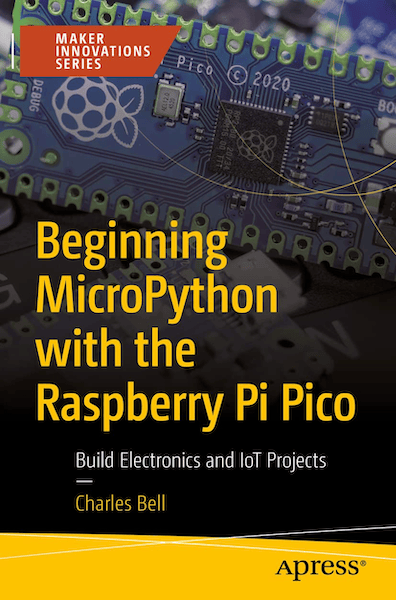 Learn how to program the Raspberry Pi Pico with MicroPython through practical, hands-on projects. This book guides you from setting up your development environment and writing your first programs to building electronic circuits and developing Internet of Things (IoT) applications.
You’ll learn how to interface the Pico with sensors and peripherals, build breadboard circuits, and develop real-world projects with step-by-step instructions, complete hardware connections, and fully explained source code. The book also introduces cloud-based IoT concepts and demonstrates how to connect the Raspberry Pi Pico to ThingSpeak for collecting and visualizing sensor data.
By the end of the book, you’ll have the skills to create your own MicroPython applications and practical IoT solutions using the Raspberry Pi Pico.
What You Will Learn
- Program the Raspberry Pi Pico with MicroPython
- Build electronic circuits and embedded applications
- Interface sensors and peripherals
- Develop IoT projects using cloud services
- Use the Grove component ecosystem
- Connect the Pico to ThingSpeak for cloud-based data logging
Who This Book Is For
This book is intended for beginners with little or no experience in programming or electronics, as well as makers, students, and anyone interested in learning MicroPython and building embedded and IoT projects with the Raspberry Pi Pico. More information..