 Loading... Please wait...

Blog
Recent Posts
ESP32-S3 vs. Raspberry Pi + PiCAN: Which Platform Is Better for Cloud-Connected CAN Bus Applications?
Posted by on
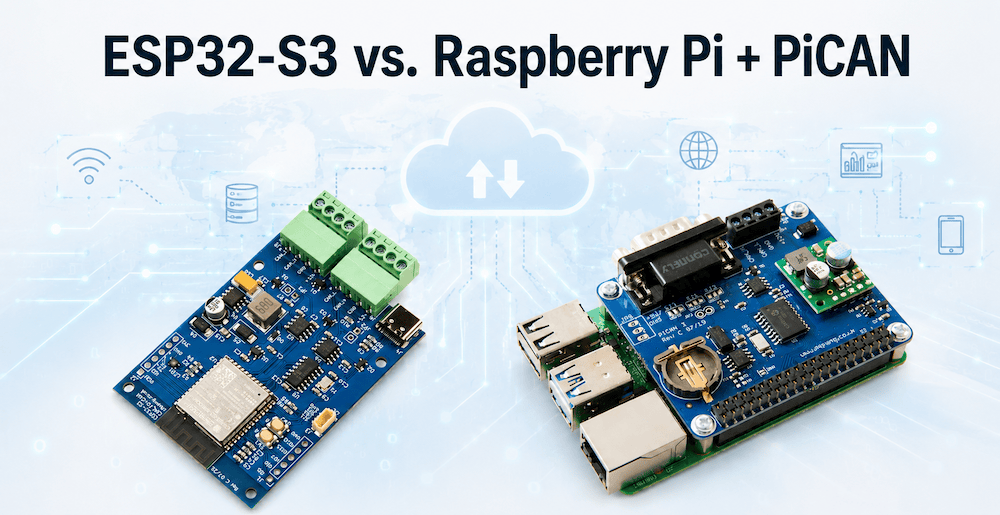 The growing popularity of Industrial IoT, fleet management, predictive maintenance, and cloud-based monitoring has created a demand for embedded systems that can bridge CAN networks with modern software platforms.
Two popular approaches dominate the market:
- An ESP32-S3 embedded system with integrated CAN connectivity
- A Raspberry Pi combined with a PiCAN interface board
Both platforms can transmit CAN data to cloud services, MQTT brokers, web dashboards, mobile applications, and industrial monitoring systems. However, they differ significantly in cost, complexity, performance, reliability, and maintenance requirements.
In this article, we compare both approaches using the ESP32-S3 Board with CAN FD and Classical CAN Ports from Copperhill Technologies as a reference platform.
The Hardware Platforms
ESP32-S3 with CAN FD and Classical CAN
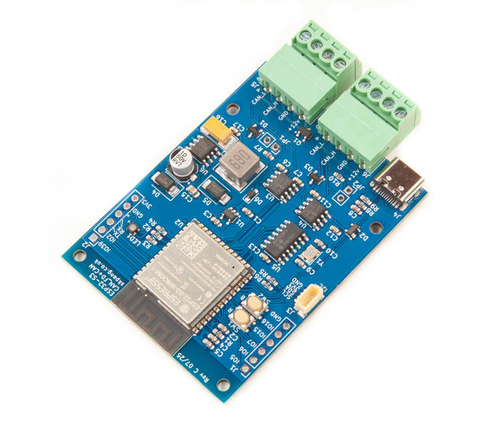 The Copperhill Technologies ESP32-S3 board combines:
- Dual-core ESP32-S3 processor
- Wi-Fi connectivity
- Bluetooth LE and Bluetooth 5
- Classical CAN interface
- CAN FD interface via MCP2518FD
- 8 MB Flash
- 8 MB PSRAM
- USB-C programming interface
- Industrial power supply support
The board was specifically designed for CAN-based IoT and embedded applications where compact size, low power consumption, and wireless connectivity are required.
Raspberry Pi + PiCAN
 A Raspberry Pi combined with a PiCAN HAT provides:
- Linux operating system
- High processing power
- Large memory capacity
- Python support
- SocketCAN interface
- Full networking stack
- Access to thousands of Linux applications
The Raspberry Pi approach essentially creates a miniature Linux computer connected to a CAN network.
Cloud Platforms
Examples:
- AWS IoT
- Azure IoT Hub
- Google Cloud IoT
- ThingsBoard
- Ubidots
- Blynk
- Losant
ESP32 Advantages
The ESP32 includes Wi-Fi directly on the microcontroller and can connect to cloud services using MQTT, HTTPS, REST APIs, or WebSockets without requiring a full operating system.
Advantages:
- Lower hardware cost
- Very low power consumption
- Fast startup (typically seconds)
- No SD card corruption concerns
- No Linux maintenance
- Excellent for dedicated gateways
Disadvantages:
- Limited local storage
- Less processing power
- More software development effort
Raspberry Pi Advantages
A Raspberry Pi can run complete cloud software stacks directly on the device.
Advantages:
- Native support for Docker
- Local databases
- Edge analytics
- Large data buffering
- Multiple simultaneous applications
Disadvantages:
- Higher power consumption
- Linux administration required
- Longer boot times
- Potential SD card reliability issues
Winner
For simple CAN-to-cloud gateways, the ESP32 is usually the better choice.
For complex edge computing systems, the Raspberry Pi has the advantage.
Web Dashboards
Examples:
- Grafana
- ThingsBoard
- Node-RED Dashboard
- Custom web portals
ESP32 Approach
The ESP32 can:
- Host lightweight web pages
- Provide REST APIs
- Serve configuration interfaces
- Push data to remote dashboards
The device itself is not intended to run sophisticated dashboard software.
Raspberry Pi Approach
A Raspberry Pi can run:
- Grafana
- InfluxDB
- Node-RED
- Local web servers
- SQL databases
directly on the device.
This allows complete local visualization without requiring an external cloud server.
Winner
Raspberry Pi.
If local dashboard generation is required, Linux provides enormous advantages.
Mobile Applications
Examples:
- Fleet monitoring apps
- Equipment monitoring apps
- Maintenance applications
ESP32 Advantages
The ESP32 supports:
- Wi-Fi communication
- Bluetooth LE
- Direct smartphone connectivity
This allows a mobile app to communicate directly with the device without cloud infrastructure.
Raspberry Pi Advantages
The Raspberry Pi supports the same functionality but usually relies on Linux networking services.
For simple mobile applications, the Raspberry Pi often represents unnecessary complexity.
Winner
ESP32.
For dedicated mobile applications, the ESP32 is usually the cleaner solution.
MQTT Brokers
MQTT has become the de facto standard for transporting CAN data into cloud environments and industrial monitoring systems. MQTT bridges the gap between local CAN networks and enterprise software platforms.
ESP32
The ESP32 can act as:
- MQTT client
- MQTT publisher
- MQTT subscriber
This is sufficient for most telemetry applications.
Raspberry Pi
The Raspberry Pi can operate as:
- MQTT client
- MQTT broker
- MQTT gateway
- Edge server
A Pi can even host a Mosquitto broker while simultaneously performing data analytics.
Winner
Tie.
ESP32 is ideal as an MQTT endpoint.
Raspberry Pi is ideal as an MQTT infrastructure node.
Fleet Management Systems
Examples:
- Vehicle tracking
- J1939 telemetry
- Fuel monitoring
- Driver behavior monitoring
ESP32 Advantages
The ESP32 excels at:
- Reading CAN data
- Processing selected parameters
- Publishing telemetry
- GPS integration
- Cellular modem integration
The resulting system is inexpensive and highly reliable.
Raspberry Pi Advantages
The Raspberry Pi becomes attractive when:
- Local databases are required
- Multiple protocols are involved
- Video processing is needed
- Large-scale edge analytics are performed
Winner
ESP32.
Most fleet-management applications only require parameter extraction and cloud transmission.
Industrial Monitoring Systems
Examples:
- Factory automation
- Process monitoring
- Machine monitoring
- Energy management
ESP32 Advantages
- Industrial reliability
- Fast startup
- Low power
- Deterministic behavior
- Minimal maintenance
Raspberry Pi Advantages
The Raspberry Pi can act as:
- Industrial gateway
- Protocol translator
- Data concentrator
- Edge server
Industrial Raspberry Pi systems are increasingly used as IIoT gateways.
Winner
Depends on application complexity.
Simple monitoring:
ESP32
Multi-service industrial gateway:
Raspberry Pi
Predictive Maintenance Platforms
Examples:
- Condition monitoring
- Vibration analysis
- Failure prediction
- Machine health monitoring
ESP32 Approach
The ESP32 can:
- Collect CAN data
- Monitor thresholds
- Calculate basic statistics
- Send data to cloud-based AI platforms
This architecture pushes computationally intensive analytics into the cloud.
Raspberry Pi Approach
The Raspberry Pi can perform significant local processing before transmitting data.
Examples include:
- Local machine-learning inference
- Data aggregation
- Edge analytics
- Historical data storage
Winner
Raspberry Pi.
Predictive maintenance often benefits from local processing power.
Reliability Considerations
One factor often overlooked is system reliability.
The ESP32:
- Runs a dedicated firmware image
- Requires no operating system updates
- Boots quickly
- Consumes little power
- Has fewer software layers
The Raspberry Pi:
- Requires Linux maintenance
- Requires storage media
- Has a more complex software stack
For deployed systems expected to run unattended for years, simplicity frequently translates into higher reliability.
Final Recommendation
If your goal is:
- CAN-to-cloud connectivity
- MQTT publishing
- Fleet management
- Mobile app integration
- Wireless telemetry
- Industrial monitoring
the ESP32-S3 Board with CAN FD and Classical CAN Ports is usually the most efficient solution.
If your application requires:
- Local dashboards
- Databases
- Edge analytics
- Docker containers
- Machine learning
- Complex protocol gateways
a Raspberry Pi with a PiCAN interface becomes the stronger platform.
In many real-world projects, the most effective architecture combines both approaches:
The ESP32 acts as the intelligent CAN gateway at the machine, while a Raspberry Pi serves as the local edge computer running databases, dashboards, analytics, and cloud services.
This hybrid architecture delivers the reliability of embedded systems and the flexibility of Linux computing in a single solution.
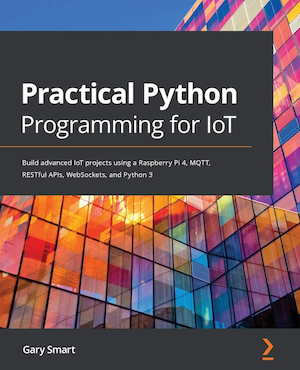 Practical Python Programming for IoT: Build advanced IoT projects using a Raspberry Pi 4, MQTT, RESTful APIs, WebSockets, and Python 3
Build practical Internet of Things (IoT) applications with Python and Raspberry Pi through a series of hands-on projects that combine software, networking, sensors, and electronics. Starting with the fundamentals of Raspberry Pi setup, GPIO interfacing, and electronic circuits, you’ll learn how connected devices communicate using technologies such as REST APIs, WebSockets, and MQTT. Along the way, you’ll create real-world applications ranging from remote LED control and motion detection to smart monitoring and automation systems.
As your skills progress, you’ll integrate sensors, actuators, motors, ultrasonic ranging, and environmental measurements into increasingly sophisticated projects. The book also covers modern Python development techniques, including asynchronous programming and publish/subscribe architectures, while demonstrating integration with IoT platforms and cloud services. By the end, you’ll have the knowledge and practical experience needed to design, build, and deploy your own intelligent IoT solutions using Python and Raspberry Pi. More information…