Loading... Please wait...

- Home
- Breakout Boards
- Microchip dsPIC33CK256MP502 CAN FD Demo Board


)

Product Description
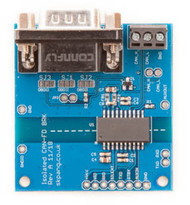
The Microchip dsPIC33CK256MP502 CAN FD Demo Board is a compact development platform for experimenting with and developing CAN FD applications. The board combines Microchip’s dsPIC33CK256MP502 Digital Signal Controller (DSC) with an onboard CAN FD transceiver, allowing it to connect directly to a CAN/CAN FD network. It operates from an 8–24 V supply with reverse-polarity protection and is supplied with demonstration firmware configured for 500 kbit/s nominal arbitration and 2 Mbit/s CAN FD data rates. Additional board features include an RGB status LED, selectable 3.3 V/5 V UART interface, and an I²C/QWIIC connector.
At the heart of the board is the Microchip dsPIC33CK256MP502, a 100 MHz single-core digital signal controller with 256 KB Flash memory and 24 KB RAM. The dsPIC33C architecture combines conventional microcontroller functionality with a DSP engine intended for computationally demanding real-time applications. This makes the device suitable not only for CAN FD communications but also for applications involving real-time control, signal processing, sensor interfacing, motor control, and digital power conversion.
Of particular interest for CAN FD development is the dsPIC33CK256MP502's integrated CAN FD controller. It supports ISO 11898-1:2015, CAN 2.0B and CAN FD operation, with nominal arbitration rates up to 1 Mbit/s and CAN FD data rates up to 8 Mbit/s. CAN FD extends Classical CAN by increasing the maximum payload from 8 to 64 data bytes and permitting a higher bit rate during the data portion of a frame. The controller also provides configurable transmit/receive FIFOs, a transmit queue, transmit event FIFO with timestamps, message filtering, and programmable retransmission behavior, giving developers considerable flexibility when implementing CAN and CAN FD nodes.
The board is supplied with an MPLAB X project using Microchip MCC Melody, providing a practical starting point for modifying the demonstration firmware and developing custom CAN FD applications; an optional bootloader is also available. Together with the onboard CAN FD physical interface, this makes the board useful for prototyping CAN FD nodes, experimenting with CAN FD frame handling and higher data rates, developing embedded CAN FD devices, or evaluating the dsPIC33CK platform before designing custom hardware.
The board also includes an I²C / Qwiic connector, providing a convenient way to expand a CAN FD development project with external peripherals. Qwiic uses the standard I²C bus together with a polarized 4-pin connector carrying 3.3 V, ground, SDA, and SCL. This allows compatible sensors, displays, memory devices, I/O expanders, and other I²C peripherals to be connected without soldering or individual jumper wires. For CAN FD development, this is particularly useful when creating a prototype node that acquires information from an external sensor or peripheral, processes it with the dsPIC33CK256MP502, and then transmits the resulting data over the CAN FD network. Multiple I²C devices can also share the same bus, subject to normal I²C addressing and electrical requirements.
- RGB LED status indictor
- Debug message on UART on J3. Selectable UART voltages (3.3v or 5v)
- 8 to 24v supply voltage with reverse polarity protection
- Powerful Microchip dsPIC33CK micro controller with 256kb flash and 24kb ram
- CAN FD transceiver
- Microchip Mplab X project using MCC Melody. Optional boot loader available
- I2C / QWIIC connector
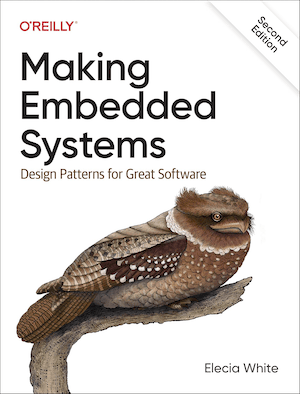
Making Embedded Systems: Design Patterns for Great Software
Interested in developing embedded systems? Because embedded systems operate under tight constraints, they demand a disciplined and efficient approach to programming. This accessible guide introduces proven development practices based on classic software design patterns as well as patterns specific to embedded programming. You’ll learn how to design system architectures around processors rather than operating systems, while developing practical strategies for working with hardware limitations, evolving designs, and manufacturing requirements.
Written by an experienced engineer whose projects range from DNA scanners to children’s toys, this book is ideal for intermediate and experienced programmers working on virtually any embedded platform. This expanded second edition adds new material on IoT and networked sensors, motors and motion, debugging, data-handling strategies, and more.
-
Optimize embedded systems to reduce cost while improving performance
-
Develop robust software architectures for resource-constrained environments
-
Work effectively with sensors, displays, motors, and other I/O devices
-
Reduce RAM usage, power consumption, code size, and processor cycles
-
Learn to interpret schematics, datasheets, and power requirements
-
Implement complex mathematics and machine learning on small processors
-
Design effective embedded systems for IoT and networked sensor applications