 Loading... Please wait...

Blog
Recent Posts
CANPico V2 with Pico WH Pre-Installed: Powerful CAN Bus Development in an Ultra-Compact Form Factor
Posted by on
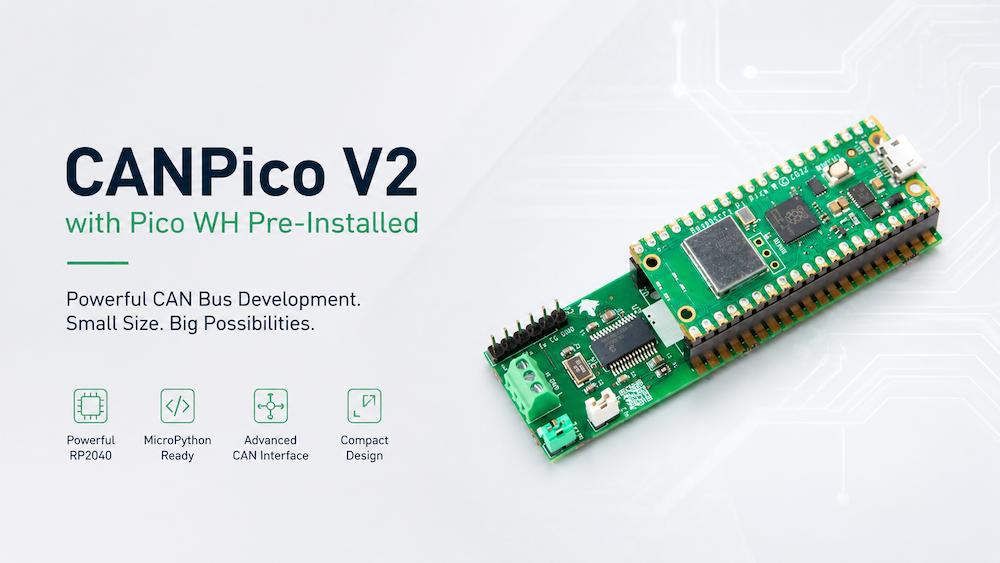 When developing CAN Bus applications, engineers often face a familiar challenge: balancing processing power, development speed, hardware complexity, and physical size. The CANPico V2 with Raspberry Pi Pico WH pre-installed solves all four challenges in a remarkably compact package.
Combining the powerful Raspberry Pi Pico WH with a sophisticated CAN interface, the CANPico V2 provides an ideal platform for engineers, researchers, educators, and hobbyists who need a small yet capable controller for CAN Bus development. Better yet, the board ships with MicroPython pre-installed, allowing developers to move from concept to working prototype in record time.
Why Small Matters
One of the most striking features of the CANPico V2 is its exceptionally compact design.
In embedded systems development, physical space is often at a premium. Whether you are working inside a vehicle dashboard, an industrial control cabinet, a robotics platform, a laboratory test fixture, or a portable diagnostic device, reducing hardware size can dramatically simplify integration.
A smaller board offers several advantages:
- Easier installation in confined spaces
- Reduced wiring complexity
- Lower overall system weight
- Better suitability for portable and battery-powered devices
- Faster prototyping and deployment
Instead of combining multiple modules—a microcontroller board, a CAN controller, a transceiver, and associated wiring—the CANPico V2 integrates everything into a single compact solution.
Powered by the Raspberry Pi Pico WH
At the heart of the CANPico V2 is the Raspberry Pi Pico WH featuring the RP2040 microcontroller.
The RP2040 provides:
- Dual-core ARM Cortex-M0+ processor
- Clock speeds up to 133 MHz
- 264 KB SRAM
- 2 MB Flash memory
- Extensive GPIO capabilities
- Flexible programmable I/O (PIO) subsystem
- Integrated wireless connectivity through the Pico WH platform
Despite its modest size, the RP2040 delivers impressive processing performance, making it suitable for real-time control systems, protocol gateways, data loggers, CAN monitoring tools, industrial automation devices, and test equipment.
For many CAN Bus applications, the combination of dual-core processing and dedicated CAN hardware provides far more computing power than is typically required.
MicroPython: Rapid Development Without Compromise
Traditional embedded development often requires writing large amounts of C or C++ code before any useful functionality can be demonstrated.
The CANPico V2 takes a different approach.
The board ships with MicroPython already installed, allowing developers to start programming immediately using one of the world's most popular programming languages.
MicroPython offers several advantages:
Faster Development
Python's concise syntax dramatically reduces coding time compared to traditional embedded languages.
Easier Learning Curve
Engineers new to embedded systems can become productive much more quickly.
Rapid Prototyping
New ideas can be tested and modified in minutes rather than hours.
Readable Code
Python code is generally easier to maintain and share across development teams.
Powerful Libraries
Developers can leverage extensive programming concepts and Python techniques already familiar from desktop and server environments.
The result is a development platform that combines the convenience of Python with the deterministic performance required for CAN Bus applications.
Designed Specifically for CAN Bus Development
Unlike generic microcontroller boards that require external CAN hardware, the CANPico V2 was designed from the ground up for CAN networking.
The board includes:
- Advanced Microchip CAN controller
- CAN transceiver
- Screw terminal connection for CAN High and CAN Low
- Selectable 120-ohm termination resistor
- Listen-only mode capability
- Dedicated instrument interface for debugging and analysis
This integration eliminates much of the wiring and hardware troubleshooting typically associated with CAN Bus development.
Built-In Tools for Professional Development
The CANPico V2 is more than just a CAN interface.
The board provides direct access to both digital and analog CAN signals through dedicated headers. These connections allow engineers to attach oscilloscopes and logic analyzers for detailed signal analysis.
Additional capabilities include:
- Trigger outputs for oscilloscopes and logic analyzers
- Access to CAN transmit and receive signals
- Hardware support for error injection experiments
- Real-time monitoring of network activity
- USB communication with host PCs
These features make the CANPico V2 particularly valuable for:
- CAN protocol development
- Automotive testing
- Industrial automation projects
- Hardware-in-the-loop simulation
- Network diagnostics
- Research and education
Development Resources That Accelerate Your Project
One of the biggest obstacles in embedded development is getting started.
Fortunately, the CANPico ecosystem includes extensive resources designed to shorten development time. Copperhill Technologies and Canis Labs provide:
- Open-source MicroPython SDK
- Comprehensive API documentation
- Hardware reference manuals
- Schematics and design files
- Example applications
- Firmware updates
- Demonstration videos
- CANHack toolkit documentation
These resources allow developers to focus on their application rather than spending days or weeks building low-level CAN drivers.
For many projects, working example code can mean the difference between a prototype completed in days versus weeks.
Real-Time Performance for Demanding Applications
Although programmed in Python, the CANPico V2 is capable of impressive real-time performance.
The MicroPython SDK includes advanced CAN APIs with:
- Large buffering capability
- High-resolution timestamps
- Efficient CAN frame handling
- Microsecond-level response times
- Host communication support via USB
This makes the platform suitable not only for monitoring and logging applications but also for sophisticated control and simulation systems.
Typical Applications
The CANPico V2 is well suited for:
- CAN Bus data logging
- Automotive diagnostics
- J1939 monitoring and analysis
- Industrial control systems
- Robotics
- CAN-to-USB gateways
- Hardware-in-the-loop testing
- Educational laboratories
- CAN protocol research
- Custom CAN network interfaces
Conclusion
The CANPico V2 with Pico WH pre-installed combines three highly desirable characteristics in a single development platform: compact size, powerful processing capability, and rapid software development.
Its small form factor makes it easy to integrate into almost any project. The RP2040 processor provides ample computing power for sophisticated CAN applications. MicroPython dramatically accelerates development. And the extensive documentation, software libraries, and example programs help engineers move from concept to working solution faster than ever.
For developers seeking a compact, capable, and developer-friendly CAN Bus platform, the CANPico V2 represents an outstanding combination of performance, flexibility, and ease of use.
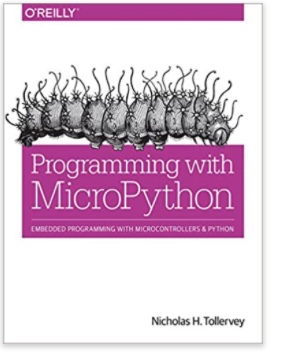 Programming with MicroPython: Embedded Programming with Microcontrollers and Python
It is exciting to get involved with MicroPython, the re-implementation of Python 3 for microcontrollers and embedded systems. This helpful guide presents the knowledge you need to roll up your sleeves and create outstanding embedded projects with this lean and efficient programming language. If you are familiar with Python as a programmer, educator, or maker, you are ready to learn and have fun along the way.
The author takes you on a journey from the first steps to advanced projects. You explore the types of devices that run MicroPython, and examine how the language interacts with hardware to process input, connect to the outside world, communicate wirelessly, make sounds and music, and drive robotics projects.
- Work with MicroPython on four typical devices: PyBoard, the micro:bit, Adafruit’s Circuit Playground Express, and ESP8266/ESP32 boards
- Explore a framework that helps you generate, evaluate, and evolve embedded projects that solve real problems
- Dive into practical MicroPython examples: visual feedback, input and sensing, GPIO, networking, sound and music, and robotics
- Learn how idiomatic MicroPython helps you express a lot with the minimum of resources
- Take the next step by getting involved with the Python community