 Loading... Please wait...

Blog
Recent Posts
ESP32-S3 CAN-Bus Board with NMEA 2000 Connector: A Powerful Platform for Marine Electronics Development
Posted by on
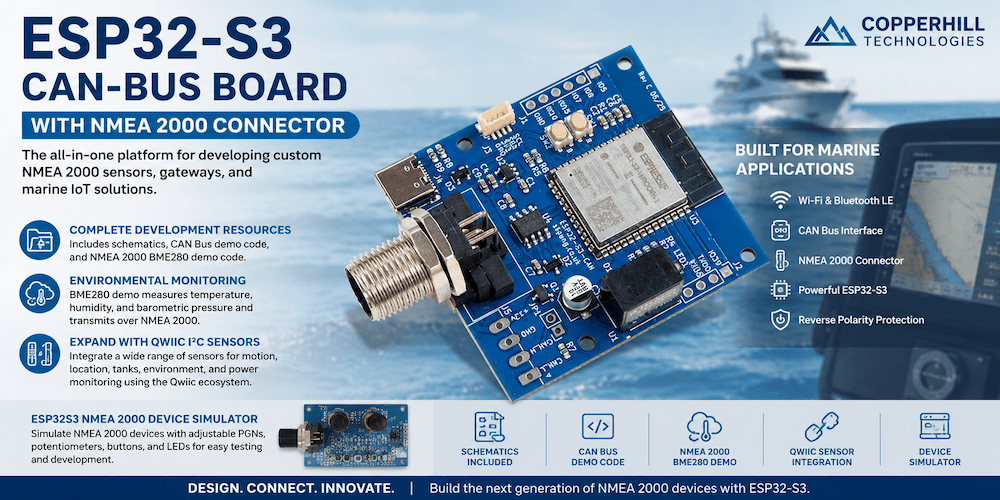 The growing popularity of NMEA 2000 networking has created a demand for affordable, flexible, and powerful embedded platforms capable of connecting sensors, displays, and control systems to marine CAN bus networks. The ESP32S3 CAN-Bus Board with NMEA 2000 Connector from Copperhill Technologies was designed specifically for that purpose.
Built around the powerful ESP32-S3 processor, the board combines CAN bus communication, Wi-Fi, Bluetooth LE, and extensive memory resources in a compact development platform suitable for marine, industrial, and IoT applications. It provides developers with everything required to create custom NMEA 2000 devices without having to design hardware from scratch.
Hardware Designed for Real-World Marine Applications
At the heart of the board is the ESP32-S3-WROOM-1-N8R8 module featuring:
- Dual-core Xtensa LX7 processor running at up to 240 MHz
- 8 MB Flash memory
- 8 MB PSRAM
- Integrated Wi-Fi
- Bluetooth Low Energy (BLE)
- USB-C programming interface
- RGB status LED
- CAN bus transceiver
- NMEA 2000-compatible connector
- Reverse-polarity protected power supply design
The combination of wireless connectivity and CAN bus support makes the board particularly attractive for marine gateways, sensor interfaces, remote monitoring systems, and custom NMEA 2000 devices.
More Than Hardware: Complete Development Resources Included
One of the most valuable aspects of the ESP32-S3 CAN-Bus Board is the availability of development resources.
Developers receive access to:
- Complete hardware schematics
- CAN bus demonstration software
- NMEA 2000 demonstration projects
- BME280 sensor demonstration code
- Example implementations for sensor integration
This dramatically shortens development time and allows users to focus on application development rather than spending weeks building basic infrastructure. Whether you are new to NMEA 2000 or an experienced embedded engineer, having working reference designs can save a significant amount of effort.
Environmental Monitoring with the Included BME280 Demo
The included BME280 demonstration project provides an excellent starting point for environmental monitoring applications.
The BME280 sensor measures:
- Temperature
- Relative humidity
- Barometric pressure
These parameters are frequently needed in marine applications, including:
- Cabin environmental monitoring
- Weather stations
- Engine room monitoring
- Bilge monitoring systems
- Vessel automation projects
The example code demonstrates how sensor data can be collected and transmitted across an NMEA 2000 network, allowing chart plotters and multifunction displays to present the information just like any commercially available NMEA 2000 sensor.
Expand Your Project with Qwiic I²C Sensors
While the BME280 provides an excellent starting point, the board becomes even more powerful when combined with SparkFun's Qwiic sensor ecosystem.
The ESP32-S3 CAN-Bus Board includes support for I²C-based sensor expansion, allowing developers to rapidly integrate additional sensors without soldering or complex wiring. The Qwiic system uses standardized connectors and cables, making sensor integration almost plug-and-play.
Potential sensor options include:
Environmental Sensors
- Temperature sensors
- Humidity sensors
- Pressure sensors
- Air quality sensors
Motion and Navigation Sensors
- Accelerometers
- Gyroscopes
- Magnetometers
- Inertial Measurement Units (IMUs)
These sensors can support:
- Heel angle monitoring
- Pitch and roll measurement
- Vessel motion analysis
- Stabilization systems
Location and Tracking
- GPS receivers
- GNSS modules
- Position monitoring systems
Water and Tank Monitoring
- Liquid level sensors
- Pressure sensors
- Flow sensors
Electrical Monitoring
- Current sensors
- Voltage sensors
- Power monitoring devices
Because the ESP32-S3 provides ample processing power and memory, developers can combine multiple sensors into a single NMEA 2000 device capable of transmitting numerous PGNs simultaneously.
Wireless Connectivity Opens New Possibilities
Traditional NMEA 2000 devices are often limited to CAN bus communication. The ESP32-S3 changes that equation.
With integrated Wi-Fi and Bluetooth LE, developers can create systems that:
- Upload vessel data to cloud services
- Interface with mobile apps
- Provide onboard web dashboards
- Support wireless configuration
- Enable remote diagnostics
- Connect NMEA 2000 networks to IoT platforms
This makes the board particularly attractive for modern connected-vessel applications.
Accelerate Development with the ESP32S3 NMEA 2000 Device Simulator
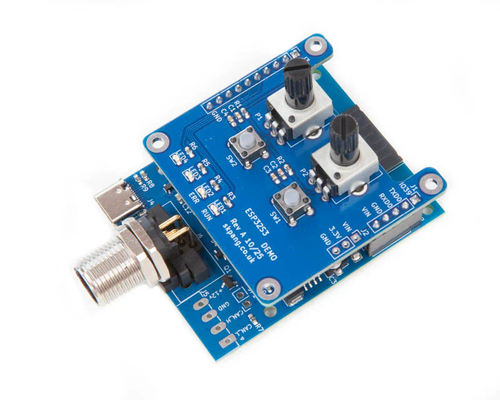 Developing NMEA 2000 devices is much easier when realistic network traffic is available during testing.
Copperhill Technologies offers the ESP32S3 NMEA2000 Device Simulator, a companion platform specifically designed for NMEA 2000 development and testing. The simulator includes:
- Two potentiometers
- Two push buttons
- Four status LEDs
- Programmable NMEA 2000 message generation
- Adjustable PGN output
- Custom firmware support
By default, the simulator generates:
- Temperature data using PGN 130316
- Humidity data using PGN 130313
Both values can be adjusted in real time using onboard controls. Because the firmware is fully programmable, developers can modify PGNs, message content, transmission intervals, and control behavior to simulate virtually any NMEA 2000 device.
For engineers developing custom sensors, gateways, or displays, the simulator provides an invaluable test environment before deploying equipment on an actual vessel.
Ideal Applications
The ESP32S3 CAN-Bus Board with NMEA 2000 Connector is suitable for:
- NMEA 2000 sensor development
- Marine monitoring systems
- Vessel automation projects
- Environmental data acquisition
- Engine room monitoring
- Wireless NMEA 2000 gateways
- Remote diagnostics systems
- Data logging applications
- Custom marine displays
- IoT-enabled marine devices
Conclusion
The ESP32S3 CAN-Bus Board with NMEA 2000 Connector offers a rare combination of processing power, wireless connectivity, CAN bus communication, and development flexibility. Combined with available schematics, CAN bus demo software, BME280 sensor examples, and support for Qwiic sensor expansion, it provides a complete platform for developing modern NMEA 2000 devices.
When paired with Copperhill's ESP32S3 NMEA2000 Device Simulator, developers gain a powerful hardware and software ecosystem that significantly reduces development time while increasing testing capabilities.
For engineers, hobbyists, and marine electronics developers looking to create the next generation of NMEA 2000 products, this platform provides an ideal starting point. More information...