 Loading... Please wait...

Blog
Recent Posts
Teensy 4.0 NMEA 2000 Development Board with IPS LCD – The Ultimate Marine Electronics Prototyping Platform
Posted by on
 In the world of marine electronics and embedded systems, developers are constantly searching for hardware that combines power, flexibility, and ease of integration. The Teensy 4.0 With NMEA 2000 Connector And 240 x 240 IPS LCD delivers exactly that—a compact yet remarkably powerful platform designed for marine instrumentation, CAN-based networking, and real-time data visualization.
Whether you are developing a custom marine display, building a diagnostic tool for NMEA 2000 networks, or experimenting with sensor integration, this board provides an ideal starting point.
A High-Performance Embedded Platform
At the heart of the board is the Teensy 4.0 microcontroller powered by the NXP i.MXRT1062 ARM Cortex-M7 processor running at 600 MHz. This processor provides exceptional performance for embedded applications, supported by 2 MB of flash memory and 1 MB of RAM, including tightly coupled memory optimized for high-speed operations.
For developers working with real-time systems, this level of processing power enables advanced tasks such as signal processing, sensor fusion, CAN message decoding, and complex control algorithms without sacrificing responsiveness.
Despite its performance, the board maintains a remarkably compact footprint, making it suitable for portable tools, experimental marine electronics, and embedded instrumentation.
Integrated NMEA 2000 Connectivity
Modern vessels rely on networked electronics to share navigation, engine, and environmental data. NMEA 2000 has become the standard marine networking protocol, built on CAN bus technology and designed to allow multiple devices to communicate seamlessly over a shared backbone.
This board integrates a Micro-C NMEA 2000 connector directly on the hardware, allowing it to connect easily to an existing marine network. The bus provides both data communication and power, simplifying wiring and installation while enabling the board to read or transmit marine data such as:
• Wind speed and direction
• GPS position and course over ground
• Water depth and temperature
• Engine performance parameters
• Navigation and heading information
Because NMEA 2000 supports a multi-talker, multi-listener architecture, a single device can exchange data with numerous sensors and displays across the vessel network.
Built-In IPS LCD for Real-Time Visualization
One of the standout features of this board is the integrated 1.54-inch IPS TFT display with a resolution of 240 × 240 pixels. The IPS technology provides wide viewing angles and vivid colors, making it ideal for displaying live sensor data or system status information.
Developers can use the display to create compact dashboards showing critical marine parameters directly on the device. During development, the display also acts as an immediate feedback interface, eliminating the need for external monitors.
This feature alone turns the board into a complete development and diagnostic tool for marine networks.
Designed for Expansion and Sensor Integration
The board also includes a Qwiic (I²C) connector, making it easy to attach a wide range of sensors and peripherals. This enables hybrid systems that combine NMEA 2000 network data with local environmental or motion sensors.
For example, developers can easily integrate:
• Temperature and humidity sensors
• Barometric pressure sensors
• Motion and orientation sensors
• Environmental monitoring devices
These sensors can then be displayed locally on the LCD or transmitted back onto the NMEA 2000 network.
Typical Applications
Because of its unique combination of processing power, networking capability, and built-in visualization, the board supports a wide range of marine and embedded development projects.
Common use cases include:
Marine Instrumentation Displays
Create compact dashboards that display navigation data, engine information, or environmental readings.
NMEA 2000 Diagnostic Tools
Monitor network traffic, analyze PGNs, or test marine electronics during development or service operations.
Portable Data Loggers
Capture vessel data such as speed, heading, or environmental conditions for later analysis.
Marine Electronics Prototyping
Develop custom autopilot interfaces, monitoring devices, or experimental marine sensors.
Educational Platforms
Teach CAN bus networking, NMEA 2000 communication, and embedded systems programming using real marine hardware.
Compact, Powerful, and Ready for Innovation
The Teensy 4.0 With NMEA 2000 Connector And 240 x 240 IPS LCD stands out as a uniquely capable development board for marine and CAN-based systems. It combines a high-performance microcontroller, native NMEA 2000 connectivity, and an integrated display into a compact platform designed for real-world experimentation and development.
For engineers, makers, marine electronics developers, and educators, it provides a powerful tool to explore and create the next generation of marine instrumentation and networked vessel electronics.
If you are looking for a compact yet powerful platform for NMEA 2000 development, marine data visualization, or embedded system experimentation, this board offers an outstanding combination of performance, connectivity, and flexibility. More information...
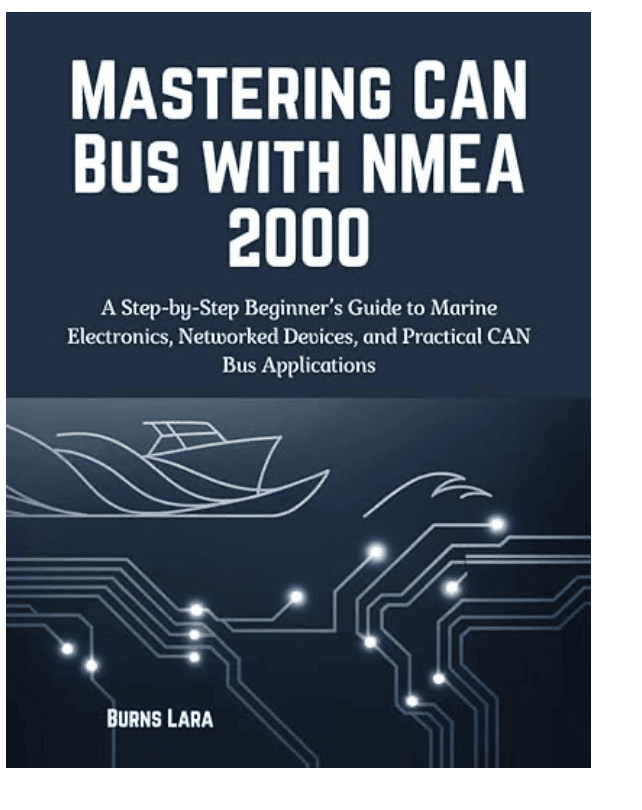 Mastering CAN Bus with NMEA 2000: A Step-by-Step Beginner’s Guide to Marine Electronics, Networked Devices, and Practical CAN Bus Applications
Take control of your boat’s electronics with confidence. Whether you are a boating enthusiast, a marine electronics hobbyist, or someone who simply wants to understand how modern vessels communicate, this book provides a clear and practical introduction to CAN Bus and NMEA 2000.
Modern boats rely on complex electronic networks to share information between engines, navigation systems, sensors, and displays. Understanding how these systems work allows you to install, maintain, and troubleshoot your vessel’s electronics without guesswork or unnecessary expense.
Inside this guide, you will learn how marine networks actually work and how to build and manage them yourself.
Inside the book you will discover:
Step-by-step guidance for building your first NMEA 2000 network from the ground up
Clear explanations of CAN Bus communication, NMEA 2000 PGNs, and how marine devices exchange data
Practical examples for connecting displays, sensors, engines, GPS units, and gateways
Troubleshooting techniques to diagnose and resolve common network problems
Professional insights for efficient wiring, stable network design, and protecting expensive equipment
This book is written specifically for beginners. No prior experience with CAN Bus, marine electronics, or networking is required. Each concept is explained in straightforward language, supported by practical examples that help you move from theory to real-world application.
By the end of the book, you will understand how to:
Build a reliable and scalable NMEA 2000 network
Understand how devices communicate and share data on the vessel network
Diagnose and fix common network issues quickly
Maintain and expand your system as new devices are added
Whether your goal is to monitor engine performance, integrate navigation systems, track environmental conditions, or simply understand how your boat’s electronics communicate, this guide provides the knowledge needed to work with NMEA 2000 systems with confidence.
Stop guessing and start understanding the technology behind your vessel’s electronics. This practical guide reveals the principles and techniques professionals use to design, install, and maintain reliable marine networks—explained in a clear, accessible way.
Take the first step toward smarter boating and gain full control of your marine electronics. More information...