 Loading... Please wait...

Blog
Recent Posts
NMEA 2000 Data Gateway Applications: What You Can Build with USB and Bluetooth Access
Posted by on
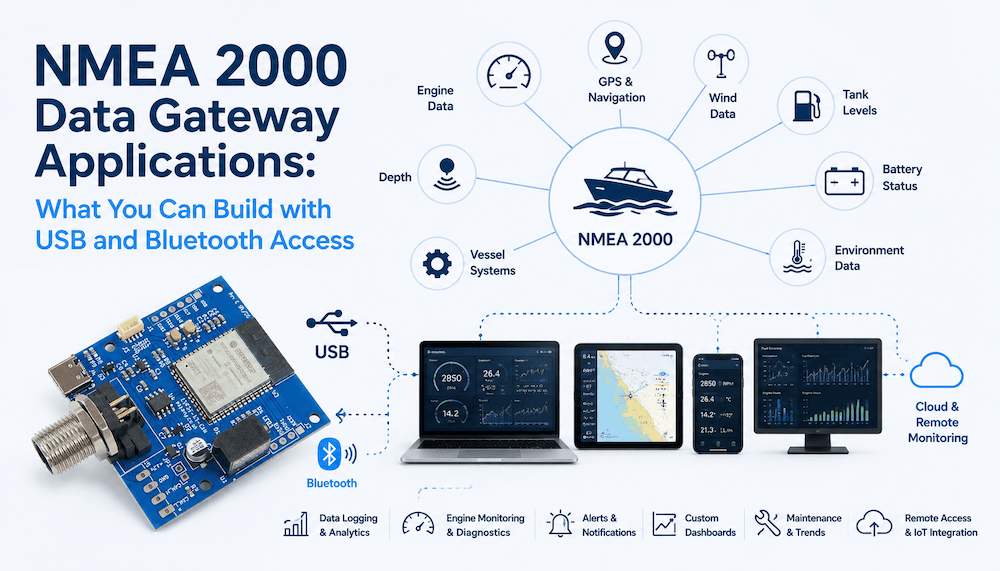 Modern boats generate an enormous amount of information. Engine controllers report RPM, temperatures, fuel consumption, and operating hours. GPS receivers provide position, speed, and heading. Sensors monitor tank levels, battery status, wind conditions, water depth, and much more.
All of this information travels across the vessel’s NMEA 2000 network.
For years, accessing that data meant purchasing expensive marine displays or proprietary software. But what if you could capture the data directly using a small ESP32-based device and send it to a computer, tablet, smartphone, or custom application via USB or Bluetooth?
The possibilities are surprisingly extensive.
Turning Your Boat into a Data Platform
Think of an NMEA 2000 network as the boat’s nervous system. Every device contributes information, and every device can potentially benefit from information provided by others.
By extracting that data and making it available to external applications, you gain access to capabilities that traditional chartplotters often don’t provide.
Instead of simply viewing data, you can analyze it, store it, visualize it, automate actions, and combine it with information from other sources.
Engine Monitoring and Diagnostics
One of the most popular uses is monitoring engine performance.
Applications can display:
- Engine RPM
- Coolant temperature
- Oil pressure
- Fuel rate
- Fuel economy
- Engine hours
- Alternator voltage
- Diagnostic information
Data can be logged continuously and reviewed later. Trends that would otherwise go unnoticed can become obvious.
For example:
- Is fuel consumption gradually increasing?
- Is coolant temperature creeping upward over time?
- Is one engine behaving differently from another?
Historical data often reveals problems long before they become expensive repairs.
Long-Term Voyage Logging
Most chartplotters provide limited logging capabilities.
With direct access to NMEA 2000 data, you can create complete voyage records that include:
- GPS position
- Speed
- Heading
- Engine data
- Wind conditions
- Water depth
- Battery status
The data can be stored locally or uploaded to cloud services for later analysis.
Many boat owners enjoy reviewing trips after returning to port. Others use the information for maintenance planning or fuel management.
Fuel Management and Cost Analysis
Fuel is one of the largest operating expenses for many vessels.
By recording fuel flow and vessel speed, software can calculate:
- Fuel economy
- Cost per nautical mile
- Optimal cruising speeds
- Fuel efficiency versus sea conditions
- Long-term fuel consumption trends
A few percent improvement in fuel efficiency can result in significant savings over a season.
Custom Dashboards
Not everyone likes the layout provided by commercial displays.
With access to raw NMEA 2000 data, developers can build custom dashboards for:
- Windows PCs
- Mac computers
- Android tablets
- iPads
- Smartphones
You decide exactly what information appears on the screen and how it is presented.
Some users prefer large engine gauges. Others want detailed numerical data or graphical trend displays.
Remote Monitoring
Imagine sitting in your cabin, at home, or in a marina office while monitoring key vessel parameters.
Applications can forward NMEA 2000 data through Wi-Fi, cellular networks, or satellite connections.
Possible uses include:
- Monitoring battery banks
- Checking bilge status
- Watching tank levels
- Tracking vessel position
- Receiving alarms
This capability is becoming increasingly popular among boat owners and fleet operators.
Data Logging for Maintenance
Maintenance decisions are often based on operating hours.
However, operating conditions can be just as important.
By recording NMEA 2000 data, you can answer questions such as:
- How many hours did the engine spend above 80% load?
- How often did coolant temperature approach warning levels?
- How many charging cycles did the battery bank experience?
This information can support predictive maintenance strategies rather than relying solely on fixed service intervals.
Research and Product Development
Marine equipment manufacturers and developers frequently need access to real-world vessel data.
An ESP32-based NMEA 2000 interface can become a powerful development tool for:
- Sensor testing
- Product validation
- Performance studies
- Data collection projects
- Academic research
Instead of investing in expensive proprietary monitoring systems, developers can collect data directly from the network.
Home Automation and IoT Integration
One of the more interesting applications involves integrating vessel data with modern IoT systems.
Examples include:
- Automatically activating cabin ventilation when temperatures rise.
- Sending text alerts when batteries reach critical levels.
- Triggering maintenance reminders.
- Uploading voyage statistics to cloud dashboards.
- Integrating boat data with home automation systems.
The ESP32 is particularly attractive for these projects because it already includes Wi-Fi and Bluetooth connectivity.
Building Your Own Marine Applications
Perhaps the most exciting possibility is the ability to create entirely new applications.
Developers can combine NMEA 2000 data with:
- Weather services
- Cloud databases
- Artificial intelligence
- Mapping software
- Fleet management systems
- Mobile applications
The result can be solutions tailored to specific boating, fishing, racing, charter, or commercial operations.
Why USB and Bluetooth Matter
USB connectivity provides a simple way to connect directly to PCs, laptops, and embedded systems.
Bluetooth adds another level of flexibility by allowing smartphones and tablets to receive data wirelessly without additional networking hardware.
Together, these interfaces make NMEA 2000 data accessible to virtually any modern computing device.
The Bottom Line
An ESP32-based NMEA 2000 data gateway is far more than a simple protocol converter.
It transforms the vessel’s network into an open data source that can power monitoring systems, maintenance tools, custom dashboards, mobile applications, cloud services, research projects, and entirely new marine technologies.
Once NMEA 2000 data is available through USB or Bluetooth, the real question is no longer “What data can I access?”
It’s “What would you like to build with it?”
 ESP32S3 CAN-Bus Board with NMEA2000 Connector
The ESP32-S3 CAN-Bus Board with NMEA 2000 Connector is a powerful development platform designed for engineers, makers, and marine electronics developers who need seamless access to NMEA 2000 networks. Built around the high-performance ESP32-S3 processor, the board combines dual-core processing, integrated Wi-Fi, Bluetooth LE, 8 MB Flash, and 8 MB PSRAM with an onboard CAN transceiver and native NMEA 2000 connectivity. This unique combination allows developers to rapidly create smart marine devices, wireless gateways, data loggers, cloud-connected monitoring systems, and custom vessel instrumentation without the complexity of designing CAN hardware from scratch.
Whether you’re building the next generation of marine IoT products, collecting vessel data for remote diagnostics, or integrating sensors into an NMEA 2000 backbone, this board provides a fast path from concept to deployment. The integrated USB-C interface simplifies programming and debugging, while the wide 7V–24V power input and I²C expansion connector support real-world marine installations and sensor integration. With extensive example code, documentation, and support for modern ESP32 development tools, the ESP32-S3 CAN-Bus Board with NMEA 2000 Connector delivers a professional-grade foundation for innovative marine networking and embedded system projects. More information...
Unlock the Future of Marine Apps with the ESP32-S3 CAN Bus Board with NMEA 2000 Connector
As the marine industry continues to embrace smart technologies, there's a growing demand for powerful, connected, and reliable embedded solutions that can handle everything from engine diagnostics to GPS data aggregation. Whether you're building a marine monitoring system, an onboard data logger, or an intelligent control unit, you need a development board that offers high [...]