 Loading... Please wait...

Recent Posts
CAN Bus Repeater Explained: How the CAN-11 Solves Ground Loops, Noise, and Network Expansion Problems
Posted by on
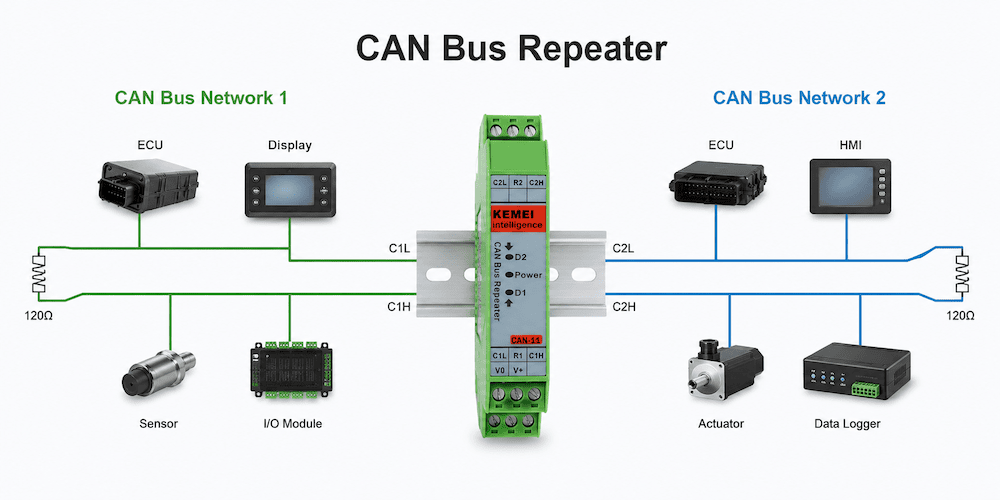 When engineers first learn about CAN bus networks, the concept appears deceptively simple: connect all nodes to the same two wires, add termination resistors at both ends, and communication just works.
In small systems, that is often true.
However, as soon as a CAN network grows beyond a handful of devices, spans long distances, operates in electrically noisy environments, or connects equipment powered from different sources, new challenges begin to emerge. Communication errors increase, intermittent failures become difficult to diagnose, and network reliability suffers.
This is exactly where the CAN-11 CAN Bus DIN Rail Isolated Repeater becomes an invaluable tool. The device is designed to improve network reliability, increase installation flexibility, and protect CAN nodes from electrical damage while maintaining complete protocol transparency.
What Is a CAN Bus Repeater?
A CAN repeater is a device that sits between two CAN bus segments and transparently forwards all CAN traffic in both directions.
To the connected nodes, the network still appears as a single CAN bus. Messages, acknowledgments, arbitration, and error handling continue to function normally.
The CAN-11 adds an important capability beyond simple signal regeneration: galvanic isolation. The two CAN segments are electrically isolated from each other while still exchanging CAN messages. This isolation dramatically improves system robustness in industrial and vehicle applications.
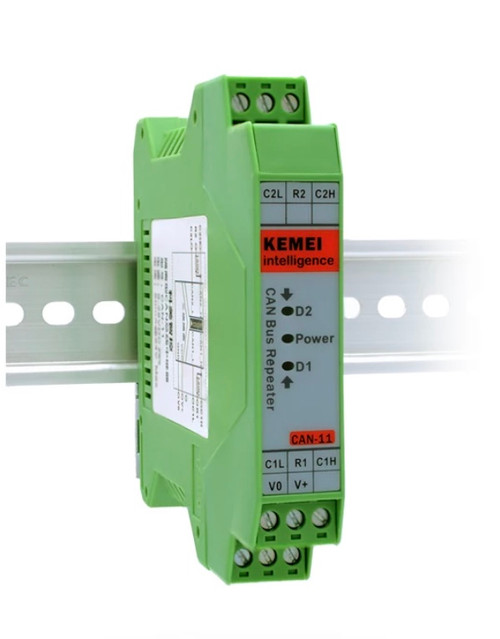 CAN-11 CAN Bus DIN Rail Isolated Repeater
The CAN-11 CAN Bus DIN Rail Isolated Repeater is an industrial-grade solution designed to improve the reliability, scalability, and robustness of CAN bus networks. By providing 1.5 kV galvanic isolation between network segments, it protects sensitive CAN devices from ground loops, electrical surges, and noise commonly encountered in automotive, heavy-duty vehicle, marine, and industrial automation environments. The repeater transparently forwards CAN messages between isolated network segments while maintaining full compatibility with CAN 2.0A/B networks. Its compact DIN-rail mount design, detachable terminals, and wide 9–28 VDC power input make installation straightforward in control cabinets, machinery, and vehicle systems.
Beyond electrical isolation, the CAN-11 solves several common network design challenges. It allows engineers to extend CAN bus length, increase node count, and implement star, tree, or segmented network topologies without compromising communication integrity. Built-in arbitration logic and a Dominant Timeout (DTO) function automatically isolate faulty network segments, preventing a single malfunctioning node from disrupting the entire system. With adaptive baud rates from 10 Kbps to 1 Mbps, support for up to 110 nodes, and an ultra-low loopback delay of approximately 110 nanoseconds, the CAN-11 provides a practical way to build larger and more reliable CAN networks while preserving the deterministic performance required by protocols such as SAE J1939, CANopen, and proprietary CAN-based systems. More information...
The Problems the CAN-11 Solves
1. Ground Loops
Ground loops are one of the most common causes of mysterious CAN communication issues.
Imagine a factory installation where equipment is powered from different electrical panels. Although all devices share a CAN network, their ground potentials may differ by several volts.
Without isolation, these voltage differences create unwanted currents through communication wiring. The result may include:
- Communication errors
- Unstable network operation
- Damaged transceivers
- Difficult-to-diagnose intermittent failures
The CAN-11 provides 1.5 kV galvanic isolation between network segments, preventing these currents from flowing through the CAN wiring.
2. Electrical Surges and Noise
Industrial environments are filled with electrical noise sources:
- Motor drives
- Solenoids
- Contactors
- Welding equipment
- High-current power systems
Similarly, heavy-duty vehicles contain alternators, starters, electric hydraulic systems, and long cable runs.
These conditions can introduce voltage spikes and transient disturbances that threaten CAN transceivers.
The CAN-11 uses magnetic isolation technology and surge protection circuitry to shield one network segment from disturbances occurring on another segment.
3. Extending Network Size
A common misconception is that a CAN network can be expanded indefinitely simply by adding more cable and more nodes.
In reality, every CAN transceiver contributes electrical loading to the network. Cable length also affects signal quality and timing.
The CAN-11 effectively creates two electrically independent CAN segments while maintaining transparent communication between them. This allows engineers to build larger systems without violating physical-layer limitations.
4. Creating Practical Network Topologies
Traditional CAN bus guidelines recommend a linear bus structure.
Real-world installations rarely cooperate.
Consider:
- Factory automation systems
- Agricultural machinery
- Building automation
- Marine electronics
- Test benches
In many cases, a star or tree structure is significantly easier to install than a long daisy chain.
The CAN-11 supports network architectures including:
- Linear topologies
- Branch extensions
- Star topologies
- Tree topologies
This provides much greater installation flexibility while preserving CAN communications.
5. Fault Isolation
A single faulty node can bring down an entire CAN network.
For example:
- A damaged transceiver
- Shorted wiring
- Connector contamination
- Water ingress
These failures may force the CAN bus into a permanent dominant state, preventing all other nodes from communicating.
The CAN-11 includes a Dominant Timeout (DTO) function. When one segment remains continuously dominant due to a fault, the repeater automatically isolates that segment, allowing the healthy side of the network to continue operating.
For mission-critical systems, this feature alone can prevent costly downtime.
Why Isolation Matters in SAE J1939 Networks
SAE J1939 networks frequently span large vehicles such as:
- Trucks
- Buses
- Agricultural equipment
- Construction machinery
- Mining equipment
These installations often involve:
- Long wiring harnesses
- Multiple power domains
- Harsh electrical environments
A CAN fault in one subsystem can potentially affect the entire vehicle network.
By isolating network segments, the CAN-11 improves reliability and protects expensive ECUs from electrical disturbances. This makes it particularly attractive for J1939 installations.
Performance Without Sacrificing CAN Timing
One concern engineers often have is whether a repeater will disrupt CAN arbitration or introduce excessive latency.
The CAN-11 is specifically designed to avoid these issues.
Key specifications include:
- Baud rates from 10 Kbps to 1 Mbps
- Loopback delay as low as 110 ns
- Built-in bus arbitration logic
- Support for up to 110 nodes
These characteristics ensure transparent operation even in demanding real-time applications.
Typical Applications
Industrial Automation
- PLC networks
- Machine control systems
- Robotics
- Distributed I/O systems
Heavy-Duty Vehicles
- SAE J1939 networks
- Construction equipment
- Agricultural machinery
- Mining vehicles
Marine Electronics
- Engine monitoring systems
- Navigation equipment
- Vessel automation systems
Laboratory and Test Systems
- CAN development benches
- HIL testing
- Data acquisition systems
- Vehicle simulation platforms
Building and Infrastructure Control
- Energy management systems
- Elevator control systems
- Distributed monitoring equipment
Installation Advantages
The CAN-11 was designed with industrial deployment in mind.
Features include:
- Standard 35 mm DIN rail mounting
- Compact 17.5 mm wide housing
- Wide input voltage range (9–28 VDC)
- Detachable screw terminals
- LED indicators for power and CAN activity
- Operating temperature range from -25°C to +70°C
These features simplify installation and troubleshooting in control cabinets and industrial enclosures.
Final Thoughts
Many CAN network problems are not caused by software, baud rate settings, or protocol issues. They originate at the physical layer:
- Ground loops
- Electrical noise
- Excessive network loading
- Faulty devices
- Improper network expansion
The CAN-11 CAN Bus DIN Rail Isolated Repeater addresses these challenges directly.
By combining galvanic isolation, fault containment, topology flexibility, surge protection, and transparent CAN operation, it provides a simple and effective way to build larger, more reliable CAN networks.
Whether you’re working with SAE J1939 systems, industrial automation equipment, CANopen devices, or custom embedded CAN applications, the CAN-11 helps ensure that your network remains stable, protected, and scalable for years to come.
 Industrial Network Security: Securing Critical Infrastructure Networks for Smart Grid, SCADA, and Other Industrial Control Systems
As cyber threats continue to evolve in sophistication and frequency, securing critical infrastructure systems—including energy production, water treatment, oil and gas facilities, transportation networks, and manufacturing operations—has become both a business necessity and a regulatory requirement. Industrial Network Security, Third Edition provides a comprehensive guide to understanding and protecting Industrial Control Systems (ICS), Supervisory Control and Data Acquisition (SCADA) networks, and other operational technology (OT) environments that form the backbone of modern infrastructure. Written by cybersecurity expert Eric Knapp, the book examines the unique protocols, architectures, and operational challenges that distinguish industrial networks from traditional IT systems while offering practical strategies for identifying vulnerabilities and mitigating risk.
This extensively updated edition incorporates the latest developments in industrial cybersecurity, including detailed analyses of real-world attacks such as Trisis, Industroyer, and Incontroller. Readers will gain valuable insights into risk management for cyber-physical systems, OT attack methodologies, USB security, OT Cyber Kill Chains, and incident response lifecycles tailored to industrial environments. The book also expands its coverage of network segmentation, monitoring, threat detection, asset discovery, log collection, and industrial-focused SIEM solutions. With clear implementation guidance, updated security controls, and practical examples drawn from actual incidents, Industrial Network Security, Third Edition serves as an essential reference for engineers, security professionals, plant managers, and anyone responsible for protecting critical infrastructure from modern cyber threats. More information...